The Jewish Chronicle
Gay marriage is ‘coming closer’ in Israel
18/01/2008
By Nathan Jeffay Tel Aviv
In what is being heralded as a “first step towards civil marriage” in Israel, same-sex and mixed-faith couples are being offered partnership cards.The cards are being issued by Tel Aviv-based pressure group New Family to allow couples who cannot wed through religious channels to sign legal documents confirming their partnership. A wallet-sized card is then issued, which either partner can later nullify. Four-hundred couples have signed up in the first fortnight. “There are couples who have been together for 30 years, and unable to get any recognition until now, who are delighted,” New Family chair Irit Rosenblum told the JC. “It gives them social recognition.”In practical terms, it is claimed the cards will make it easier for such couples to access their rights in areas including inheritance, tax and fiscal law. New Family has sent letters to every municipality asking for official recognition of the cards, and has so far received three responses — all positive — from Tel Aviv, Lod and Mevasseret Zion. Although it anticipates opposition in religious areas, “it is too soon to know”, Ms Rosenblum says.Although the scheme might appear a gimmick, “this is a real revolution, an alternative to religious marriage. This is the first step to show that society here in Israel accepts the new family, which is not using the existing institutions for recognising partnerships. It will be the first step towards civil marriage.”Among the first recipients of the partnership cards were Lior and Sharon Brand from Ramat Gan. Mr Brand refers to the process as their “marriage” and the couple followed the signing with a “wedding” in the Judean Desert.“I do not practise any religion and — even though we would have been accepted — getting married under the rabbinate was out of the question,” he explained. “This way we could do it as we wanted.” With only religious marriage available in Israel, thousands of couples unable to wed through a synagogue or mosque are deprived of legal recognition for their relationship. As well as same-sex couples, the system excludes mixed-faith couples and those whose union is forbidden by religious law, such as divorcees or converts who want to marry a Cohen. It also applies to many Russian and Ethiopian immigrants who are considered Jewish by the Law of Return but not by halachah. For heterosexual couples affected, the only answer until now has been to travel to Cyprus for a civil ceremony
Friday, January 18, 2008
Gay marriage is "coming closer" in Israel


Thursday, January 17, 2008
Chemistry.com National Survey Says 74% of America's singles endorse gay civil unions
Chemistry.com National Survey Says 74% of America's singles endorse gay civil unions
DALLAS -- A national survey released today by Chemistry.com, the fastest growing relationship site*, reveals that Americans are broad-minded when it comes to love. Chemistry.com commissioned the survey to continue to host the dialogue with single Americans and gain additional insight into current attitudes and behaviors around dating and relationships.
"We're constantly looking at how people view love and companionship in order to better serve our millions of members," said Mandy Ginsberg, general manager of Chemistry.com. "Our mission is to help each person find the type of relationship they're looking for."
The survey, conducted by Gfk Roper Public Affairs, reveals Americans' true beliefs on controversial topics ranging from pre-martial sex to same sex relationships, demonstrating that Americans have a progressive and open-minded perspective on modern day relationships.
Highlights from the survey include:
Americans views on divorce: 84% of Americans agree that people who have been divorced have just as much a right to find a romantic relationship as singles
Insight into relationship intimacy while dating: a large majority of Americans, 84%, agrees that there is nothing wrong with premarital sex between two consenting adults in a relationship.
Attitudes towards same-sex relationships: 72% of singles agree that gay people fall in love the same way straight people do while about eight in ten (79%) single Americans believe that gay people should have the right to find a meaningful relationship and (74%) singles endorse the idea of gay marriage or civil unions.
"Chemistry.com prides itself with an open, non-judgmental approach, which has struck a chord with many Americans," Ginsberg continued. "We believe that people want to be associated with a brand that supports their own personal values, and we welcome anyone to 'come as you are' to Chemistry."
About Chemistry.com
Launched by Match.com in February 2006, Chemistry.com was created to bring together independent-thinking, confident, diverse singles that are serious about finding a meaningful relationship. Based on the research of renowned biological anthropologist Dr. Helen Fisher, Chemistry.com uses a proprietary test to predict which two people are most likely to experience a life-changing jolt of chemistry. This unique approach, combined with its "come as you are" philosophy and private matching technique, makes Chemistry.com the ideal place to find the relationship that is right for each individual, whether it's marriage, romance, a partnership or a long-term commitment. Chemistry.com is an operating business of IAC (NASDAQ:IACI).
Survey Methodology
Gfk Roper conducted the survey on behalf of Chemistry.com from November 30 to December 3, 2007 among a national random sample 1,004 U.S. adults age 18 and older. All interviews were conducted by telephone. The margin of error for the total sample at the 95% confidence level is +/- 3 percentage points.
Marriage Jihad
Marriage Jihad
By: ANTHONY M. BROWN
01/17/2008
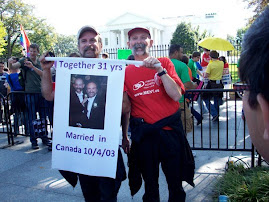
According to the Catholic Church, I'm more dangerous than al-Qaeda. My daughter belongs in a madrasa and I commit acts of social terrorism every time I introduce my husband Gary as my "husband Gary." Pope Benedict XVI believes that gay people are a greater threat to the family than global violence or nuclear proliferation.
In his January 1, 2008 World Peace Day address, the pontiff stated that deviation from the "one man, one woman" family structure was against the moral norm, and prioritized it in his speech as a more dire concern than the conflict in the Middle East or global warming.I guess that makes me a marriage terrorist.I never understood why Catholics hate gays. I know that statement is a generalization. My in-laws have loved Gary and me for the last 19 years, Gary much longer, and have been Catholic the whole time. The Spanish Inquisition, a tolerantly permissive attitude toward the Nazis, and the child molestation scandal cover-up aside, the Catholic Church has done a lot of good for the world.It's ironic, though, that the people in the Church hierarchy who are so critical of our families and who have made it their mission to see that we cannot marry, have all pledged to live outside the "family," on whose behalf they so loudly protest, and are all "married to God." Whatever the reason, the church's message against gay people takes it toll.Over the holidays we went to western Pennsylvania to visit Gary's family. I stopped going to Catholic Mass with his parents after the church voiced its support for a federal marriage amendment, but Gary continues to go with them when we are at their home.It is an hour that reminds him of his past. It is an hour that he can spend with his mom and dad while they are still here on this earth.As he walked into the service on December 29, 2007, he saw the blue brochures everywhere. They said, "The institution of marriage is under attack and the time has come for Pennsylvanians to take action." They used the words "THREAT" and "DANGER" and asked, "Do you really care about marriage?""Do you care enough to really do something?"Anyone who didn't realize what was really going on would, of course, answer, "Yes!"Unfortunately, the brochures seek support for an anti-gay marriage amendment to the Pennsylvania Constitution making it impossible for any same-sex couples to marry there, as well as barring recognition of any legally performed same-sex marriage, like Gary's and mine from Canada.The political truth of the matter is that they already tried this in late 2004. It didn't work because some key Pennsylvania lawmakers introduced different versions of the amendment in the House and Senate. A politically-engineered argument over the differences in language was used to delay and essentially kill the initiative.In Pennsylvania, two successive legislative sessions must pass the amendment before it can go to the people for a vote. In the '06 elections, the state House of Representatives went Democratic and there is little to no chance that the current majority caucus would allow it to be introduced again.So, again, why are the Catholics doing this?If there isn't the political agenda of getting conservative voters to the polls in a swing state for a presidential election, I simply must believe that they "aren't really that into us."So, why do I keep caring about what they are up to?Gary was shaken by the church's blatantly anti-gay message. He walked out of the Mass during the sermon when the priest launched into his hate speech. He wrote an email about his experience and sent it to his database. He has received more than 100 replies from all over the world. Friends forwarded the email to their friends and so on.Each respondent had their own story of when, why, and how they felt betrayed by their own church and left it.We are adults. Wounds are processed in a different way. When a 13-year-old sits in that church and hears their words of intolerance and cannot understand why they are "different," he or she just might believe the church. Last week a 14-year-old British girl hung herself because she could no longer take the schoolyard taunting about her being lesbian. An 11-year-old boy killed himself the year before in Sussex England because of gay-related hate bullying.And yet the Church maintains that there is no connection to its stance of anti-gay bigotry. When a Church lends its implicit seal of approval to marginalizing and denigrating others, there can be no Christian reason.Anthony M. Brown s helped prepare the brief for the Lawrence v. Texas sodomy case while interning at Lambda Legal in the summer of 2002. He is the executive director of The Wedding Party and currently heads the Nontraditional Family and Estates Law division of McKenna, Siracusano & Chianese. He can be reached at Brown@msclaw.net.
Majority favors legalized unions -- baltimoresun.com
Majority favors legalized unions -- baltimoresun.com
By Laura Smitherman Sun reporter
January 17, 2008
Article tools
E-mail
Share
Digg
Del.icio.us
Facebook
Fark
Google
Newsvine
Reddit
Yahoo
startChangeSocialBookmarkingBG();
Print
Reprints
Post comment
Text size:
As the General Assembly gears up for a debate on the rights of gay couples, a solid majority of Maryland voters supports some form of legalized same-sex unions, according to a recent Sun poll.Nineteen percent of likely voters said they support gay marriage, and 39 percent said they back civil unions, meaning that nearly three out of five believe the state should formally recognize same-sex relationships. Maryland law bans same-sex marriage.Thirty-one percent of those polled said they disagree with granting either form of same-sex unions, but only half of those opponents said a constitutional amendment is needed to ban them. Eleven percent said they were not sure or declined to answer the question.
"This is a state that is much more open-minded to a legal arrangement between two people of the same sex, whether they call it marriage or civil unions," said Steve Raabe, president of Annapolis-based OpinionWorks, the polling firm that conducted the survey for The Sun. "It's not a state characterized by a large evangelical constituency but rather a more liberal electorate."But consensus on same-sex unions in Annapolis might be out of reach this year. Gov. Martin O'Malley, a Democrat who courted gay voters during his campaign, has said he prefers civil unions, while gay-rights activists are pushing for a marriage bill with an exception to make it clear that no religious institutions or clergy would be compelled to perform or recognize those marriages.Leaders in the Democratic-controlled State House are also split, with House Speaker Michael E. Busch endorsing civil unions and Senate President Thomas V. Mike Miller opposing both civil unions and same-sex marriage.Meanwhile, Republican lawmakers advocate a constitutional ban, arguing that such a measure is needed to protect the institution of marriage.That diversity of opinion was mirrored by respondents to the Sun poll who said in follow-up interviews that their convictions were forged through religious, cultural and personal experience.Aleshia Williams, 28, a lesbian who lives in Baltimore, said she believes that O'Malley stopped short of embracing gay marriage for political reasons and that the issue should be a matter of civil rights, not religion."We should be able to do what we want. We're not hurting anybody by getting married," Williams said. "Why not just let us live our lives? Why do they think they can play God?"Support for gay marriage is strongest in Baltimore and in the Washington suburbs, according to the poll. Support for gay marriage was highest among voters who are younger than 35, with 37 percent favoring the idea. Just 13 percent of those older than 65 support gay marriage. Whites are more likely to support gay marriage, while blacks are more likely to say that same-sex unions should be illegal.The statewide poll of 904 voters was conducted by telephone Jan. 6-9. It has a margin of error of 3.5 percentage points.Religion also played a strong role in voters' attitudes. Seventy percent of those who identified themselves as Jewish supported gay marriage or civil unions, while 10 percent opposed both concepts. Evangelical Christians were most opposed to gay unions, with 45 percent saying the state should not recognize any same-sex relationships. Opposition was equally strong from those who attend religious services of any faith at least weekly.David Shafer, 63, of Frederick said the debate should be framed in religious as well as moral terms. He advocates a constitutional ban. "Gay marriage is one of the many steps denigrating our society," he said. "I just feel that it's wrong."A slim minority of poll respondents, about one in six, want to change the state constitution, but that number could increase significantly with a high-profile campaign similar to those launched in other states, Raabe said.Maryland law defines marriage as a union between a man and a woman. A lawsuit seeking to overturn that statute failed last year, effectively moving debate over the issue to the State House.Only Massachusetts allows same-sex marriage. Nine other states, including Connecticut, New Jersey, New Hampshire and Vermont, offer civil unions or domestic partnerships.Approval of civil unions, often viewed by voters as a compromise, was spread fairly evenly across racial, age and gender lines, poll results showed.Curtis Potter, 80, of Columbia favors civil unions as a way to grant gay couples rights conferred in marriage, while respecting religious objections. He said his opinion has been shaped by his childhood on a North Carolina farm, where he saw "a lot of prejudice," and by his experience as a manager in the federal government and of his own business, where he saw "society and co-workers lash out at gay people for being unacceptable.""It's time for our legislatures on the state and national level to really come up with laws that grant total equality," he said. "But when you think of marriage, right away you think of what God intended and our collective moral compass, and I think we need to abide by that."Lawmakers said that it is too early to determine whether a consensus will form behind any one proposal. At the same time, some legislators plan to file bills that would confer rights piecemeal to gay couples, such as those concerning property ownership and medical decision-making. Legislators, including Miller, have supported increasing rights for same-sex couples in the past."Where we end up in this larger debate remains to be seen, but if we don't ask right off for what we want then we're never going to get it," said Del. Heather R. Mizeur, a Montgomery County Democrat, explaining why she and others are seeking gay marriage and not a separate legal institution such as civil unions.Foes of gay marriage also plan to push their cause this year. Del. Donald H. Dwyer Jr., an Anne Arundel County Republican and one of the General Assembly's most outspoken critics of gay rights, said it is time for the legislature to vote on all of the proposals so that constituents know where their representatives stand. He plans to sponsor a constitutional ban on gay marriage and civil unions."Win, lose or draw, this debate needs to happen," he said.laura.smitherman@baltsun.com
Tuesday, January 15, 2008
Anglican Parish to Defy Ban on Gay Weddings
Parish Votes to Defy Ban on Gay Marriage
by 365Gay.com Newscenter Staff
Posted: January 14, 2008 - 5:00 pm ET
(Toronto, Ontario) One of the oldest Anglican parishes in North America has become the first to approve holding weddings for same-sex couples. The vote by parishioners of Toronto's Church of the Holy Trinity poses a direct challenge to the leaders of the Anglican Church of Canada, which tonight begins its annual synod in Winnipeg.
The resolution says that the parish will "continue to exercise its conscience and bless same-sex unions and marry same-sex couples."
Holy Trinity, in the heart of Toronto, has a long tradition of rocking the Anglican boat. It was one of the first to reach out to the homeless. In the 1960s it became a refuge for American draft dodgers and in the late '60s welcomed gay groups to meet in the church.
In 2003, shortly after same-sex marriage became legal in Ontario Ted Scott the retired primate of the Anglican Church of Canada blessed the union of gay activists Alison Kemper and Joyce Barnett following their marriage at Toronto city hall.
While three dioceses have voted to allow priests to conduct blessing ceremonies over the past 12 months, Holy Trinity goes far beyond that by endorsing gay marriage. And, unlike the four, Holy Trinity does not seek the permission of its bishop.
The dioceses of Niagara, Ottawa and Montreal all voted to approve blessing ceremonies. So far only the bishop of Niagara has given his approval. (story) In 2002 the diocese of New Westminster, in British Columbia, became the first to give the OK to same-sex blessings.
When the Anglican Church general synod begins Monday night it will have a resolution to consider that basically would allow individual congregations to decide for themselves whether or not to bless gay marriages, but not to perform actual wedding ceremonies.
A conservative group of parishes across the country has warned that if the measure passes they will break away.
Last week the leader of Canada's Anglicans sent a letter to his primates of the worldwide Anglican Communion explaining the developments around the blessing of same-sex unions.
In the letter Archbishop Fred Hiltz said that "It is important to note that the Anglican Church of Canada has not altered its doctrine of marriage as outlined in our prayer books and canons (church laws)."
Hiltz, however, put the situation in context, writing that Canadian Anglicans "live in a country where the federal government in 2005 approved legislation that allows the marriage of same-gender couples."
The issue of gays in the worldwide Church has grown increasingly more intense since the ordination of Gene Robinson as Episcopal bishop of New Hampshire in 2003.
Conservatives in the Church, primarily in Africa, have threatened a schism if the Episcopal Church in the US and the Anglican Church in Canada do not bar gay clergy and promise to refrain from gay union blessings.
©365Gay.com 2008
Same-sex marriage ban may not make ballot - 01/14/2008 - MiamiHerald.com
Same-sex marriage ban may not make ballot - 01/14/2008 - MiamiHerald.com
BY GARY FINEOUT
gfineout@MiamiHerald.com
TALLAHASSEE -- A proposed constitutional amendment to ban same-sex marriage in Florida may not make it to voters this year, after organizers -- who proclaimed a month ago they had gotten it on the November ballot -- found out Monday they haven't collected enough signatures after all.
A counting glitch -- which has the state pointing fingers at Miami-Dade County -- has resulted in Florida4Marriage.org falling 22,000 voter signatures short of the 611,000 needed to place the amendment on the ballot.
The group has a tight deadline -- Feb. 1 -- to get the signatures to state election officials.
A month ago, backers of the amendment declared they had met their goal and began attacking groups that had formed to fight the amendment. On Monday, the leader of the effort said he had little time to figure out what happened, but said he would push volunteers to start gathering petitions again.
''There's a real temptation in pointing fingers, but we're interested in getting the job done,'' said John Stemberger, an Orlando attorney and chairman of Florida4Marriage.org. ``We will immediately jump into action. I'm confident if every petition is counted that is submitted prior to Feb. 1 then we should have no problem.''
While Florida4Marriage.org has relied on volunteers, it may face tough going, because campaign finance records show that the group is broke. The organization had received financial help from the Republican Party of Florida, but since Gov. Charlie Crist came into office, the party has stopped giving the group money.
State law already bans same-sex marriage, but Stemberger and other supporters contend a constitutional amendment is needed to keep the law protected from a legal challenge. Opposition groups have organized and raised money to try to defeat the amendment, which would need approval from 60 percent of voters.
To get on the ballot, organizers must get 611,000 signatures, including a certain amount in half of Florida's 25 congressional districts. State officials ordered a new count of all petition signatures last week after acknowledging a glitch in the state's $23 million database system that is supposed to tally the information electronically.
Sterling Ivey, a spokesman for Secretary of State Kurt Browning, said the new count showed that Miami-Dade had somehow ''double-counted'' 27,000 petition signatures for the amendment that had been turned in before Jan. 1, 2007, when the new system went online.
But Miami-Dade Elections Supervisor Lester Sola said the error happened on the state's end, saying that for months his office had warned the state the numbers its system was showing were in error. Sola even sent a letter on Dec. 21 to Browning saying the number of signatures from Miami-Dade were being ``recounted.''
''The bottom line is that their system doubled the number of petitions that some counties were submitting,'' Sola said.
Ivey, however, insisted that the problem happened because the Miami-Dade system ''uploaded'' an incorrect number into the state computer.
''The numbers in the system were incorrect because their vendor uploaded more signatures than they verified,'' Ivey said.
Monday, January 14, 2008
Third effort begins for Indiana marriage ban -- Queer Lesbian Gay News -- Gay.com
Third effort begins for Indiana marriage ban -- Queer Lesbian Gay News -- Gay.com
published Thursday, January 10, 2008
A Republican in the Indiana Senate has filed a third resolution calling for a constitutional ban on same-sex marriage in the state. The previous two such resolutions failed to make it to the House.
Sen. Brandt Hershman, one of the resolution's sponsors, has been urging the House to take up the issue early this year, the Associated Press reported. Toward that end, fellow Republican Eric Turner has said he plans to file a matching resolution in the Democrat-controlled House.
House Speaker Patrick Bauer, a Democrat, told the AP that while he is willing to introduce the resolution in committee for consideration, he doesn't feel it is necessary, given an existing state statute that bans same-sex marriage.
To amend the Indiana constitution, a resolution must pass two consecutive separately elected general assemblies before the measure can be placed on a statewide ballot. (The Advocate)