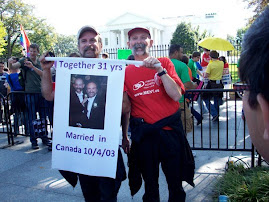
Lawmakers take sides on gay marriage | DesMoinesRegister.com | The Des Moines Register
click link above
A majority of Iowa's lawmakers - 123 of 150 - say they believe marriage should only be between a man and a woman.
But it's not clear whether those same lawmakers have enough votes to pass a constitutional amendment to ban same-sex marriage.
It's also not clear whether lawmakers will ever get a chance to vote on the issue.
A Des Moines Sunday Register survey of legislators shows the 100 members of Iowa's House of Representatives are split 50-50 on how they would vote on an amendment to prohibit gay marriage. Of the 50 who would support a constitutional amendment, 45 are co-sponsors of the legislation.
Sunday, February 10, 2008
Lawmakers take sides on gay marriage | DesMoinesRegister.com | The Des Moines Register


Saturday, February 9, 2008
Brubaker seeks ban on gay marriage in PA
LancasterOnline.com:News:Brubaker seeks ban on gay marriage
State Sen. Michael Brubaker is poised to introduce legislation that would write a ban on gay marriage into the state Constitution, the Intelligencer Journal has learned.
According to various sources, the Warwick Township Republican is shopping for co-sponsors to attach their names to the legislation, which would have to go through a lengthy process and likely a bitter political fight in order to become law.
"He's a very accomplished person, and we think he can do well in a leadership position on this," said Michael Geer, a Lancaster County resident and president of the Pennsylvania Family Coalition.
Brubaker did not return several messages seeking comment.
Brubaker apparently is not alone in his efforts. A GOP source told the Intelligencer Journal Thursday night that a Democrat, state Rep. Richard T. Grucela of Northampton County, will introduce identical legislation in the state House.
"With Republicans in the minority, there's no way that (Democratic) leadership over there is going to look at a Republican bill," said the source, who wished to remain anonymous, talking about internal legislative strategy.
With Democrats holding a one-vote majority in the state House, Republicans reached out to Grucela, a Democrat who supported the gay marriage ban when the same political fight erupted two years ago.
According to www.pa4marriage.org, the Web site for the Coalition to Protect Marriage in Pennsylvania, Brubaker is asking other legislators for their support.
"The goal is simple," the Web site reads, "Protect the definition of marriage as the union between one man and one woman and prevent creation of civil unions (or other terms used to give all the legal benefits of marriage under a different name).
"Your help is needed now! You can help Sen. Brubaker get other senators to sign on as co-sponsors."
Information also can be found on the election Web site of state Senate Majority Leader Dominic Pileggi, a Delaware County Republican (www.pileggi08.com) as well as several gay or conservative Web sites.
Pennsylvania already has a statute narrowly defining marriage as a man-woman union, but many conservatives fear that the law is vulnerable to a court challenge unless it is written into the state Constitution.
Geer said man-woman marriage deserves such protection because a mother-father relationship is healthier for children than same-sex marriages.
"Recognition of other relationships such as same-sex marriage don't have equivalent benefits to society, and therefore don't deserve the same level of recognition," Geer said.
"This ultimately is about democracy and whether citizens can decide what marriage will be in the future, instead of judges."
Writing new language into the state Constitution is a long, grueling process that can take several years to complete.
The House and the Senate must approve identical language in consecutive two-year legislative sessions. The proposed amendment is then put to a voter referendum.
In 2006, state Rep. Scott Boyd, a West Lampeter Republican, was the chief sponsor of a House bill that said:
"Only a marriage between one man and one woman shall be valid or recognized as a marriage in this Commonwealth, and neither the Commonwealth nor any of its political subdivisions shall create or recognize a legal status identical or substantially equivalent to that of marriage for unmarried individuals."
The bill passed the House on June 6, 2006, but once it reached the Senate, its days were numbered. Senate Republicans took issue with some of the language, saying the it ambiguously addressed the issue of civil unions, making it unlikely to pass in a voter referendum.
E-mail: dpidgeon@lnpnews.com
Thursday, February 7, 2008
Marriage, Civil Union, or Domestic Partnership... What’s the Difference? :: EDGE Boston
Marriage, Civil Union, or Domestic Partnership... What’s the Difference? :: EDGE Boston
Marriage, Civil Union, or Domestic Partnership... What’s the Difference?
by Joyce Kauffman
EDGE Contributor
Wednesday Feb 6, 2008
click link above
In December of 2003, the Supreme Judicial Court determined that same-sex couples were entitled to the benefits of marriage under the Massachusetts constitution. Goodridge v. Dept. of Public Health, 440 Mass. 309 (2003). An avalanche of change with respect to the legal recognition of same-sex relationships in the United States, begun more than a decade before when the Hawaii case of Baehr vs. Miike was initially filed, continues. In the 1990’s, the Hawaiian court seemed poised to grant marriage rights to same-sex couples until the legislature intervened by enacting a Defense of Marriage law defining marriage as between one man and one woman. The Hawaiian legislature went on to enact the Hawaii Reciprocal Beneficiaries law in July 8, 1997. The law provides limited state rights to same-sex couples and "represents a commitment to provide substantially similar government rights to those couples who are barred by law from marriage." Since then, several jurisdictions have enacted some kind of protective status for same-sex couples, some more that are more "susbtantially similar" to marriage and some that are less. It all depends on where you live.
.
California High Court to Hear Oral Arguments in Historic Marriage Case on March 4
gay news blog: California High Court to Hear Oral Arguments in Historic Marriage Case on March 4
SAN FRANCISCO – The California Supreme Court announced today that it will hear oral arguments on March 4 in the cases challenging the exclusion of same-sex couples from marriage.
Fifteen same-sex couples, Equality California, and Our Family Coalition will be represented at oral arguments by Shannon Price Minter, Legal Director of the National Center for Lesbian Rights, which is serving as co-counsel with Lambda Legal, the American Civil Liberties Union, Heller Ehrman LLP and the Law Office of David C. Codell.
The marriage cases were filed in March 2004. San Francisco Superior Court Judge Richard A. Kramer ruled that the exclusion of same-sex couples from marriage violates the California Constitution. In a 2-1 vote, the California Court of Appeal reversed Judge Kramer’s ruling. Shortly after the Court of Appeal’s decision, the California Supreme Court granted review of the cases in order to consider the constitutional questions itself.
Governor Arnold Schwarzenegger said that the California Supreme Court should decide the constitutional questions posed by the marriage statutes when he vetoed two measures passed by the California legislature in 2005 and 2007 that would have permitted same-sex couples to marry.
The marriage cases are among the most heavily briefed cases in the history of the California Supreme Court. Late last year, more than 20 counties and municipalities filed a friend-of-the court brief in support of marriage for same-sex couples, including some of the most populous cities in California: Los Angeles, San Diego, San Jose, Long Beach, Sacramento, and Oakland. Also registering their support for marriage equality were numerous legal and bar associations, including the Los Angeles County Bar Association. In addition, many of the state’s leading constitutional law scholars and family law professors filed briefs urging the court to permit same-sex couples to marry. More than 250 religious and civil rights leaders and organizations, including the California NAACP, Mexican American Legal Defense and Educational Fund, California Council of Churches, Asian Pacific American Legal Center, and National Black Justice Coalition, also filed briefs supporting same-sex couples seeking the right to marry.
The California Supreme Court typically issues its decisions within 90 days following oral arguments.
2008 marks the 60th anniversary of the California Supreme Court’s historic 1948 ruling that found it unconstitutional for the state to restrict access to marriage based on the race of the spouses. That ruling was the first of its kind in the nation’s history, and is now the law of the land across the country. The California NAACP, NAACP Legal Defense & Education Fund, Inc., and Howard Law School Civil Rights Clinic have urged the court to apply the reasoning from its 1948 decision to the present marriage cases.
Lambda Legal: Update: Marriage Recognition for Same-Sex Couples in New York
Lambda Legal: Update: Marriage Recognition for Same-Sex Couples in New York
Published 02/06/08
Lambda Legal has been advocating for the rights of same-sex couples to have their marriages respected in New York since jurisdictions like Canada and Massachusetts first began to confer marriage rights. New York's governor, attorney general, state comptroller, State Department of Civil Service, mayors in cities large and small around the state, courts and countless other New Yorkers have confirmed that valid out-of-state marriages of lesbian and gay New Yorkers are entitled to legal respect here.
Where we stand today
The Martinez v. County of Monroe decision, coming from a New York appellate court on February 1, 2008 in response to a challenge brought by the NYCLU and Rochester attorney Jeffrey Wicks on behalf of a lesbian couple, ruled that valid out-of-state marriages of same-sex couples are subject to legal recognition in this State. This ruling is consistent with the trial court victories in Godfrey v. Spano and Godfrey v. DiNapoli, two earlier Lambda Legal cases. Martinez must be followed by the lower courts statewide unless and until there is a conflicting decision from another appellate court or from the New York Court of Appeals.
Martinez is the latest ruling, issued by the highest court yet, applying New York's longstanding marriage recognition rule to require respect for out-of-state marriages of same-sex couples even though these couples currently cannot marry within New York. These rulings also are consistent with what many statewide and local government and private officials and entities have agreed is required in New York — respect for out-of-state marriages for purposes of spousal health and other insurance coverage, retirement benefits, death benefits, and the countless other protections that come for spouses through marriage.
Lambda Legal — Making the case for marriage recognition for same-sex couples in New York.
Funderburke v. New York State Department of Civil Service
Lambda Legal represents a couple of 45 years, married in Canada in 2004, who were denied spousal health coverage by the former employer of retired public school teacher Duke Funderburke in this case filed in State Supreme Court (New York's trial-level court) in 2006. The trial court ruled against Funderburke in 2006 - in a decision now repudiated by the Martinez decision. While the case has been on appeal, another Appellate Division in New York, the State Department of Civil Service (DCS) reversed its prior policy and since May 2007 extends spousal employment benefits to same-sex spouses married to employees at more than 800 public employers around the State. Funderburke's spouse now has health coverage as a result. The government defendants in Funderburke moved to dismiss the appeal. Just days before the ruling in Martinez, Lambda Legal argued the appeal in the Appelate Division, Second Department seeking to have the incorrect decision reversed or vacated and removed from the books.
Godfrey v. Spano
After Westchester County Executive Andrew Spano issued a 2006 Executive Order confirming that the County would respect out-of-state marriages of same-sex couples for official County purposes, an antigay group sued him in Westchester State Supreme Court. Lambda Legal intervened in the case on behalf of Michael Sabatino and Robert Voorheis, a Westchester couple of three decades who had married in Canada in 2003. Sabatino and Voorheis had seen how important it is that their marriage be respected after Sabatino was able to be at Voorheis's side and make medical decisions as his spouse when Voorheis was rushed to the hospital with chest pains.
In March 2007 the State Supreme Court ruled in favor of the County Executive and Lambda Legal's clients, holding in the first decision of its kind that valid out-of-state marriages of same-sex couples are subject to legal respect in New York. The antigay plaintiffs have appealed that decision to the Appellate Division, Second Department. The State Comptroller, DCS and Attorney General have filed a brief siding with the County Executive and Lambda Legal's clients in the pending appeal.
Godfrey v. DiNapoli
In October 2004 the New York State Comptroller issued an opinion confirming that the State Retirement System would follow the longstanding marriage recognition rule and give legal respect to out-of-state marriages of same-sex couples. The State Comptroller's opinion was challenged in yet another case filed in September 2006 by the same antigay group that brought Spano. Lambda Legal intervened on behalf of a married New York lesbian couple, Peri Rainbow and Tamela Sloan, state employees who together adopted a special needs child from foster care and who depend on having the protections of marriage for their family. A State Supreme Court in Albany rejected this attack against a government official for respecting the rights of lesbian and gay families, dismissing the case in September 2007. The antigay group has filed a notice of appeal in DiNapoli to the Appellate Division, Third Department, which sits in Albany.
Lewis v. New York State Department of Civil Service
The same antigay group has brought a fourth case challenging the DCS decision won in the midst of the Funderburke case to adhere to the marriage recognition rule and provide spousal benefits to married lesbian and gay public employees. Lambda Legal clients Rainbow and Sloan intervened in Lewis to protect the health coverage they have been able to obtain for their family under the DCS policy. Motions to dismiss the case are pending in State Supreme Court before the same judge who ruled in Godfrey v. DiNapoli that marriages of same-sex couples get legal respect in New York.
Where we go from here
The appellate decision in Martinez confirms what Lambda Legal has been advocating for and what courts, New York's governor, attorney general, state comptroller, and countless others in New York already agree: If you have a valid marriage from a jurisdiction like Canada that allows same-sex couples to wed, you are legally married in New York and entitled to have your marriage respected here.
The next step is for New York same-sex couples to be able to marry within their home state. And New York is already far along in taking this step: In June 2006 the New York State Assembly passed, by a vote of 85-61, a bill sponsored by the Governor that would allow New York same-sex couples to marry in their home state. The New York State Senate must now pass the bill so that the Governor can sign it into law.Document updated 12/1/2006-->
Tuesday, February 5, 2008
A Victory for Same-Sex Marriage - New York Times#
A Victory for Same-Sex Marriage - New York Times#
February 5, 2008
Editorial
A Victory for Same-Sex Marriage
In a decision at once common-sensical and profound, a New York State appeals court ruled Friday that same-sex marriages validly performed in other jurisdictions are entitled to recognition in New York. It was common sense because it simply accorded same-sex marriages the same legal status as other marriages. It was profound because of the way it could transform the lives of gay people.
The plaintiff in the case, Patricia Martinez, a word-processing supervisor at an upstate college, married her longtime partner, Lisa Ann Golden, in Canada in 2004. When Ms. Martinez applied for health care benefits for her spouse, the college denied the application on the grounds that New York did not recognize the marriage.
The court, by a 5-0 vote, declared that the college was wrong. Employers in the state must accord same-sex couples the same rights as other couples. To reach that result, it simply applied New York’s “marriage recognition rule.” Under this century-old common-law rule, marriages validly contracted out of state must be accorded respect in New York, and parties to such unions treated as spouses, regardless of whether the marriage would be allowed in New York.
The rule applies unless the Legislature explicitly prohibits recognition or recognition would be abhorrent to public policy. Unlike many states, New York has not passed a law denying recognition to same-sex marriages performed elsewhere. The court rightly decided that recognizing same-sex marriages would not be “abhorrent.”
The ruling is particularly welcome because it follows a regrettable decision two years ago by New York’s highest court. That decision said that prohibiting same-sex marriages from being performed in New York does not violate the State Constitution. Honoring same-sex marriages validly performed out of state is a wholly separate legal issue, a point that New York’s attorney general, Andrew Cuomo, usefully underscored in a friend-of-court brief.
The new decision still leaves considerable work to be done. New York’s ban on performing same-sex marriage remains in force. And there is a chance that the marriage-recognition decision will now be appealed.
Still, the ruling marks important progress toward changing laws and attitudes that deprive gay people of equal rights and deny the dignity of New York’s many gay families. They should be able to live, marry and raise children with the same respect and the same rights as anyone else.
Friday, February 1, 2008
In Court Ruling From New York, Gay Marriage Wins a Victory - New York Times
In Court Ruling From New York, Gay Marriage Wins a Victory - New York Times
February 2, 2008
State Court Recognizes Gay Marriages From Elsewhere
By ROBERT D. McFADDEN
A New York appellate court ruled Friday that valid out-of-state marriages of same-sex couples must be legally recognized in New York, just as the law recognizes those of heterosexual couples solemnized elsewhere. Lawyers for both sides said the ruling applied to all public and private employers in the state.
Even though gay couples may not legally marry in New York, the appellate court in Rochester held that a gay couple’s 2004 marriage in Canada must be respected under the state’s longstanding “marriage recognition rule,” and that an employer’s denial of health benefits had discriminated against the couple on the basis of their sexual orientation.
“The Legislature may decide to prohibit the recognition of same-sex marriages solemnized abroad,” a five-judge panel of the Appellate Division of State Supreme Court ruled unanimously in rejecting a 2006 lower court decision. “Until it does so, however, such marriages are entitled to recognition in New York.”
For more than a century, the court noted, New York State has recognized valid out-of-state marriages. Moreover, it said that the Court of Appeals, the state’s highest judicial body, has said the Legislature may enact laws recognizing same-sex marriages. “In our view, the Court of Appeals thereby indicated that the recognition of plaintiff’s marriage is not against the public policy of New York,” the court held.
As a practical matter, the marriages of thousands of gay couples entered into outside the state have been recognized in recent years by many state and local agencies and by private employers for purposes of allowing health and life insurance coverage, child care and other benefits. But others have resisted doing so voluntarily, pending the outcome of numerous cases in the courts.
Friday’s ruling, legal experts said, was the first by an appellate division court, and would make the recognition of valid out-of-state gay marriages mandatory across New York. It was not clear whether Monroe County and Monroe Community College in Rochester, the employer in the case, would appeal.
Daniel DeLaus Jr., the county attorney for Rochester, said his office was reviewing the decision and would decide whether to seek an appeal.
Jeffrey Wicks, a lawyer who represents the plaintiff, Patricia Martinez, said that New York had recognized common-law marriages, even marriages of closely related people that might not be allowed in the state. “There’s a long tradition in New York of recognizing marriages that couldn’t be performed in New York,” he said.
The New York Civil Liberties Union, which represented Ms. Martinez, a word-processing supervisor at the college, hailed the ruling. The union called it “the first known decision in the country to hold that a valid same-sex marriage must be recognized.”
“This is a victory for families, it’s a victory for fairness and it’s a victory for human rights,” said Donna Lieberman, executive director of the N.Y.C.L.U. “Congratulations to all same-sex couples validly married outside of New York State: You are now husband and husband, wife and wife. Now we need to work toward a New York where you don’t have to cross state or country lines to get married.”
The New York City Council speaker, Christine C. Quinn, the first openly gay leader of the Council, also applauded the ruling. “If this is saying companies have to do it, it’s a tremendous step forward in recognizing the diversity of families in New York City.”
New York City already extends marriage benefits to workers in domestic partnerships, and under a law passed in 2002, it provides all city benefits and services to same-sex couples whose unions are recognized by other jurisdictions. But that law has no power to impose such rules on private companies.
In 2004, the Council adopted legislation sponsored by Ms. Quinn that would have required large companies doing business with the city to provide equal job benefits to domestic partners. Mayor Michael R. Bloomberg vetoed the bill, and while the Council overrode the veto, the mayor said it violated state and federal laws and would prove costly to taxpayers. He sued successfully to block it in a case decided in 2006 by the Court of Appeals.
Mayor Bloomberg’s office declined to comment on Friday’s ruling, saying it had not seen the decision.
Attorney General Andrew M. Cuomo also declined to comment, noting that his office may be involved in an appeal as the traditional defender of state agencies. Monroe Community College is a branch of the State University of New York.
In the past, Mr. Cuomo has said that state law requires that marriages performed in other states, and in Canada, be recognized in New York.
In the case before the appellate division in Rochester, Ms. Martinez and her partner, Lisa Ann Golden, formalized their longstanding relationship in a civil union ceremony in Vermont in 2001, and were married in Ontario on July 5, 2004.
A few days later, Ms. Martinez applied to Monroe Community College for health care benefits for her spouse. In November 2004, the college’s director of human resources, Sherry Ralston, denied the application, contending that the state did not recognize the marriage as a matter of law and public policy.
Ms. Martinez sued in 2006, arguing that her constitutional and civil rights had been violated. A State Supreme Court justice, Harold Galloway, dismissed the lawsuit in August 2006, saying the state did not recognize same-sex marriages. The state, he wrote “currently defines marriage as limited to the union of one man and one woman.”
But the appellate court disagreed, citing the century-old “marriage recognition rule” applying to heterosexual couples and noting that the Court of Appeals had implied that the Legislature could adopt a law legalizing same-sex marriage.
In early 2006, the court said, Monroe Community College had begun extending health-care benefits to Ms. Golden under a new contract provision. However, the judges held, the plaintiff was entitled to unspecified monetary damages for the period during which the benefits were wrongly denied.
Danny Hakim and Ray Rivera contributed reporting
Subscribe to:
Posts (Atom)