The Constitutionality of Prop. 22 - City on a Hill Press
By Marie Haka
Next week, a heated battle will unfold in California’s highest court. On March 4, the California Supreme Court will hear arguments regarding the constitutionality of the state’s same-sex marriage ban. Petitioners challenging the ban include several same-sex couples seeking marriage licenses as well as citizens of the City and County of San Francisco. Respondents defending the ban include the State of California, Gov. Schwarzenegger, the Proposition 22 Legal Defense and Education Fund and the Campaign for California Families.
Both the proponents and the opponents of the ban have emotional and well-developed arguments.
Matthew Staver is the founder and chairman of Liberty Counsel, an organization geared towards “advancing religious freedom, the sanctity of human life, and the traditional family,” according to the Liberty Counsel website. Staver will be arguing in front of the California Supreme Court that the same-sex marriage ban is constitutional. He cites the history of marriage in California and the will of Californian voters in upholding same-sex marriage bans as reasons for maintaining the restriction.
“One hundred and fifty years ago, the California Supreme Court said that one of the interests it has in marriage is the interest in procreation and childrearing, providing the optimal environment in which the child can have exposure to both genders, male and female,” Staver said. “The people passed Proposition 22 by 61 to 62 percent of the vote in 2000, and that didn’t create marriage as one man and one woman. What that did was it solidified the people’s interest in preserving heterosexual marriage.”
Second-year Ian Sentelik sees the opposition to same-sex marriage as a use of personal beliefs to justify the bans.
“It’s just the fact that they don’t like it and thus it shouldn’t happen,” said Sentelik, who is gay. “And that’s just ridiculous.”
Molly McKay is the media director of Marriage Equality USA, an organization whose purpose is to fight for equal marriage rights for same-sex couples. McKay believes that same-sex marriage bans are unconstitutional because they deny same-sex couples federal rights.
“Right now in California, domestic partnerships have most of the same rights that married couples have under state law, but the problem is that we don’t have access to any of the 1,138 federal rights that come with the civil marriage license,” McKay said. “There’s a constitutional right to marry the person that you choose.”
Historically, groups have been refused personal freedoms because of the possibility of physical and emotional harm or an intrusion in others’ individual rights. McKay denies that any sort of harm would befall opposite-sex marriage, and that no personal or religious freedoms would be interfered with if same-sex marriage were made legal.
“What possible harm could come from ensuring that same-sex couples and their kids are equally protected and treated as full U.S. citizens under the law?” McKay asked. “People need to recognize that we all have civil rights. ”
Staver argues that research proves there are differences in the development of children raised by opposite-sex couples and same-sex couples, and that allowing same-sex couples to marry would damage the traditional family. He cites the studies of two University of Southern California professors, Judith Stacey and Timothy Biblarz, as well as his own work.
“There is a significant amount of research that suggests that children do best when they are exposed to both genders,” he said. “I’ve written a book called ‘Same-Sex Marriage: Putting Every Household At Risk,’ and I cite a lot of research there.”
Conversely, McKay believes that all families should be respected uniformly regardless of their composition.
“We want to support the notion that all families should be treated equally,” McKay said. “Family is family wherever there’s love, and we just need to ensure that we’re all being treated equally under the law.”
She also points to documented research that suggests children of same-sex couples are raised and develop just like the children of opposite-sex couples.
“There have been numerous studies that show that gay parents raise just as well-adjusted children as heterosexual couples do, such as the American Psychological Association’s ‘Lesbian and Gay Parenting’ report,” McKay said. “There’s no difference in the parenting, but there is a slight bit of discrimination that those kids face that could be rectified by the state allowing their parents to be married.”
McKay sees the ban on same-sex marriage as unfounded, unconstitutional and a form of state-sanctioned intolerance.
“California has eliminated every discriminatory barrier, except for this one,” McKay said. “This is just another form of gender discrimination that needs to go.”
Thursday, February 28, 2008
The Constitutionality of Prop. 22 - City on a Hill Press


Wednesday, February 27, 2008
Lesbian mom fights for justice in partner's death. Mother and kids denied visitation with dying partner in Florida hospital. | ProudParenting.com
Lesbian mom fights for justice in partner's death. Mother and kids denied visitation with dying partner in Florida hospital. | ProudParenting.com
Wed, 02/27/2008 - 12:47pm by Jeff
A year ago Janice Langbehn's partner of nearly 18 years was pronounced brain dead after being stricken with a brain aneurysm. While at Jackson Memorial Hospital - in Miami - she was met with prejudice and apathy. Janice and her family were consistently denied visitation and didn't see her partner, Lisa Pond, until many hours after she was admitted. Lambda Legal has officially sent a notice of intent to sue to the hospital on Janice's behalf.
"The treatment that Janice and her children received was unethical and discriminatory," said Beth Littrell, Staff Attorney for Lambda Legal. "This letter puts them on notice that we are advocating for justice for Janice and her children."
While on a family cruise leaving from Miami - Lisa, a healthy 39 year-old, suddenly collapsed. She was rushed to Miami's Jackson Memorial Hospital with her partner Janice and three children following close behind. There, the hospital refused to accept information from Janice about her partner's medical history. Janice was informed that she was in an antigay city and state, and she could expect to receive no information or acknowledgment as family.
A doctor finally spoke with Janice telling her that there was no chance of recovery. Other than one five minute visit, which was orchestrated by a Catholic priest at Janice's request to perform last rites, and despite the doctor's acknowledgement that no medical reason existed to prevent visitation, neither Janice nor her children were allowed to see Lisa until nearly eight hours after their arrival.
Soon after Lisa's death, Janice tried to get her death certificate in order to get life insurance and Social Security benefits for their children. She was denied both by the State of Florida and the Dade County Medical Examiner.
Article adapted by ProudParenting.com from original press release.
Gay Divorces in New York: Marriages By Default? :: EDGE Boston
Gay Divorces in New York: Marriages By Default? :: EDGE Boston
Gay Divorces in New York: Marriages By Default?
by Kilian Melloy
EDGE Contributor
Tuesday Feb 26, 2008
What makes a family? Sharing in life’s triumphs and travails, some would say; dividing up domestic chores, others might argue. In a New York ruling, though, divorce, as much as togetherness, might just delineate family.
The New York Daily News reported in an article published today that a New York State Supreme Court justice has ruled that the marriage performed in Canada for two women residing in New York must be recognized by New York state law.
Therefore, ruled Justice Laura Drager, the womens’ marriage cannot simply be declared null. For the two to legally disentangle, they must proceed the same way every other legally recognized family does: with a divorce.
The ruling, reported by the New York Post to be precedent-setting, was handed against a political backdrop that sees some expectation for the New York State Assembly to approve marriage equality legislation at some point, most likely next year--a bill that Governor Eliot Spitzer, who campaigned in part on a platform of GLBT equality, has already said he would sign.
Meantime, in neighboring New Jersey, a commission studying whether civil unions offer enough protections to same-sex families to qualify them as, in fact, creating marriage equality has determined in a preliminary report, issued Feb. 19, that civil unions do not, in fact, create marriage equality, but rather relegate couples of the same gender to "second class status," according to the Associated Press, which published a story on Feb. 17, in advance of the publication of the commission’s findings.
When "Beth R." sought a divorce from "Donna M.," whom she had married in a 2004 ceremony celebrated in Canada, "Donna M." responded with the legal argument that because the women had been married in Canada, where marriage equality is the law of the land, rather than in New York, where current law forbids marriage between people of the same gender, the marriage carried no weight under state law and no divorce proceedings could take place.
The case went to court, where Justice Drager ruled that "out-of-state same-sex marriages are properly recognized under our law," thereby honoring the status of the two women as a legal family in the breach--but honoring it all the same.
"Beth R." will now be able to press on with the divorce, which will include a custody battle for the couple’s two children (which are biologically the children of "Donna M.")
Drager based her ruling on the observation that there are only two instances in which New York law refuses to recognize marriages performed outside the state.
In one instance, marriages performed elsewhere can be refused recognition in New York if state law specifically provides for such refusal.
In the other instance, the state of New York could refuse to recognize a marriage that would be "abhorrent to New York public policy."
Although state law bars the granting of marriage to same-sex couples within the state, it does not specifically say that same-sex marriages performed elsewhere cannot be honored in the state.
As for marriages deemed "abhorrent to New York public policy," Drager found that these constitute a very narrow and limited field: "so narrow that it has been applied only to marriages involving polygamy or incest," the ruling said.
Raoul Felder, the attorney for "Donna M.," disagreed, saying, "The judge’s decision was scholarly and well thought out, but it sets aside 200 years of decisional and statutory law in New York."
Added Felder, "She wants to change the law. That’s something for the Legislature to do."
Felder said that he would appeal the case.
Susan Sommer, attorney for "Beth R.," saw the ruling differently. saying that the judge had not rewritten the law, but rather was "just applying it in a different situation."
If the divorce proceeding were to go forward, it would involve questions of custody even though "Donna M." had given birth to both of the couple’s daughters, one in 2003, and the other in 2006.
Older daughter "J.R." called "Beth R." "Mom," and "Donna M." "Mommy." The judge’s ruling noted that both spouses "cared for the children and contributed to their support."
Drager’s decision describes both women as in their 40s and working in media.
"They met in late 1999 and soon thereafter entered into an intimate relationship," Drager wrote.
They moved in together, and Donna M. had a baby via artificial insemination in October 2003. They tied the knot in front of family and friends in Toronto on Valentine’s Day in 2004, and Donna M. gave birth to another girl in 2006.
The elder child, identified as "J.R.," referred to Beth R. as "Mom" and Donna M. as "Mommy," and both women "cared for the children and contributed to their support," the judge wrote.
The ruling could mean a tough custody battle even though "Beth R." did not adopt the children.
Another case of two women splitting up and turning to the courts to determine whether the relationship being dissolved was, in some sense, a marriage by default, also hit the news with a story published Feb. 26 by the New York Daily News.
The second couple, who reside in Manhattan, are also going through a legal battle the outcome of which could bolster the argument that couples of the same gender need and deserve the same treatment before the law that heterosexual couples are granted.
Halina Avery and Molly Caldwell, reported the New York Daily News, were together for 14 years, during which time they wore commitment rings and held property in common.
Now, as the two are in the midst of splitting up, Caldwell says that she is entitled to her share of the couple’s belongings.
Said Caldwell, "I considered Halina my spouse."
Continued Caldwell, "We had everything that married couples had. Our families considered us married."
Court documents contain a statement from a friend of the women who said that the two had been "family in every sense of the word," reported the New York Daily News.
The couple broke up in 2006, but the legal ramifications continue, starting with a suit that same year in which Avery sought to have Caldwell removed from her life insurance policy.
Avery also attempted to oust Caldwell from the co-op that the two jointly owned.
Caldwell fought back, going to court to win support as Avery’s ex, as well as a portion of the couple’s assets, which could be considerable; Avery’s career is in opera, but she is the heiress to the Fortune 500 company Avery Dennison office products.
Said Aaron Goodman, attorney for Caldwell, "This was, for all intents and purposes, a marriage."
Continued Goodman, "They should be treated no differently than the parties in a divorce."
But Avery’s attorneys say that Caldwell is looking for the things that a married woman going through a divorce would look to obtain. They also say that the women had what amounted to a prenuptial agreement in place before the breakup.
Said Avery;s attorney Yetta Kurland, "They never entered into, nor intended to enter into, a marriage."
Continued Kurland, "If they had intended to marry, or file as domestic partners in New York City, then they would have done so."
The agreement that both women signed in 1995 stipulates that in the event of their relationship ending, neither one would seek property or money from the other.
Said Kurland, "Any rights [Caldwell] could have had would have been waived in the agreement."
Added Kurland, "She’s asking the court to ignore that living-together agreement."
Kurland said, "This former relationship was significant in time and commitment, but it was not a marriage," and its end ought not to be treated as a divorce.
But Goodman declares, "What this is, is a divorce."
Says Caldwell, "What I really would just like is for myself and others like me to be treated fairly."
Manhattan Supreme Court Justice Leland DeGrasse will rule on the case.
Kilian Melloy reviews media, conducts interviews, and writes commentary for EDGEBoston, where he also serves as Assistant Arts Editor.
Gothamist: After Same-Sex Unions, Courts Face Same-Sex Divorce
Gothamist: After Same-Sex Unions, Courts Face Same-Sex Divorce
After Same-Sex Unions, Courts Face Same-Sex Divorce
Two lawsuits currently wending their way through New York courts are forcing judges to grapple with the legal ramifications of “gay divorce.”
In one case, State Supreme Court Justice Laura Drager is allowing a Manhattan woman to sue for divorce and custody of children borne by a woman she married in Canada in 2004. The ruling echoes a recent appellate court decision in Rochester that found "out-of-state marriages of same-sex couples must be legally recognized in New York" since out-of-state heterosexual marriage are recognized.
A second case involves Halina Avery, 39-year-old heir to the Fortune 500 office products firm, and her former partner, 37-year-old real estate agent Molly Caldwell. The pair lived together since 1994 but broke up in 2006 after Caldwell admitted kissing another woman in a bar. Avery soon sued Caldwell to remove her from a life insurance policy and evict her from the co-op they shared. Now, according to the Daily News, Caldwell is demanding an equitable distribution of the money she used to share “with the woman she called her wife.”
Lawyers for Avery contend their client made provisions for her former partner - and that the two signed what was a prenup of sorts. Caldwell is trying to apply the terms of marriage to the relationship when, legally, they don't apply, Avery's camp contends.
"They never entered into, nor intended to enter into, a marriage," said Yetta Kurland, a lawyer for Avery. "If they had intended to marry, or file as domestic partners in New York City, then they would have done so."
Caldwell says Avery “cut her off at the waist” and insists the case be handled just like a divorce. Avery’s lawyers point to their “1995 living-together agreement, which states neither woman would make a claim for support, money or property in case of a breakup.” A ruling is expected soon and could set a major precedent for what qualifies as a legally binding same-sex domestic partnership.
Spanish PM pledges gay rights
The Times - Article
Spanish PM pledges gay rights
AFP Published:Feb 26, 2008
--------------------------------------------------------------------------------
MADRID - Spanish Prime Minister Jose Luis Rodriguez Zapatero has pledged his Socialist Party would further advance gay rights if he is re-elected in March 9 polls, in an interview with a gay magazine.
Under Zapatero, who came to power in 2004, Spain has already become a world leader when it comes to the rights of gays, lesbians and transsexuals.
"We will continue to make reforms to improve the conditions of all," he said in an interview with the monthly gay magazine Zero, where he appeared on the cover for the third time since 2002.
"We must facilitate the implementation of the rights that we have already approved: the right to adoption (for same-sex couples), of course, and the right to legally change sex," he said.
If the conservative opposition Popular Party of Mariano Rajoy wins the election, Zapetero vowed to prevent "a single step backwards" in the policies of his government. "I will do whatever possible so that Mr. Rajoy does not withdraw the rights of any family," he said.
Spain became only the third member of the European Union, after the Netherlands and Belgium, to allow same-sex marriages in July 2005 with a law that also legalised adoptions by gays and lesbians.
The measure was heavily criticised by the Roman Catholic Church in Spain and a section of the Popular Party.
The PP has gone to the constitutional court to challenge the use of the word "marriage" in the law, and has vowed if elected to withdraw the right of gays and lesbians to adopt.
Homosexuality was legalised in Spain in 1979, four years after the death of dictator Francisco Franco whose regime shipped gays to institutions that some activists have likened to concentration camps.
"We are the envy of other countries for what we have achieved (on gay rights), and we have the support of a lot of countries," said Zapatero.
Opinion polls give Zapatero a narrow lead over Rajoy ahead of the elections
Monroe county's appeal on same-sex marriage protested
Democrat & Chronicle: Local News
County's appeal on same-sex marriage protested
Victoria E. Freile
Staff writer
February 25, 2008 1:31 pm — About 75 people today gathered outside the Monroe County Office Building to protest county officials’ decision to appeal a court ruling that requires New York State to recognize same-sex marriages performed outside the Empire State.
“Everyone deserves to be treated equally and fairly under the law,” said Todd Plank, who helped organize today’s rally.
Numerous organizations, including The Gay Alliance of Genesee Valley, Interfaith Advocates and Social Action for Marriage Equality, were represented among those who gathered outside the County Office Building, 37 W. Main St., at noon. A second rally is planned in the same spot today at 4 p.m.
On Feb. 1, the Appellate Division of New York State Supreme Court said that same-sex marriages legally consecrated elsewhere must be recognized in New York, unless the Legislature passes a law to deny their legitimacy.
Last week, Monroe County Executive Maggie Brooks announced that the county would appeal the appellate court ruling to protect taxpayers.
“We certainly cannot ignore the definition of marriage that currently exists under New York state law,” Brooks said in a statement. She last week said the county must appeal the decision to protect county taxpayers.
“We wanted her to hear from the people — all taxpayers who don’t have an issue with extending equal benefits for equal work,” Plank said.
The appeal focuses on the marriage of Chili residents Patricia Martinez and Lisa Ann Golden, who attend today’s protest.
Their union, legally consecrated in Canada in 2004, was not immediately accepted by Martinez’s employer, Monroe Community College. In 2005, she sued to get health care benefits for Golden. Earlier this month, a court ruled in her favor.
As long as the Martinez case ruling stands, same-sex marriages legally performed elsewhere will be entitled to the same treatment under state law as marriages between a man and a woman.
While bundled in winter ware, many attendees held signs showing their distaste for Brooks’ action. Two such signs read, “Equal taxes equals Equal rights,” and “Love doesn’t discriminate. Monroe County does.”
Rod Frohman, an associate pastor for the Third Presbyterian Church in Rochester, said he was “mystified that Brooks would pick this up,” and attended the rally so the community knew the parish supports equal rights and equal marriage in New York.
Catherine Lewis, 54, of Fairport, who attended with her partner of eight years, Angela Bonazinga, said she didn’t think Brooks’ was representing the best interests of the community. She described the potential economic impact as miniscule and said Brooks’ action sent the wrong message about the county.
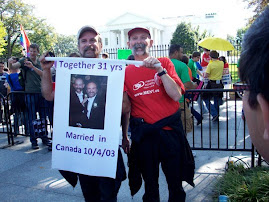
“It’s just about being fair,” said Neil Floar of Rochester, who married his partner of 38 years, Tom Morse, in Canada in 2004. “We’re not asking for special rights, we’re asking for equal rights.”
VFREILE@DemocratandChronicle.com
Toasting an Oscar Win, Hoping for Greater Rights - New York Times
Toasting an Oscar Win, Hoping for Greater Rights - New York Times
February 25, 2008
Toasting an Oscar Win, Hoping for Greater Rights
By NATE SCHWEBER
WEST ORANGE, N.J. — It was part Oscar party and part civil rights rally.
More than 300 people filled a theater here to standing-room-only capacity on Sunday evening to watch “Freeheld,” which won the Academy Award for best documentary short subject.
The film beat out three other documentaries, “La Corona,” “Salim Baba” and “Sari’s Mother.” The nominations and winner were introduced by United States servicemen and women shortly after 11 p.m.
“I’m here to watch the film because of what it could do for us,” said Doug Laverty, 40, a police officer in Passaic County who was featured in the film.
The 38-minute documentary chronicles the experiences of an Ocean County prosecutor’s investigator, Detective Lt. Laurel Hester, who died of lung cancer in February 2006 at 49. She fought her illness while battling the Ocean County freeholders for benefits for her partner, Stacie Andree.
Ms. Andree and the filmmaker, Cynthia Wade, were attending the Oscar ceremony in Hollywood.
At dramatic moments in the documentary, including a scene in which Lieutenant Hester, who lived in Point Pleasant, appears in a wheelchair at a freeholders’ meeting to ask that her pension be transferred to Ms. Andree, sobs could be heard in the audience.
“It was a tough movie to watch,” said Sam Joseph, 49, who lives in South Orange. “I’ve been with my partner for 30 years and it’s always been an issue: What if one of us get sick?”
None of the five Ocean County freeholders, who ultimately voted to extend benefits to same-sex couples, were at the screening.
Some in the audience on Sunday were same-sex couples who said they were still fighting for benefits for their partners.
Craig Ross, 46, watched the movie with his partner, Richard Cash, 54, for whom he is trying to obtain insurance through his employer, a technology company based in the Midwest.
“I have asked about it, but they don’t recognize civil unions, only marriage,” Mr. Ross said.
Mr. Cash added, “Like Laurel said, we don’t want to be treated differently than anybody.”
In 2006, Gov. Jon S. Corzine signed legislation extending benefits to same-sex couples under a civil union law.
According to Steven Goldstein, president of Garden State Equality, more than 2,400 couples in New Jersey have entered into same-sex unions, and about one-fourth of them have filed complaints with Garden State Equality over benefits. The group is an advocacy organization for gay, lesbian and transgender people in New Jersey.
“I wish this film had a happy ending,” Mr. Goldstein shouted to the crowd after the credits rolled. “It does not. Our civil union law is failing; it is not respected like marriage.”
Between the showing of the film and the beginning of the Oscar broadcast, Ed Mather, 66, of Morris County, said he was still working for the right to marry his partner of 39 years, the Rev. Robert O. Kriesat, with whom he attended the screening.
“The goal is full marriage rights,” he said.
Mr. Kriesat, 68, who appeared briefly in the film petitioning the freeholders, said it was the second time he had seen the movie, and it again made him think of what could happen if he or his partner fell ill.
“It’s almost as hard to watch the second time,” he said.
Though about half the audience left after the screening, the rest watched the broadcast, anxiously waiting for the category in which “Freeheld” was entered.
In stark contrast to the somber film, the Oscar party afterward was a raucous event, in which wine and Champagne flowed, and breathless quips about moviegoers’ clothes were made by a Joan Rivers impersonator.
A cheer went up when “Freeheld” was announced as the winner. Joan Hervey, 53, who appeared in the film, said she felt “a rush of joy,” and David Smith, 23, managing director of Garden State Equality, said, “I feel empowered.”