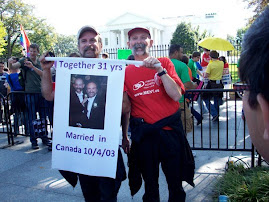
No Blue Skies for Bi-National Couples
By: SEBASTIAN CORDOBA
01/03/2008As 2008 unfolds, those gay and lesbian Americans who are in relationships with men and women from beyond our borders are probably wondering what these 12 months will bring for them, especially during an election year. As was the case during the year that just ended, the news will continue to be grim.
2007 saw the reintroduction of the Uniting American Families Act (UAFA), a bill that could bring relief. However, as in 2005, it failed to get substantial traction in Congress and received even less coverage from the press. The only time when the issue peeked out nationally in the media was during the "forum" of Democratic presidential hopefuls on the gay TV network Logo. Even then, the question was posed only to New Mexico Governor Bill Richardson, the matter of gay and lesbian immigration and same-sex bi-national couples otherwise conspicuously absent from the event.Such omissions hint at the lack of awareness regarding this issue in both the LGBT community and mainstream America . On the blogosphere, discussion of the UAFA in 2007 centered on various candidates refusing to endorse it, claiming immigration rights for same-sex couples would invite fraud and overburden the immigration bureaucracy. No word on why at least 19 other countries seem to be able to handle the responsibility for family unification policies that do not discriminate against gay and lesbian families.Unfortunately, there is a tremendous lack of information among gays and lesbians about this issue despite the fact that its impact is as devastating as any unequal law in this country. Today, if an American falls in love with a same-sex foreign national, the options open to the couple are to stay together in exile (and only if the other country to which they are moving is receptive to homosexual relationships), expensive commuting between two countries, or the last, and probably most dangerous - breaking US law by overstaying a visa.As an activist and filmmaker working on the subject for several years, I have discovered that much of the confusion about couples' rights is due to gay marriage becoming law in Massachusetts and Canada. Many people believe that after a marriage performed in those locales, the right to sponsor one's same sex spouse to live in the U.S. would logically ensue. The gripping tales of approximately 18,000 American men and women in bi-national same-sex households - a 2001 Census figure, which experts believe grossly understates the true picture - prove them wrong, thanks to the Defense of Marriage Act (DOMA), a legacy of Bill Clinton's presidency.DOMA prohibits the federal government from recognizing such marriages for the purpose of family unification in immigration cases. Therefore, these couples' amazing love stories are undermined and often destroyed by the sorrow and financial expense that they must incur to maintain a barely tolerable situation. Would any member of Congress allow such a status quo to prevail if it impacted all heterosexual bi-national couples? Of course not.And yet, every day in this country gay and lesbian foreign nationals are deported, torn from the US citizens with whom they have built lasting and loving relationships for no reason other than their sexual orientation.As more countries move forward to grant immigration rights to the gay and lesbian foreign national partners of their citizens, the unnecessary pain imposed on these couples in the US becomes more incomprehensible. This ought to be a rallying cry for American gays and lesbians since this is clearly a matter in which they face anti-gay discrimination. The rights of a heterosexual man or woman who has met a future spouse only once-and can thereby get the partner a "fiancé visa" and by marrying them an immediate "green card" - trump the freedom given committed same-sex couples no matter how long they have been together and how interdependent both financially and emotionally they have become. I have witnessed couples with kids who have been together for 15 years facing enormous economic pressures and family demands in their effort to remain in the country - long-time partners confined to spending hours in front of a web-cam to catch a glimpse of their loved ones; law-abiding Americans having no other choice but to help their partners remain in the country unlawfully. Curiously, the federal government recognizes committed same-sex relationships for certain types of non-immigrant visas. For example, a British national obtaining some professional visas (types E, H, or L) can secure a companion visitor visa (B-2), with extensions in six-month increments, for his or her same-sex partner, allowing them to "visit" for the duration of their partner's work stay in the US.But an American living overseas who wants to return to his homeland with his or her foreign-born partner would have no way of doing so.These inconsistencies and the "brain-drain" they are forcing upon our country when educated and tax-paying Americans are forced to leave well-paying jobs-not to mention the taxpaying potential of their partners - argue forcefully that a change in the system is overdue.Contrary to what most people believe, a legal solution can be achieved without legalizing gay marriage. Out of all the countries providing a legal framework for gays and lesbians to sponsor their foreign-born partners, only the Netherlands, Belgium , Spain, South Africa, and Canada have instituted same-sex marriage. UAFA, the bill that could create a solution for same-sex bi-national couples in the US, is also not dependent on a resolution of the gay marriage debate here.Still, the measure will not be going before Congress until at least 2009. The bill had 87 sponsors in the House and nine in the Senate when reintroduced in 2007. Such modest numbers clearly indicate that much work needs to get done to secure its passage, even with a Democratic president in the White House.A few organizations around the country, such as Out4Immigration, Immigration Equality, and Human Rights Watch, among some others, are working tirelessly, along with several lawmakers, chiefly New York Representative Jerry Nadler and Vermont Senator Patrick Leahy, both Democrats, to make this a possibility.Until these advocates are able to win the day, the situation will be dire for those Americans who choose their same-sex partners from the wrong side of the border. Their goal is not to advance any political agenda: These men and women are only trying to build a future with the person with whom they have chosen to share the rest of their lives. For now, their unions may well not be a mirthful "forever after," but rather a short course in despair, hopelessness, and tears. With a national election at hand this year, now is the time for the LGBT community and its allies to awaken from their complacency and unawareness and mount a vigorous grassroots and media campaign to gain wider support in favor of passage of the Uniting American Families Act in 2009.Sebastian Cordoba is a film director who recently produced "THROUGH THICK AND THIN, an award-winning documentary about the immigration struggle of bi-national gay and lesbian couples.
Wednesday, January 9, 2008
No Blue Skies for Bi-National Couples


Friday, January 4, 2008
Altered Lives | Print Article | Newsweek.com
Altered Lives Print Article Newsweek.com
Kate Fleming drowned at home in her flooded basement. One year later, her tragic death could reshape the gay-marriage debate.
Newsweek Web Exclusive
Updated: 12:02 PM ET Dec 21, 2007
Charlene Strong was on her way home in a pounding Seattle winter storm when the call came from her partner, Kate Fleming. Sounding stressed, Fleming told her that a rain was flooding down a hillside and into the couple's basement, where Fleming, an audiobook narrator, was at work in her recording studio. What happened over the next half hour cost Fleming her life and changed Strong's forever. As the rain poured down, a flood of water cascaded down the slope in their wooded neighborhood and into the house. The basement began filling with water. Fleming called again a few minutes later to say that she was stuck in the windowless studio, with water rising rapidly. Something, she said, must have fallen and blocked the door.
When a panicked Strong arrived minutes later, she couldn't force open the studio door, which was clamped shut by the force of the water. She tried to slash into the plaster wall with a knife, forgetting that the couple had added an extra layer of sheet rock for soundproofing. As Strong struggled outside the door, Fleming called 911 on her cell phone. But the water was rising so quickly that in a matter of minutes, Strong was submerged and had to grope for the safety of the stairwell.
"I knew she was underwater by then," said Strong. "And nothing would budge." Long minutes passed before rescue workers arrived and cut a hole in the bedroom floor. A fireman jumped into the black water below to retrieve a comatose Fleming.
Frantic efforts produced a pulse. An ambulance raced Fleming to the hospital, with Strong close behind. At the door of the hospital emergency room, a social worker informed her that only family members were allowed inside. When Strong protested that she was Fleming's partner, the social worker said that under Washington state law, same-sex partners did not qualify as family. Only an urgent call to Fleming's sister in Virginia cleared the way to get Strong through the doors. Ninety minutes later, Fleming died, with Strong at her side.
The nightmare didn't end there. The next day the man handling the funeral arrangements insisted on dealing with Fleming's mother, though Strong told him she was Fleming's spouse. "He said, 'You don't have any rights in the state of Washington'." says Strong. "I left the room and started crying."
Together for 10 years, the couple had held a commitment ceremony that was not officially binding but a symbol of their relationship. "Kate was my wife, and I was her wife, and that's the way we always thought of each other," said Strong.
The second night after Fleming's death, an anguished Strong lay awake, replaying the harrowing scenes in her mind—the flood, the hospital, the funeral home. Though still in shock, her rage was mounting. "I could handle someone calling me a homo," she told NEWSWEEK. "But saying you don't count, that's something that had to change."
Strong knew that a bill had been introduced in the Washington state legislature aimed at granting same-sex couples and older unmarried adults some of the same rights—such as those to make medical decisions and inherit property—as those enjoyed by married couples. Several days after the funeral service, she called to her friend Joe McDermott, then one of five openly gay representatives in the state legislature, asking if she could help push the bill. A little more than a month after Fleming's death, Strong appeared before a state Senate subcommittee and told in measured tones what happened that December night and in the days that followed.
Hearing how Strong was treated the night of Kate Fleming's tragic death was "critical" for lawmakers, says Lisa Stone, the director of the Northwest Women's Law Center, which advocated for the bill. "It's always better if you can put a face to an issue." Last April, thanks in part to Strong's powerful testimony, the bill passed. Strong was there when Gov. Christine Gregoire signed the bill into law, making Washington the eighth state to officially recognize same-sex couples. Two filmmakers were also on hand, recording the ceremony for Equal Rights Washington, an advocacy group for the state's gay and lesbian community. Before the day was over, one of the filmmakers, David Rothmiller, had persuaded Strong to participate in a documentary about her experiences in the wake of Fleming's death. "Our goal is to present Charlene and Kate's story as one that isn't threatening," says Rothmiller. "It's a threatening topic to some people because they don't understand why we should allow homosexuals to marry."
The film, "For My Wife," will be released at selected film festivals next month. Strong, who plans to help promote the film, will also travel to New York where she will get training as a public speaker and activist from the Gay and Lesbian Alliance Against Defamation (GLAAD). "Charlene has a powerful story that resonates with people," says GLAAD President Neil Giuliano. "That's why she's very compelling."
These days Strong lives in a studio apartment in Seattle, having moved there from her water-ravaged home last February. The couple's three cats have been farmed out to friends and neighbors, but Strong's dog, Pepper, is still with her. She's quit her job as a dental-office manager, for now, to devote herself full time to her cause. The other day, she drove to the postage stamp of a house where Fleming died, even as clouds hung low over the Seattle landscape. Flowers had been left by friends to mark the one-year anniversary of Fleming's death. A picture of Fleming was there as well, inscribed by Strong: "I miss you Kate. You will always be the love of my life."
Accompanied by a reporter from NEWSWEEK, Strong opened the door to the house and the stench of mildew wafted through the rooms. The wooden floors were dirty and warped. The shirt Fleming was wearing still lay where it was tossed aside that night by paramedics. The basement was littered with debris and the walls were boarded up where the water had coursed through and taken out one side of the house. NO TRESPASSING signs were posted on the wooden fence and the once-manicured garden was overgrown with weeds.
Even now, the year is a blur—the unimaginable tragedy, the insults in the name of the law, the hearings, the movie. The transformation from private citizen to activist, from couple to mourning single has left her still stunned. In a wan voice, Strong described a section of the garden where she and Fleming would sit in the late afternoon and drink a beer or two when the work day was done. "I know I'm not the only one who's gone through this," she says. "But I feel like someone has picked me up and plunked me into a whole new world." It's a world she hopes, in which no other grieving survivor will have to repeat the nightmare she faced after Kate Fleming's death.
URL: http://www.newsweek.com/id/81305
Wednesday, January 2, 2008
Gay marriage live and let live
Gay marriage live and let live
Gay marriage: live and let live
1/2/2008 - In this column, we consider whether the state should recognize gay marriage. This issue is distinct from whether gay sex is immoral, because one might think that the state should recognize some immoral contracts (for example, a contract to supply pit bull puppies to the Aryan Brotherhood). The issue is not merely academic. Gary Gates of UCLA Law School points out that a 2000 U.S. Census report noted that there were 600,000 same-sex couples and in 2005, the Census Bureau estimated that the number is greater than 770,000. Gay marriage is currently legal in the Netherlands, Belgium, Canada, South Africa, and Spain. In the United States, gays can get married in only one state, Massachusetts, and in Iowa this issue is currently in dispute. In addition, nine other states grant civil unions to gays. These offer the same legal rights as heterosexual marriages. These states include Connecticut, New Hampshire, Vermont, and New Jersey. In addition, the Defense of Marriage Act (signed into law by President Clinton on 1996) made two changes in the law. First, it permits any state to refuse to recognize a gay marriage performed in another state. Second, it prevents the federal government from recognizing same-sex or polygamous marriage for any purpose.Here is a good principle for state recognition and enforcement of contracts. If a contract was voluntarily entered into, doesn’t involve activity that is already illegal, and doesn’t involve direct harm to others, the state should recognize and enforce it. This is why we allow persons to purchase goods that are destructive (for example, cigarettes and alcohol) and that offend the majority’s sensibility (for example, pornography). Jennifer Roback Morse writing for National Review argues against this claim. She argues that marriage is a permanent bonding of persons and not a contract. Even if true, state recognition of it is a recognition and enforcement of a contract. This is why it carries with it changes in the property ownership (for example, joint ownership of marital assets) and certain remedies in the case of contract dissolution (divorce). This is also why much of the state marriage-license requirements (competency, voluntary agreement, and conscionable terms) track contract law. Her argument is an interesting metaphysical claim about the nature of marriage, but irrelevant to the issue at hand.With this in mind, let us consider the arguments against gay marriage. First, it is argued that gay sex is immoral and that the state shouldn’t recognize contracts to do immoral things. As argued for in a previous column, the arguments for this claim are unconvincing. Even if convincing, the state recognizes a wide range of contracts involving behavior that many consider immoral (for example, prostitution in Nevada and pornography in California) and so it is hard to see how this objection is supposed to work.Second, some opponents of gay marriage argue that state recognition of it would harm children. This argument is also hard to follow. One-third of lesbian couples and one-fifth of gay male couples have children. This involves at least 154,000 couples (one-fifth of 770,000 couples). It is not clear that gay couples harm children who were born into them because the children owe their lives to the couples. The notion that gay marriage harms children not born to gay couples is a claim in need of supporting studies. I haven’t seen any. I should note that a few anecdotes are not data. As always the opponents of liberty (in this case the liberty to form a contract and have it enforced) should bear the burden of proof. Third, other opponents claim that state recognition of gay marriage will break up heterosexual marriages. The data doesn’t support this. Wikipedia reports that divorce rates in the one state where gay marriage is legal, Massachusetts, are the lowest in the country and dropped after gay marriage was legalized. Researcher Darren Spedale similarly found that after Denmark legalized gay marriage, the rate of heterosexual marriage increased and divorce rates fell. However, let’s assume that there was data supporting the claim that recognizing gay marriage correlated with greater harm to children and higher divorce rates. This still would not provide a sufficient case against gay marriage because the harm would be indirect. The responsibility for harm to children should fall on those who molest, injure, or abandon them, not third parties who affect how others think about the world. Such a system tries to control what persons do by controlling what they think and this treats Americans like children. Fourth, opponents assert that if gay marriage should be legalized, then so should polygamous marriages (one person married to two or more others) and adult incest marriage. This, the opponent argues, is ridiculous. As reported by William Saletan of Slate.com, one response is that adult incest might lead to birth defects. But, as he points out, states might simply recognize it if the couple proves that they are infertile or are too old to procreate. This is the rule that five states adopt with regard to cousin marriage. In addition, if we are concerned about birth defects, then perhaps the state should sterilize or criminalize reproduction by persons whose retardation, mental illness, or physical abnormalities are in part genetic. Another response is that gay marriages are morally right, healthy, or characterized by love and this is not true of these other relationships. The moral claim is likely false for the same reason that it is false with regard to gay sexuality, such behavior does not involve a right infringement or exploitation. The latter two claims are empirical and in the absence of data, there is no way of knowing whether this is true. Even if true, this generalization admits of exceptions and the exceptions have rights. For example, the case for state recognition of gay marriage doesn’t rest on claims about the frequency of gay versus straight promiscuity, cheating, or comparative depth of love. The same reasons that justify gay marriage also justify permitting adult-incest and polygamous marriage. People are still free to try to get others to avoid this sort of behavior, they just can’t use state coercion as a means of persuasion. I realize a lot of readers find adult-incest relationship and polygamous relationships disgusting, but this is merely aesthetic. The same can be said for those who find the idea of obese people having sex disgusting. In short, the arguments against gay marriage fail on their own terms and in any case are trumped by liberty. Stephen Kershnar is a Fredonia State University professor. Send comments to editorial@observertoday.com
Registry might see changes - South Sound - The Olympian - Olympia, Washington
Registry might see changes - South Sound - The Olympian - Olympia, Washington
Brad Shannon
If 2007 was a good year for the legal rights of same-sex couples in Washington state, advocates say they want the next year to bring even more rights — and some responsibilities — to the state's domestic partnership registry.
The registry has drawn 3,161 same-sex couples and unmarried heterosexual couples to sign up since it went into effect July 22.
Considered the first step toward legal same-sex marriage, it provides about 10 legal rights enjoyed by married couples, including rights of visitation in hospitals and certain rights to participate in end-of-life decisions.
"We are planning to continue the incremental strategy we set out on last year. We are working right now on the details of what will be included. But we are proposing a package that would expand the rights," Rep. Jamie Pedersen, a Seattle Democrat and lawyer, said recently.
Pedersen said bill sponsors are debating whether to clarify community property statutes that already can extend to same-sex couples or whether to address nursing home issues, including privacy concerns.
Another is the way a same-sex couple's joint ownership of a home can lead to a denial of coverage under Medicaid but not for a similarly situated married couple.
But he said the bills could include "a substantial chunk of the 400 rights that same-sex couples and partners over 62 don't have access to without marriage."
Opposition is expected no matter what rights are proposed.
"Obviously there are going to be bills sponsored by Democratic legislators," Republican Sen. Dan Swecker of Rochester said recently. "I'm here and ready to oppose them, but I don't have a clue on what they are proposing.''
Swecker has taken a lead in opposing gay-rights legislation in recent years. "I'll probably be a voice in the wilderness. The Republicans are in such a minority,'' Swecker added.
Swecker predicted that whatever moves in the Legislature "will depend on the Democratic leaders and how much tolerance for risk they have in the next election."
Pedersen is one of several openly gay lawmakers along with Sen. Ed Murray, D-Seattle, who championed the state's groundbreaking domestic partnership registry that won passage in 2007.
Murray has said it is all about marriage equality and that it might take three to 10 years to achieve full equality.
Pedersen said he doesn't just want rights for registered domestic partners; he also wants to include responsibilities — such a requiring registered partners of elected and appointed political figures to report gifts, sources of income and contracts on forms filed with the Public Disclosure Commission.
"I think the point is this is not a lark. This is a serious legal obligation … People need to understand that when they go into it,'' Pedersen said of domestic partnerships.
Senate Majority Leader Lisa Brown, D-Spokane, said she anticipates at least one bill expanding rights.
She suggested the chamber's reasoning to follow a process they've seen before, laying out the rights and responsibilities associated with marriage and asking if there is there a reason not to extend the rights to same-sex couples.
House Speaker Frank Chopp said recently he expects Pedersen, Murray and others to propose an expansion of the list of rights available to same-sex couples through the registry. And, he said, he supports that effort.
Olympia City Councilman Jeff Kingsbury, who sued unsuccessfully with other same-sex couples to overturn Washington's one-man, one-woman definition of marriage, said he is pleasantly surprised to see lawmakers are continuing to push for more rights on the registry, believing the short session would be more focused on making budget adjustments and few policy changes.
But he said he is disappointed to again see an incremental approach rather than an all-out push to legalize same-sex marriage. And he questioned the idea of requiring disclosure of a partner's assets under state law, saying: "I don't know why couples that are exempt from all the privileges of marriages federally should be required to report their partners' assets.''
The legislative session starts Jan. 14 and runs 60 days.
Brad Shannon is political editor for The Olympian. He can be reached at 360-753-1688 or bshannon@theolympian.com.
Same-sex marriage ban faces pivotal year | IndyStar.com
Indiana Same-sex marriage ban faces pivotal year IndyStar.com
Legislature to decide whether amendment goes to voters or starts over
By Bill Ruthhart
bill.ruthhart@indystar.com
December 31, 2007
Back to the drawing board -- or on to the voters.
By the time the 2008 legislative session ends in March, one of those two fates awaits a proposed amendment to Indiana's Constitution that would ban same-sex marriages.
To amend the constitution, two consecutively elected legislatures must pass the measure. Voters must then approve it in a general election. The General Assembly passed the amendment in 2005 but has failed to do so since.
If lawmakers in both the House and Senate pass the amendment this session, voters would get their say in November. But if the amendment fails, the lengthy process would have to start over again.
Supporters of the proposed ban don't want to see that happen.
"This is an issue where the legislators need to remember that the people of Indiana need the opportunity to vote to protect marriage," said Eric Miller, founder of the conservative activist group Advance America. "We have to let the people decide."
Indiana has a state law that bans same-sex marriages. But supporters say an amendment is necessary to prevent judges from overturning the law and allowing gay marriages.
Opponents say the amendment would extend constitutional protections to discriminatory behavior and that political and social conservatives are using the divisive issue as a way to drive voters to the polls.
Republican and Democratic lawmakers alike supported the amendment's first sentence, which defines marriage as the union between a man and a woman.
But that was outweighed by concerns over its second phrase, which says state law "may not be construed to require that marital status or the legal incidents of marriage be conferred upon unmarried couples or groups."
That sentence, foes of the amendment argue, could jeopardize domestic-partner benefits, weaken domestic-violence laws and hurt Indiana companies' ability to recruit top employees.
In 2005, when Republicans controlled the Senate and House, both chambers voted overwhelmingly to pass the amendment. In 2007, with Democrats in control of the House, the amendment died in committee.
Amendment backers accused House Speaker B. Patrick Bauer of breaking a promise to allow the full House to vote on the issue. Bauer, D-South Bend, denied that and maintained he promised to allow the measure to run through the legislative process.
Bauer has not said whether he intends to allow the amendment to be heard this year.
On three occasions, the Senate has approved the amendment first and passed it on to the House. That, however, won't happen this session.
Sen. Brandt Hershman, R-Wheatfield, has sponsored the amendment in the Senate in past instances. Though he said he'd do so again this session, Hershman said it will be up to the House to pass the amendment first.
"I don't see a benefit in the Senate stating a view it has stated three times previously," Hershman said. "There is little use to move it forward if the House is simply going to block further consideration.
"I'm looking to the House to initiate the process this time around."
That means Rep. P. Eric Turner, R-Marion, will be charged with pushing the measure first -- a job that he said he's willing to tackle.
"I think Senator Hershman is probably tired of starting it and seeing it die in the House at the hands of the speaker," Turner said. "I'm certainly willing to start something in the House."
Miller, one of the state's most prominent lobbyists and a key supporter of the amendment, said he would encourage both the House and Senate to consider the amendment simultaneously.
But Walter Botich, the legislative chair for Indiana Equality, a gay rights advocacy organization, said lawmakers have more urgent issues, namely a property-tax crisis, to sort out. His group opposes the amendment.
"We have more pressing issues to deal with this session, and property taxes are on everyone's minds," Botich said. "The issue no longer seems as important to most, I think."
A recent poll conducted for The Indianapolis Star and WTHR (Channel 13) supports that notion.
The November statewide survey showed that 49 percent of Hoosiers support the amendment, down from 56 percent in 2005.
"This (amendment) was a tool to turn out voters, but since then, the general public has wised up," Botich said. "They realize this isn't a pressing issue, it's made to divide people, and it's something that Indiana doesn't need."
Gov. Mitch Daniels has no say on constitutional amendments and generally has steered clear of the issue, saying it's a legislative decision. In a recent Star interview, however, he indicated a measure of support.
He said he was "a believer in traditional marriage and a supporter of the law we have on the books now" and that he agreed "with the idea of protecting it (the law) against some creative judicial ruling in the future."
Amendment supporters point to a recent court ruling in Iowa as good reason to push the ban through.
A county judge there ruled that the state's law banning same-sex marriages violated the constitutional rights of due process and equal protection of six gay couples who had sued.
For four hours, gay couples had the right to marry in Iowa before the same judge delayed the issuance of any more same-sex marriage licenses until the matter could be heard by the state's Supreme Court.
"To those in the House who say they believe in marriage as (an institution) between one man and one woman but don't think there's a need for a constitutional amendment, all they have to do is look at what happened over the summer in Iowa," said, Turner, the Republican from Fort Wayne.
"That should give us some momentum going into the session."
Botich, of Indiana Equality, doubts it.
"I don't think that strengthens their argument at all," he said. "At this point, Hoosier voters and Hoosiers in general are tired of this issue."
N.H. civil unions: legal protections, obligations and pitfalls - BostonHerald.com
N.H. civil unions: legal protections, obligations and pitfalls - BostonHerald.com
By Associated Press Saturday, December 29, 2007 http://news.bostonherald.com/ U.S./ Northeast Region
CONCORD, N.H. - New Hampshire’s new civil unions law — though well-intentioned — makes a promise to gay couples it can’t keep: that all the rights, obligations and responsibilities of marriage will be theirs.
In fact, they will not be treated equally, either inside New Hampshire or beyond its borders.
They will fall into a separate, evolving legal class recognized by only a handful of states. And more than 1,100 federal laws will discriminate against them regardless where they live.
Gay couples taking advantage of the law — which takes effect Tuesday — indeed acquire substantial new state protections ranging from important health benefits to the ability to inherit without a will.
But they will be treated legally as two unmarried adults in all but New Jersey, Vermont, Connecticut and California. They probably will be recognized in Oregon, whose domestic partner law was to take effect Tuesday, but a federal judge put the law on hold last Friday pending a February hearing requested by opponents.
Their status isn’t as clear in Massachusetts, the only state that allows same-sex marriage, nor in Washington, Maine, Hawaii and the District of Columbia, which recognize domestic partners to varying degrees.
Adding to the legal confusion, gay couples moving to New Hampshire and getting united may still face questions about their status. For example, just released New Hampshire Insurance Department guidelines recognize, without question, health insurance policies subject to Oregon law, but those from California only on a case-by-case basis.
Even if they never leave New Hampshire, couples united under the new law won’t have the same rights or receive the same benefits that heterosexual couples enjoy under federal laws. They are specifically excluded under the 1996 federal Defense of Marriage Act, which defines marriage as between one man and one woman. Many states have adopted similar laws.
Gay couples united in New Hampshire — or any other state — won’t qualify for federal Social Security or veterans survivor benefits or be able to sponsor a foreign national to immigrate as their spouse.
Federal laws governing multistate employer health plans will continue to allow the companies to discriminate against their united gay employees. Such discrimination will be illegal under state-regulated health plans that cover married couples.
Also, united gay couples will pay taxes on most if not all of the value of costlier health insurance plans — a cost not passed onto married couples. Unlike married heterosexual couples, united gay couples cannot file joint federal income tax returns.
Another potential downside faces couples who come to New Hampshire to enter civil unions. They run the risk of being locked in legal limbo if they return home to a state that doesn’t recognize their status. A similar problem faces New Hampshire couples who move away.
More than 9,300 companies already cover gay couples, including The Associated Press, UPS and Verizon. Though that number is growing, many companies still do not extend benefits.
Gay couples with one member working for the state or local government in New Hampshire now will get the same pension benefits as their heterosexual counterparts. But gay couples that include a federal employee won’t get the same recognition under the federal retirement system.
Gay couples won’t pay state taxes to transfer property from one partner to the other, but they could be liable for federal gift taxes.
In short, legal experts say couples should see a lawyer before entering into a union — or at least check with their employer’s benefits department so they aren’t surprised at being taxed or disappointed at being excluded. They also should keep — and carry out of state — legal documents that married couples might not need, such as ones allowing each other to make medical decisions if one is incapacitated.
"Everything couples did before to protect themselves, they should do after a civil union," said Michele Granda, a staff attorney for Boston-based Gay & Lesbian Advocates & Defenders, or GLAD.
"It really is a level of fairness that is long overdue, but there are holes in the safety net," she said. "It’s a step, but it can’t be a stop. It’s opened the door to a future of possibilities but it will not provide the equality that many people think it will."
The benefits can be substantial, however.
Lara Schwartz, legal director for the Human Rights Campaign, said New Hampshire’s law in particular provides important protections for couples and children when one spouse dies or the couple divorces.
"It’s basically the state enforcing your promises to one another," she said.
Unlike heterosexual marriage, civil unions are not universally recognized, however, which can make entering into one far easier than getting out of one.
New Hampshire has no waiting period for a civil union regardless of residency. Nor is there a waiting period for divorce if both are residents. But if only one of the divorcing parties is a resident, he or she must wait one year.
John Rich, a Manchester attorney, said residents who have homes in another state but retain New Hampshire as their official domicile should be able to get a divorce. Couples who move and break their ties to New Hampshire may experience the dilemma facing a gay Rhode Island couple that married in Massachusetts: a requirement that one move to Massachusetts for a year to dissolve the marriage.
"When you cross state lines, there’s a question whether your family exists at all," Schwartz said.
Seven years after enacting the nation’s first civil unions law, Vermont is asking the public if same-sex marriage would provide more equity.
Thomas Little, chairman of the Vermont Commission on Family Recognitions and Protection, said the most frequent complaint at hearings is that federal law doesn’t recognize gay unions. That wouldn’t change if Vermont allowed same-sex marriage, he said.
But Middlebury attorney Beth Robinson, chairwoman of the Vermont Freedom to Marry Task Force, argues that more companies would provide health benefits to gay families if the legal designation changed to "married." More importantly, the designation would provide stronger legal grounds to sue for full recognition, Robinson said.
New Hampshire Gov. John Lynch said he hasn’t analyzed what other states have done or what impact his state’s law will have on them. He signed the law to end discrimination and protect families, he said.
"I think we’ve done the right thing in New Hampshire and that’s the state I’m primarily worried about," Lynch said.
Despite the limitions of civil unions, New Hampshire expects 3,500 to 4,000 couples to get them in the first year.
Some, like Jeff Burr, 49, and Neil Blair, 44, of Franconia, want to put faces to the law.
"Yes, it’s about the civil rights, but its also about the whole civil rights movement. It’s about the big picture. It’s about the journey. It’s about doing what’s right," said Blair.
Others, like Betsy Peabody, 46, and Dianne Harhigh, 49, of Concord, want to legally strengthen their family by making a stepparent adoption possible. Harhigh plans to adopt Peabody’s 6-year-old daughter, Julia.
Peabody is a realist. She knows civil unions aren’t the same as marriage.
"I’m OK with forward motion even if it’s not where we want to be. It’s not realistic to get to where we want to be without steps along the way," she said.
Friday, December 28, 2007
Court Halts Oregon Gay Partnership
Federal Court Halts Oregon Gay Partner Registryby The Associated Press
Posted: December 28, 2007 - 8:00 pm ET
(Portland, Oregon) A federal judge on Friday placed on hold a state domestic partnership law that was set to take effect Jan. 1, pending a February hearing.
The law would give some spousal rights to same-sex couples.
Opponents asked U.S. District Judge Michael W. Mosman to intercede after the Oregon secretary of state's office ruled in October that they had failed to collect enough valid signatures on a referendum to block the law.
The Oregon measure covers benefits related to inheritance rights, child-rearing and custody, joint state tax filings, joint health, auto and homeowners insurance policies, visitation rights at hospitals and others. It does not affect federal benefits for married couples, including Social Security and joint filing of federal tax returns.
After the Legislature approved the domestic partnership law this year, gay rights opponents launched an effort to collect enough signatures to suspend the law and place it on the November 2008 ballot for a statewide vote.
But state elections officials said this fall that the effort fell 116 valid signatures short of the 55,179 needed to suspend the law.
In court Friday, Austin Nimocks, a lawyer for Alliance Defense Fund, which opposes the measure, said the state's review process was flawed, disenfranchising citizens who had signed petitions.
The state's largest gay rights group, Basic Rights Oregon, criticized the judge's decision.
"It's unfair our families once again are bearing the brunt of this ongoing struggle," said Jeana Frazzini, a spokesman for the group.
Eight other states have approved spousal rights in some form for same-sex couples - Connecticut, Vermont, New Hampshire, New Jersey, Maine, California, Washington and Hawaii. Massachusetts is the only state that allows gay