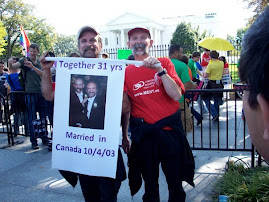
Bid for hold on California gay marriage ruling could postpone unions - San Jose Mercury News: "By Howard Mintz
Mercury News
Article Launched: 05/22/2008 04:19:13 PM PDT
Gay weddings in California are likely to be stalled until at least mid-July following a request filed today with the California Supreme Court by conservative groups seeking a hold on last week's ruling striking down the state ban on same-sex marriage.
In a 21-page legal brief, the Arizona-based Alliance Defense Fund is asking the Supreme Court to rehear the case on one issue - a request to postpone the impact of last week's ruling until after the November election, when voters may consider a ballot initiative to restore the ban on same-sex marriage through a constitutional amendment.
Lawyers for the defense fund argue that freezing the ruling would avoid legal chaos around the state as gay couples move to capitalize on their newfound legal right to marry by obtaining marriage licenses between now and November.
The Supreme Court seldom grants motions to rehear its decisions, but such requests create a procedural delay in the usual 30-day window before a ruling becomes final. The justices typically take another 30 to 60 days to resolve rehearing petitions, which would push potential wedding dates for same-sex couples into late summer.
Same-sex couples have already been preparing to marry in counties across California, hoping they might be able to obtain marriage licenses as soon as mid-June. Today's legal filing now heightens the possibility couples will have to wait longer, although court officials say the stay request is certain to be resolved well before the fall election"
Thursday, May 22, 2008
Bid for hold on California gay marriage ruling could postpone unions - San Jose Mercury News


Marriage Equality USA video moment of decision
Here is Molly McKay taking us through the final minutes before and after the decsion was announced.
Broun says he'll push for amendment to ban gay marriage 05/21/08
Broun says he'll push for amendment to ban gay marriage 05/21/08
Broun says he'll push for amendment to ban gay marriage
| | Story updated at 11:28 PM on Wednesday, May 21, 2008
U.S. Rep. Paul Broun, R-Athens, said Tuesday he will propose an amendment to the U.S. Constitution banning same-sex marriage in reaction to a California Supreme Court ruling last week legalizing the practice.
"My amendment will preserve the original intent of the drafters of the Constitution, by ensuring that no state or federal judge can take it upon themselves to suddenly discover a right to homosexual marriage within the text of the document," Broun said in a news release. "It will also provide a defense against activist judges who seek to overturn the will of the people by manipulating state constitutions in order to impose their preferred policy position."
Broun previously has said he opposes same-sex marriage, but it should be up to states to ban it, a stance his opponent in the July Republican primary, state Rep. Barry Fleming, has criticized. Fleming also has called for such a ban.
Georgia voters approved an amendment to the state constitution outlawing same-sex marriage in 2004
: The California Same-Sex Marriage Ruling What it Says, What it Means, and Why It's Right
FindLaw's Writ - Dorf: The California Same-Sex Marriage Ruling What it Says, What it Means, and Why It's Right
Michael C. Dorf
Last week, the California Supreme Court handed down a landmark ruling legalizing same-sex marriage in the nation's most populous state. With the decision in In re Marriage Cases, California becomes only the second state in the country to grant same-sex couples the right to enter into marriages that are in name as well as substance the full equal of opposite-sex couples' marriages.
Like the ruling by the Massachusetts Supreme Judicial Court in the 2003 case of Goodridge v. Dep't of Public Health, last week's California ruling rested in part on the fact that the state already provided same-sex couples the option of entering into state-sanctioned domestic partnerships (sometimes called "civil unions") with the same legal benefits and responsibilities as marriage. Maintaining a separate name for the institution that applied where same-sex couples are involved, both the California and Massachusetts high courts said, was a form of second-class citizenship for the members of such couples..
In this column, I shall lay out the key features of the California Supreme Court ruling and then consider its likely consequences. Finally, I shall defend the ruling against the charge that the Court acted precipitously, moving faster than public opinion (in particular, public opinion in California itself, as measured in a relatively recent ballot initiative), and thus illegitimately.
The California Ruling in a Nutshell, and Why It Is the Last Judicial Word on the Subject
Last week's ruling was based entirely on the California Constitution. Although the actual doctrines the California Supreme Court invoked closely parallel doctrines that the U.S. Supreme Court has announced in interpreting the federal Constitution, the California Court made abundantly clear that its ruling rested solely on state constitutional grounds. Consequently, there will be no occasion for the U.S. Supreme Court to review the ruling, as the U.S. Supreme Court only exercises jurisdiction to decide issues of federal law.
What, then, did the California Supreme Court hold? The majority opinion covers 121 pages, and so I can only briefly summarize it here.
First, the decision holds that the California Constitution confers upon Californians a fundamental right to marry. The state, and various same-sex marriage opponents, had argued that the right to marry had to be understood in its historical context, and that was as a right of opposite-sex couples alone to marry. The Court rejected this argument as legerdemain. In so doing, the Court drew an analogy to its own 1948 decision invalidating a law barring interracial marriage, and quoted New York Chief Judge Judith Kaye's observation (in dissent in New York's same-sex marriage case) for the proposition that ìfundamental rights, once recognized, cannot be denied to particular groups on the ground that these groups have historically been denied those rights.î
Second, the California Supreme Court ruled that sexual orientation is a "suspect classification" like race or sex—the sort of government classification that is presumptively invalid because it so often relies on stereotypes about people who, as a group, have long been the victims of discrimination.
Accordingly, the court subjected the California law to "strict scrutiny," a demanding standard of review that required the government to show that restricting marriage to opposite-sex unions was "necessary" to achieve a "compelling interest." Finding that the government interests cited in support of the restriction were barely even legitimate, much less compelling—as they appeared to send a message that the state does not fully approve of same-sex couples' unions—the Court had little difficulty invalidating the law as violating both the California Constitution's right to marriage (derived from express textual protection for, among other things, "privacy"), and its right to equal protection of the law.
Likely Consequences of the Ruling: Minimal Outside California, and Potentially Temporary Inside the State
Last week's ruling is likely to have little impact outside of California—due primarily to the federal Defense of Marriage Act (DOMA). The federal DOMA gives no effect to same-sex marriages for purposes of federal law. Thus, for example, while married same-sex couples in California can file joint state tax returns, they must file separate federal returns.
The federal DOMA also authorizes California's sister states to refuse to recognize same-sex marriages performed in California. To be sure, there is some doubt whether this aspect of the federal DOMA is valid, because Article IV of the federal Constitution requires each state to give "full faith and credit . . . to the public acts, records, and judicial proceedings" of sister states. Congress is only empowered to "prescribe the manner" in which such acts, records and proceedings are proved. Nonetheless, states have long had the ability to deny recognition to some marriages celebrated elsewhere, and most states currently invoke this principle with respect to out-of-state marriages (as explained in a column earlier this year by Joanna Grossman). Thus, even without relying upon the authority DOMA purports to confer (and even if this aspect of DOMA were indeed to be held unconstitutional), states may be able to refuse to recognize out-of-state same-sex marriages.
Moreover, even in California, last week's ruling may prove short-lived, because it can be overturned by the voters of California by a ballot initiative amending the state Constitution, perhaps as early as November.
The California Supreme Court's ruling invalidated a statute that was adopted as a result of a 2000 ballot initiative, Proposition 22. That Proposition provided: "Only marriage between a man and a woman is valid or recognized in California," and it passed with over 61 percent of the vote. The California Supreme Court held that the law enacted by Proposition 22 was inconsistent with the California Constitution. The court was able to do so because ordinary ballot initiatives in California establish only ordinary statutes, which cannot contradict the state Constitution.
However, a special procedure enables a ballot initiative to become part of the California Constitution (and thus immune to further state constitutional challenge). Such an initiative will be somewhat more difficult to get onto the ballot than its predecessor, but not greatly so: In order to place an ordinary ballot initiative before the voters, organizers need signatures from registered voters comprising five percent of the number of ballots cast in the last gubernatorial election; for placing a constitutional amendment on the ballot, the threshold is eight percent.
The backers of a measure to convert Proposition 22 into a constitutional amendment are currently gathering signatures for their proposal, and if they succeed in satisfying the eight- percent threshold, then a simple majority of votes would amend the state constitution. (Alternatively, a two-thirds vote in the California legislature could also place a constitutional amendment proposal on the ballot.) Although Governor Schwarzenegger has stated his opposition to the proposed amendment, there remains a substantial chance that it will pass.
Did the California Supreme Court Act Precipitously?
The ease with which the California Constitution can be amended provides a partial answer to critics—some of whom even support same-sex marriage on policy grounds—who take issue with the California Supreme Court's decision on the ground that courts should not try to bring about social change in advance of popular acceptance.
That criticism may have some force when leveled at the U.S. Supreme Court in its interpretation of the federal Constitution, because the federal Constitution is extraordinarily difficult to amend. Consequently, a Supreme Court decision based on the Justices' perceptions of what rights count as "fundamental" can control legislation throughout the country, even if a substantial majority of the U.S. population disagrees. But if even a simple majority of Californians disagree with the state Supreme Court about the scope of the fundamental right to marry, and if only eight percent of voters are willing to sign a petition, then their understanding will prevail over the California Supreme Court's. In the argot of constitutional law, decisions of U.S. constitutional law are strongly "counter-majoritarian"; decisions of the California Supreme Court are only weakly counter-majoritarian.
That point holds more broadly, as well. In general, state constitutions are substantially easier to amend than the federal Constitution. For that reason, charges of "judicial activism" against state courts ring hollow—or at least, they should.
Furthermore, even if the California Supreme Court's decision were not subject to being overridden by a constitutional ballot initiative, one could hardly blame the California Justices for applying the law as they sincerely saw it. On the two key issues, the Justices simply followed where logic led. To say that the fundamental right to marriage can be denied to same-sex couples simply because it traditionally has been denied to them would, as the Court explained, be flatly inconsistent with its decision in the interracial marriage case. Likewise, gay, lesbian, and bisexual Americans have been, and continue to be, subject to discrimination and outright hatred that warrant treating sexual orientation as a suspect classification, at least if one faithfully applies the principles laid down in prior cases.
What the critics of the California Supreme Court decision are really saying, when they contend that the Court should not have recognized the right of same-sex couples to marry, is that the Justices should have ignored the law for practical reasons: Courts cannot bring about social change if the surrounding society is not prepared for it, the critics say, and may even precipitate backlash.
The criticism may well be right, but it is beside the point. The Justices of the California Supreme Court, like all judges, swore an oath to apply the law. California constitutional law has long rejected the notion that the meaning of terms in the state Constitution—such as "marriage"—is frozen from the moment of enactment. Nor does California constitutional law embrace the view that minority rights turn on the majority's willingness to recognize those rights.
Accordingly, the claim that the Justices of the California Supreme Court confused their own policy preferences with the law is exactly backwards. The critics of the ruling are upset precisely because the Court did follow the law. Should the voters of California respond by overriding the decision by ballot initiative, that will not in any way prove that the Court erred. It will show only that the voters have sullied the noble principle of equality with an exception rooted in prejudice.
What Do You Think? Message Boards
--------------------------------------------------------------------------------
Michael C. Dorf is the Isidor & Seville Sulzbacher Professor of Law at Columbia University. He is the author of No Litmus Test: Law Versus Politics in the Twenty-First Century and he blogs at michaeldorf.org.
Monday, May 19, 2008
Ellen DeGeneres and Portia de Rossi plan to wed - Times Online
Ellen DeGeneres and Portia de Rossi plan to wed - Times Online
From The TimesMay 17, 2008
Los Angeles
Ellen DeGeneres, the TV talk show host, is putting a California Supreme Court ruling in favour of gay marriage into action. She and her actress girlfriend, Portia de Rossi, plan to marry, DeGeneres has announced.
She was recording an episode of The Ellen DeGeneres Show on Thursday, the day the state’s high court overturned California’s laws against gay marriage.
She said that she and de Rossi would be getting married. De Rossi, 35, who was in the studio, and DeGeneres, 50, were applauded by audience members.
The court ruling means that same-sex couples could tie the knot in as little as a month. However, religious and social conservatives are seeking to put a constitutional amendment on a ballot in November that would undo the Supreme Court ruling and ban gay marriage.
DeGeneres and the glamorous de Rossi have been a familiar couple at Hollywood events, including the Academy Awards. (AP)
California chief justice says same-sex marriage ruling was one of his toughest - Los Angeles Times
California chief justice says same-sex marriage ruling was one of his toughest - Los Angeles Times
Ronald M. George, a moderate Republican who voted with the majority, likens the case to civil rights battles.
By Maura Dolan
Los Angeles Times Staff Writer
May 18, 2008
SAN FRANCISCO — In the days leading up to the California Supreme Court's historic same-sex marriage ruling Thursday, the decision "weighed most heavily" on Chief Justice Ronald M. George -- more so, he said, than any previous case in his nearly 17 years on the court.
The court was poised 4 to 3 not only to legalize same-sex marriage but also to extend to sexual orientation the same broad protections against bias previously saved for race, gender and religion. The decision went further than any other state high court's and would stun legal scholars, who have long characterized George and his court as cautious and middle of the road.
But as he read the legal arguments, the 68-year-old moderate Republican was drawn by memory to a long ago trip he made with his European immigrant parents through the American South. There, the signs warning "No Negro" or "No colored" left "quite an indelible impression on me," he recalled in a wide-ranging interview Friday.
"I think," he concluded, "there are times when doing the right thing means not playing it safe."
Yet he described his thinking on the constitutional status of state marriage laws as more of an evolution than an epiphany, the result of his reading and long discussions with staff lawyers.
As he sometimes does with the most incendiary cases, George assigned the majority opinion to himself. He wrote and rewrote, poring over draft after draft. Each word change had to be approved by the other three justices joining him in the majority. Even the likely dissenters had to be told in "pink slips" of every word change.
On Wednesday, the long-awaited ruling was finally ready.
Court Clerk Fritz Ohlrich locked up stacks of the fat, stapled court opinions in his office to protect against leaks, and George's staff asked that security be beefed up. A fellow justice told George she would be at her desk in the morning because she wanted "to be part of history."
On Thursday, George was in his chambers, being interviewed for a documentary on death penalty administration. He said he wished he had canceled the interview.
He was on camera when he heard "a big roar" from the crowd outside.
George, who grew up in Los Angeles, said he counts gays among his friends. Four years ago, he peered out his chambers' windows across from San Francisco City Hall to watch gay couples lining up to marry. He saw the showers of rice, the popping of champagne corks, the euphoria of the couples.
He later joined four other justices in nullifying the marriage licenses, which the court deemed to have been granted illegally by San Francisco. The court refused to take up the constitutional questions of same-sex marriage then, insisting the cases work their way up through the courts.
A trial judge ruled in favor of same-sex marriage. A court of appeal overturned that ruling. And finally, the case was on George's desk.
'Very fatalistic'
George said he had voted to void the marriage licenses because he did not think they should be "in limbo" while the courts tackled the constitutional issues. Once he took up the constitutional challenge, he said he did not permit any consideration of political fallout.
"I am very fatalistic about these things," he said. "If you worry, always looking over your shoulders, then maybe it's time to hang up your robe."
Court rules bar George from discussing the ruling until it takes effect in 30 days or more.
During the two-hour interview with The Times, he refused to disclose anything about the court's internal deliberations and responded to a number of questions by reading aloud from the decision. His elegant and comfortable chambers had neat stacks of papers piled on the floor, all over his desk and on a long conference table.
Asked whether he thought most Californians would accept the marriage ruling, George said flatly: "I really don't know."
He indicated he saw the fight for same-sex marriage as a civil rights case akin to the legal battle that ended laws banning interracial marriage. He noted that the California Supreme Court moved ahead of public sentiment 60 years ago when it became the first in the country to strike down the anti-miscegenation laws.
California's decision, in a case called Perez vs. Sharp, preceded the U.S. Supreme Court's action on the issue by 19 years. Even after that ruling, Californians passed an initiative that would permit racial discrimination in housing. The state high court again responded by overturning the law, George said.
Rather than ignoring voters, "what you are doing is applying the Constitution, the ultimate expression of the people's will," George said.
By the time of the same-sex marriage oral argument in March, three other justices had tentatively decided to join George's opinion. They are Justices Joyce L. Kennard, Kathryn Mickle Werdegar and (sole Democrat) Carlos R. Moreno, the court's more liberal wing.
George said the oral argument marked the "highest point" for the court, and he was "so glad" the session was televised. "I was incredibly proud of how we acquitted ourselves in such a difficult and well publicized case," he said.
Relations among the justices remained warm and cordial. George said he was even pleased with the dissents, which contended that a decision on same-sex marriage should be made by the people, not the court.
Some judges in other states that had considered same-sex marriage had written in ways that were "homophobic" and demeaning to lesbians and gays, statements "that you don't find" in California's dissenting opinions, George said. They were signed by Justices Marvin Baxter, Ming Chin and Carol A. Corrigan.
'A real conundrum'
"When is it that a court should act?" George mused. "When is it that a court is shirking its responsibility by not acting, and when is a court overreaching? That's a real conundrum. I have respect for people coming out on different sides of this issue."
George's reputation for caution is based on the court's tendency, under him, to decide cases narrowly, refusing to reach issues not necessary to the case at hand. Advocates thrust the central constitutional question of equality for gay people on the court; there was no way to avoid it.
George also had taken risks before. Shortly after Gov. Pete Wilson elevated him to chief justice in 1996, George obtained enough votes to change the court's stance on parental consent for abortion. He wrote the ruling that overturned the state's parental consent law, sparking a campaign by anti-abortion groups to oust him.
After a justice's appointment, voters are asked to retain him or her at the next gubernatorial election. At the time of the parental consent decision, some judges were just squeaking by their retention votes.
Eric George, 39, a Los Angeles lawyer and the chief's eldest son, decided to mount a full campaign to protect his father's seat. After George was reconfirmed by a healthy margin, Eric George said he gave his father some playful advice.
"Could you wait at least 10 years for another controversial decision like this?" he asked.
George said the only other decision that anguished him as much as same-sex marriage occurred at the beginning of his career, when as a Los Angeles County Superior Court judge he insisted that a serial killer known as the "Hillside Strangler" be prosecuted over the objections of the Los Angeles district attorney.
The district attorney's office said there wasn't enough evidence to win a conviction, so George asked the attorney general's office to prosecute it. The trial, expected to last a year, took two years. George remembers warning his wife, Barbara, "This may become known as George's folly." The jury eventually convicted on nine of 10 murder counts.
Santa Clara University law professor Gerald Uelmen, who has closely followed George's court tenure, said "the biggest surprise" of the marriage ruling was that George favored it. Uelmen said George must have done "some real soul searching."
The "very carefully written opinion" reflects that George "is very sensitive to how this will be perceived," Uelmen said. "He realized that this more than any other thing he does as chief justice will define his legacy. He'll certainly take a good deal of political heat over this."
Mathew Staver, founder of Liberty Counsel, said he had long expected George to vote against same-sex marriage.
"His change from where I thought he would be is baffling," said Staver, whose group promotes traditional marriage.
UCLA law professor Brad Sears said, "Definitely what created the majority was George's support."
A proposed initiative that would amend the Constitution to again ban same-sex marriage is headed for the November ballot, but even if it passes, gays in California will enjoy heightened protections from discrimination as a result of Thursday's ruling. George will appear on the state ballot for retention in two years.
He went home Thursday night drained and discovered a card left by friends at his San Francisco apartment. It was a Japanese watercolor of a branch with red berries. His friends had written "Congratulations!" inside.
"Why not go out on a limb?" the greeting on the card read.
maura.dolan@latimes.com
Viewpoint: What the California Gay Ruling Won't Do - TIME
Viewpoint: What the California Gay Ruling Won't Do - TIME
Friday, May. 16, 2008 By JOHN CLOUD Two couples wait for California's Supreme Court to rule on a ban against gay marriage in San Francisco, May 15.
Kimberly White / ReutersArticle ToolsPrintEmailReprintsSphereAddThisRSSYahoo! Buzz A little more than an hour after the California Supreme Court ruled yesterday that gay couples can legally wed, one of the plaintiffs in the case, Stuart Gaffney, was exultant. Speaking for himself and his partner of 21 years, Gaffney told a press conference, "This is the happiest and most romantic day of our lives." Really?
Related Articles
Weddings Undone
Oregon’s Supreme court last week declared invalid the marriages of 3,022 gay couples wed last year i...
Arnie Nixes Gay Marriage
It took 20 months of wheedling and browbeating to get the California legislature to pass a pioneerin...
IS THERE A RIGHT TO DIE?
Whatever one thinks about the Supreme Court’s landmark Roe v. Wade decision of 1973, there can be li...
What’s at Stake in The Fight
The Power Broker SANDRA DAY O’CONNOR - Conservative yet moderate, sticking up for Roe v. Wade and ...
Gaffney and his boyfriend should consider a gay cruise, or just a walk in the park before the weather turns hot. As sweeping as they can be, court decisions are not romantic. The sentiment that courts can deliver happiness is one cherished by generations of civil rights attorneys (and, apparently, their plaintiffs), but before we get too excited, we might pause to consider what the California court did not — and could not — deliver: legal equality for gay couples. As I pointed out in an earlier story, more than a thousand federal laws apply to married couples, and many of them accord substantial benefits in an array of programs, from Social Security to food stamps to federal housing. Gay couples in California will now be able to wed under state law, as those in Massachusetts can, but their marriages will still be something less than what straight Californians enjoy.
I am hoping for invitations to some lavish gay beach weddings in the next few months, but at the end of the year, the gays who stage those weddings will still be filing separate 1040s. That's not going to change any time soon, since both John McCain and Barack Obama (and, for that matter, Hillary Rodham Clinton) share the same position on equality for gay couples: they oppose it. Neither candidate would end federal discrimination against gays who want to marry.
One of the most puzzling things to me about heat for Obama on the left is that the Senator has taken such retrograde positions on gays. A little more than a year ago, after Peter Pace, then chairman of the Joint Chiefs of Staff, told the Chicago Tribune that he believes gay sex is "immoral," Obama initially declined to disagree with him. Obama's campaign waited hours before making clear that gays aren't actually immoral. (Thanks so much!) Later in the year, Obama's campaign enlisted the support of a Christianist entertainer, Donnie McClurkin, who publicly advocates the idiocy that people can change their sexuality by praying to Jesus.
Obama would benefit from reading the California court decision. At enormous length (nearly 30,000 words) and with great clarity, the court laid to rest all the silly arguments against marriage equality marshaled by the right over the last few years. Three quick examples of such arguments:
1. What gays really want is a wholly new right, the right to "gay marriage." The court answered by citing Perez v. Sharp, its own 1948 decision legalizing interracial marriage: "The court did not characterize the constitutional right that the plaintiffs in that case sought to obtain as 'a right to interracial marriage,' and did not dismiss the plaintiffs' constitutional challenge on the ground that such marriages never had been permitted in California. Instead, the Perez decision focused on... the importance to an individual of the freedom to join in marriage with the person of one's choice... It is a fundamental right of free men."
2. Marriage exists mainly for the purpose of protecting society by encouraging stable homes for children. The obvious retort to this position is that plenty of straight couples don't have children, and yet they can still marry. Those opposed to gay marriage answer this objection by saying that the state can't go around inquiring which straight couples are fertile and which are infertile; they do know, though, that no gay couple can have kids on its own. The California court's wonderfully dismissive response: "If that were an accurate and adequate explanation for the absence of such a limitation, it would follow that in instances in which the state is able to make a determination of an individual's fertility without such an inquiry, it would be constitutionally permissible for the state to preclude an individual who is incapable of bearing children from entering into marriage." Not even the most hard-core opponent of marriage equality takes that position.
3. If gays are allowed to marry, it will send a message to straight people not only that having children isn't important, but that it doesn't really matter whether kids are raised by their biological parents. The court's response: "Although we appreciate the genuine concern for the well-being of children underlying that position, we conclude this claim lacks merit... Our recognition that the core substantive rights encompassed by the constitutional right to marry apply to same-sex as well as opposite-sex couples does not imply in any way that it is unimportant or immaterial to the state whether a child is raised by his or her biological mother and father. We do not alter or diminish either the legal responsibilities that biological parents owe to their children or the substantial incentives that the state provides to a child's biological parents to enter into and raise their child in a stable, long-term committed relationship."
I could go on — the court certainly does — but suffice to say that this ruling effectively ends the academic debate over whether marriage inequality can be justified. By taking on virtually every objection to marriage rights for same-sex couples, even the most transparently bigoted, the court has produced a document that will be cited for generations. By comparison, the 2004 Massachusetts decision legalizing gay marriage in that state was much less ambitious. The California ruling will undoubtedly fuel the efforts of those who want to amend the U.S. and California constitutions to ban gay marriage, but for now it's enough to enjoy the court's bracingly simple money quote: "An individual's sexual orientation — like a person's race or gender — does not constitute a legitimate basis upon which to deny or withhold legal rights." I just hope someone alerts the candidates for President.