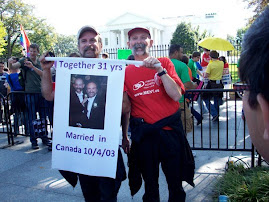
Obama Moving Toward Endorsement of Marriage Equality? :: EDGE Los Angeles:
President Obama indicated to a group of bloggers that his attitude toward marriage equality may be evolving toward an acceptance of full-fledged legal equality for gay and lesbian families.
Anti-gay politicians have, over the course of the last two years, defended their views by saying that their stance on marriage equality is "the same as that of the president." As a candidate, Obama spoke of wanting to see the repeal of the so-called "Defense of Marriage" Act, the anti-gay federal law from 1996 that excludes same-sex families from any sort of federal recognition. At the same time, Obama said that his personal view of marriage is that it should be reserved as a special right for heterosexual couples.
In an interview with a group of gay bloggers, Obama was asked about marriage equality by Joe Sudbay of America Blog. Obama reiterated that he is "a strong supporter of civil unions," and added, "I have been to this point unwilling to sign on to same-sex marriage primarily because of my understandings of the traditional definitions of marriage.
But I also think you’re right that attitudes evolve, including mine," Obama added. "And I think that it is an issue that I wrestle with and think about because I have a whole host of friends who are in gay partnerships. I have staff members who are in committed, monogamous relationships, who are raising children, who are wonderful parents."
The president went on to say that he was "not prepared to reverse myself here, sitting in the Roosevelt Room at 3:30 in the afternoon," but that the issue remains "something that I think a lot about."
Obama also talked about having a strategy to be sure that another anti-gay law, "Don’t Ask, Don’t Tell," is repealed, and opined strongly that, while he understands the frustrations of the GLBT community, he does not agree that his administration has failed to do its best for gay Americans.
"I guess my attitude is that we have been as vocal, as supportive of the LGBT community as any President in history," Obama told Sudbay. "I’ve appointed more openly gay people to more positions in this government than any President in history. We have moved forward on a whole range of issues that were directly under my control, including, for example, hospital visitation." Added the president, "And so, I’ll be honest with you, I don’t think that the disillusionment is justified."
While some might see Obama’s remarks as evidence that he might one day shift in his view on marriage equality, others are unwilling to subscribe to that notion--if for no other reason than that skepticism remains as to the sincerity of the president’s lack of support for marriage rights for same-sex families. An Oct. 28 New York Magazine article by Dan Amira openly dismissed as "disingenuous" the distinction Obama makes when he says he upholds civil unions but not marriage equality.
Titled, "President Obama Getting Closer to Ending His Pretend Opposition to Gay Marriage," the article noted that Obama had opposed Proposition 8, the 2008 ballot initiative that rescinded marriage rights for gay and lesbian families in California. The article also tallied the president’s record of support for GLBT equality, and recalled that in 1996 Obama answered a questionnaire that asked about marriage equality by saying that he would be in favor of it.
"When you add it all up, the only conclusion that really makes sense is that, in his heart, Obama is fine with gay marriage, but didn’t think the nation was ready for a president who felt that way," Amira wrote. The article then went on to say, "Approval of gay marriage surged, it was legalized in a number of states, and Obama’s support for civil unions, which would have been considered relatively enlightened five or ten years ago, began to seem downright antiquated to many people."
Amira speculated that the comment might herald an open declaration of support for marriage equality in 2012. Given the social shift, a pro-marriage stance from Obama would "be inherently mainstream."
An Oct. 27 Politico article by Josh Gerstein echoed those speculations, citing Richard Socarides, who said, "Presidents don’t usually think out loud unless they intend to send a signal that they are shifting a position." Socarides, who had served as an advisor to Bill Clinton, went on to add, "I think [Obama] realizes he can’t run as a gay rights advocate in 2012 and be against marriage equality. People see domestic partnerships are separate but equal."
Kilian Melloy reviews media, conducts interviews, and writes commentary for EDGEBos
Thursday, October 28, 2010
Obama Moving Toward Endorsement of Marriage Equality? :: EDGE Los Angeles


Friday, October 8, 2010
Leonard Link: Another Loss for Alliance Defense Fund in its campaign to rid America of legal recognition for same-sex partners
Leonard Link: Another Loss for Alliance Defense Fund in its campaign to rid America of legal recognition for same-sex partners:
Another Loss for Alliance Defense Fund in its campaign to rid America of legal recognition for same-sex partners
The Alliance Defense Fund (ADF), an organization dedicated to opposing gay rights in the courts, has struck out in the Court of Appeals of Ohio (8th Appellate District) in its challenge to the city of Cleveland's domestic partnership registry ordinance. The court ruled unanimously on September 30 that Ohio's anti-gay marriage amendment did not deprive the Cleveland city government of the ability to establish a domestic partnership registry. The city's legal staff successfully defended the local law, with amicus assistance from the ACLU of Ohio and Lambda Legal's Midwest Office in Chicago and cooperating attorneys from Cleveland.
The city enacted its ordinance on December 8, 2008. Couples can file their declarations of domestic partnership with the city if they meet specific criteria, thus generating a document that attests to their status as domestic partners recognized by the city of Cleveland. The ordinance does not provide any specific benefits to registered partners apart from the municipal recognition of their relationship.
But ADF promptly acted to stir up litigation, claiming that the ordinance violates Section 11, Article XV, of the Ohio Constitution, the marriage amendment whose passage was secured by opponents of same-sex marriage. That provision states: "Only a union between one man and one woman may be a marriage valid in or recognized by this state and its political subdivisions. This state and its political subdivisions shall not create or recognize a legal status for relationships of unmarried individuals that intends to approximate the design, qualities, significance or effect of marriage." The plaintiffs' argument, as summarized by the court of appeals, was that if domestic partnerships recognized by Cleveland "approximate just some of the enumerated aspects of marriage, then the domestic partners ordinance is unconstitutional." The trial court rejected this argument, and denied injunctive relief against operation of the registry. The court of appeals agreed with the trial court.
Writing for the unanimous three-judge panel, Judge Colleen Conway Cooney looked to a prior ruling by the Ohio Supreme Court rejecting the argument that because of this amendment, the state could not address domestic violence within same-sex couples under its criminal law. According to the Supreme Court, being married is "a status" that "gives a person certain legal rights, duties, and liabilities." In light of this, the court concluded that "the second sentence of the amendment means that the state cannot create or recognize a legal status for unmarried persons that bears all the attributes of marriage - a marriage substitute." In other words, the amendment would likely prohibit Ohio from establishing civil unions or domestic partnerships that carry all or virtually all of the state-law rights associated with marriage, but it does not stand in the way of the state, or its political subdivisions, extending lesser degrees of recognition to same-sex relationships in regard to particular policy issues.
Or, as Judge Cooney interprets the prior decision, "the Ohio Supreme Court explained that any legally established relationship bearing less than all the attributes of marriage is constitutional."
The Cleveland ordinance falls far short of even that. Although its qualifying criteria require domestic partners to reside together, to maintain a "committed relationship," and to "share responsibility for each other's common welfare," there is no enforcement mechanism. A domestic partner would not be able to bring his or her partner to court on a claim that they were failing to meet the obligations to which they swore when filing the partnership declaration. "Domestic partners who separate cannot take advantage of the domestic relations laws that govern divorce, alimony, child support, child custody, and equitable distribution," Cooney observed. In addition to not receiving many of the affirmative benefits accorded to married couples by the city and state, the court pointed out, as Lambda argued in its amicus brief, "the term 'domestic partner' completely lacks the social and emotive resonance of 'husband' and 'wife'" and "domestic partnerships are not given the same respect by society as a married couple, and they share none of marriage's history and traditions.'
In light of the Ohio Supreme Court's limiting construction of the constitutional language -- which could have been construed to have broader effect -- the court of appeals' ruling in the case was a foregone conclusion, and one wonders why ADF bothered bringing the case, other than to raise the flag, raise some money, and try to make some propaganda against equal rights for gay people.
ADF had also raised what seems a make-weight argument, that Cleveland exceeded its home rule power by enacting the amendment. This argument ran aground on the inconvenient fact (inconvenient for ADF, at least), that this same court had previously rejected a home rule argument that was raised to challenge a domestic partnership ordinance enacted by Cleveland Heights several years before the marriage amendment was passed. The court pointed out that the Cleveland registry, like the Cleveland Heights registry, did no more than give recognition to the relationship, providing no affirmative rights and being completely paid for by the applicants' fees so the municipalities bore no expenses from providing the registry. In addition, and most notably, no private entity is required by these ordinances to give any recognition to domestic partnerships, although it has proven that some employers and businesses have decided to adjust their policies to recognize registered domestic partners voluntarily.
Judge Christine T. McMonagle concurred in Judge Cooney's opinion. Judge Sean C. Gallagher also voted to affirm the trial judge, but without specifically concurring in the text of Cooney's opinion. He provided no explanation for his limited concurrence.
If it acts true to form, ADF will seek to appeal this to the Supreme Court of Ohio.
Thursday, October 7, 2010
Debunking the Five Myths Held By Those Who Oppose Same-Sex Marriage | Gay Rights | Change.org
Debunking the Five Myths Held By Those Who Oppose Same-Sex Marriage | Gay Rights | Change.org:
The original title for this post was "The Case Against Gay Marriage," a play on a post I wrote yesterday covering the New Yorker event where Cynthia Nixon schooled the National Organization for Marriage on the subject of marriage equality.
Folks like the National Organization for Marriage, and many others who oppose marriage equality, often harness rhetoric like "protecting the family" as a validation for furthering unequal rights. What I mean to raise in this post -- or rather, to debunk -- is the preposterous notion that marriage is pre-political or that it is somehow sacred. I even mean to bring into question whether marriage is even something to be desired, whether you're gay or straight or otherwise, religious or not.
One caveat -- of course I believe in equal rights for all; my gay brothers and sisters (myself included) should have access to exactly the same rights and privileges under federal, local and religious law that everyone else does. Assuming ceteris paribus, that all other things are equal, let's please take a moment to examine the very core of the issue in order to debunk the myths that come up repeatedly in this debate.
1. Marriage is pre-political. This is frankly poppycock. Marriage is one of the oldest political institutions that exist. The union was a way of keeping a family -- and their land and money -- legally bound and protected. Marriage historically has been about economics; marriage for love didn't even enter into cultural discourse until just a few hundred years ago.
2. Marriage is for procreation. Again, this is null and void in the modern age. Yes, marriages were cemented prior to the golden age of industrialization some 150 years ago and going back because having children meant free farm labor, the main bread earner for a home. In today's society, people have children for all sorts of good and bad reasons, but nine times out of ten, it's not to pull an ox cart in a field. Plus, there's always the known argument that plenty of people get married with no intention of having little rug rats, or else they are infertile and cannot have children.
3. History says marriage is between a man and a woman. This is also silly because gay was okay back in the day. People tend to forget, especially all of those "well informed" evangelicals, that Christians and everyone before them, prior to Paul the Apostle's clamping down on what marriage should and shouldn't be, made more allowances for same-sex love than we even do today. Most anti-gay sentiment comes not from the bible, and certainly not from pre-Judeo-Christian times, when same-sex desire was widely accepted, but from biblical interpretation by a small handful. Yes, a man married a woman in ancient Rome, Greece, the Middle East, The Far East in order to protect the family wealth and land, but when it came to desire and love, it is well-documented that men sought the comforts of other men.
4. Same-sex marriage will weaken the institution of marriage. This claim is often used though there has been no proof, let alone even one believable example, of how this may be a valid argument. I'm pretty sure it's the insanely high divorce rate and potential outmoded notions of wedlock that is weakening marriage, not gay people who want to buy into the tradition, that are threatening harm. In fact, in places like Washington D.C. and Massachusetts, same-sex marriage is emerging as the very thing that is saving marriage (not to mention the economy).
5. If you allow gay marriage, other bad things will follow. Lions and tigers and bears, oh my! This is the dumbest argument yet against same-sex marriage, that somehow if you allow gay people to get hitched, somehow polygamy, bestiality, and other apocalyptic events will occur. Folks, the gay people who want to get married are the most conservative that we have to offer as a community. The rest of us leather-donning, gender-bending, sex-crazed freaks couldn't care less about entering into your so-called sacred institution, let alone bringing our Boston Terriers with us.
If folks were to truly understand the history and politics of the institution we call marriage, I wouldn't be surprised if people everywhere, gay and straight, start to deliberately hop off the wedding bandwagon and opt instead to break down, rather than embrace, this passé pastime.
Friday, October 1, 2010
What Makes a Family? More Americans Say Gays Count - Newsweek
What Makes a Family? More Americans Say Gays Count - Newsweek:
The idea that gay couples who are married or have children qualify as “families” has rapidly become the majority view in the U.S., and researchers credit public discussions about gay marriage—by supporters as well as vehement opponents—for the unexpectedly fast pace of change. That’s the surprising conclusion of the Constructing the Family Surveys, which monitor Americans’ opinions about what makes a family. The surveys were launched in 2003 by researchers at Indiana University; the University of California, Irvine; the University of Utah; and the University of South Carolina. A detailed analysis of the results are included in the new book Counted Out: Same-Sex Relations and Americans’ Definitions of Family.
These results are particularly startling because of the widespread assumption that the passage of “defense of marriage” legislation in many states (and the federal Defense of Marriage Act) in recent years represented a growing backlash against gay marriage and gay families. But based on the new data, Brian Powell, a professor of sociology at Indiana University, says he has to conclude that any such backlash was short-lived. “Social change usually occurs at a glacial pace,” he says. “What we’re seeing is a very rapid shift in people’s views of who they consider to be a family.”
When the researchers reviewed the first round of survey results in 2003, they found that about 41 percent of the respondents supported gay marriage, yet 53.6 percent agreed that two men living with a child constituted a “family,” and 55 percent said the same thing about two women living with a child. By 2010, not only did a majority (52 percent) say they were in favor of gay marriage, but the proportion who believed that gays living with kids are families had grown to 68 percent.
Powell says the team concluded that a variety of recent societal shifts were key to this accelerated rate of change, including the fact that homosexuals have become increasingly open with friends, family, and acquaintances about their sexual orientation. In 2003, 58 percent of the survey’s respondents said they didn’t have any family or friends who were gay. By 2010, that proportion had fallen by almost a third: only 40 percent said they didn’t have any gay friends or relatives. Only 18 percent said they didn’t know anyone who was gay.
While you might presume that those with a gay family member were the most open to gay marriage, Powell says that people with gay friends are more likely to be swayed. “Maybe that’s because you choose your friends but only a few of your relatives,” he says. Overall, in 2003 the researchers found that 20- to 29-year-olds were the most supportive of gay marriage; by 2010, that group had expanded upward to age 38. “That’s a big jump in a short time,” Powell says.
Researchers who did follow-up interviews with some respondents also noticed significant changes in the way people spoke about gay issues over the last seven years. When they talked to their first group in 2003, Powell says, “a lot of people would lower their voices before saying the word ‘gay.’ They didn’t want to say it out loud.” But starting the next year, as defense-of-marriage laws became a major political issue and there was much more public discourse about gay issues, people seemed to become more comfortable discussing the topic. Respondents began to mention, for example, “the impact of seeing Lynne Cheney talking about her daughter on TV,” Powell says, and “people became much more likely just to say the word. The sheer fact of talking about it seems to make a difference. It brings it out of the shadows.”
Celebrities who are open about their sexual orientation have also had an impact. “When Ellen DeGeneres had her own show on TV in 1997 and came out, there was an uproar,” Powell says. “But since then we’ve certainly seen a large increase in the number of same-sex couples on TV. Look at the show Modern Family. If you had told people there would be a same-sex couple with a child on a mainstream TV show and that it would win an Emmy, no one would have believed that 10 years ago.”
Over the last seven years, Powell says, the researchers were also able to document a “profound shift” in what the public considers to be the determinant of an individual’s sexual orientation. “By 2010, the proportion who say homosexuality is the result of either ‘genetics’ or ‘God’s will’ is over 60 percent, and those who say it’s caused by bad parenting has gone way down. That means the number who think [sexual orientation] cannot be changed has gone up.” Interestingly, the 15 to 20 percent who say homosexuality is the result of God’s will also tend to be among the most open to gay rights, he says.
Finally, there’s the effect of what Powell calls “the power of law.” “In 2003, many people said gay couples didn’t qualify as ‘families’ because they couldn’t get married,” he says, and only 26 percent of all respondents disagreed with that idea. “But once gays were allowed to be legally married, even in just a few states, more people (59 percent by 2010) were willing to describe a married gay couple without children as ‘a family.’ ”
The trends Powell and his colleagues are documenting are similar to what sociologists found during the years when interracial marriage was becoming more common and legal, culminating with the U.S. Supreme Court’s Loving v. Virginia decision in 1967, which struck down Virginia’s ban and made such marriages legal throughout the country. “Before the Loving case, Americans were overwhelmingly opposed to interracial marriage,” Powell says. “But after Loving was upheld by the U.S. Supreme Court, views shifted. By 1972, only a third of whites were still opposed. There was a huge drop in resistance as a result of the legal shift.”
What does all this portend for the near future? While those who strongly oppose gay marriage have been a powerful political bloc because they tend to be one-issue voters, Powell says his best guess is that their numbers will continue to shrink. Between 2003 and 2010, he says, the number of people who adamantly opposed gay marriage declined from 45 percent of the survey’s respondents to 35 percent. “I suspect that this is changing more rapidly than most politicians realize,” he says. That should be a lesson to politicians: don’t assume you know what the voters think. They could be way ahead of you.
Wednesday, September 29, 2010
A look at key gay-marriage laws in America - Yahoo! News
A look at key gay-marriage laws in America - Yahoo! News:
It's been 17 years since Hawaii's Supreme Court first ruled that summarily restricting marriage to opposite-sex couples violated the equal protection clause of that state's constitution. Yet, to this day, only five states and the District of Columbia permit gay couples to marry. It took another 11 years after the Hawaii decision before any state allowed same-sex couples to tie the knot.
The Hawaii court's revolutionary decision prompted gay-marriage opponents to obtain a legislative amendment to the state constitution to eliminate the constitutional basis for the court's conclusion. Thus, the Hawaii court's ruling did not actually lead to same-sex marriages. While several states and localities fashioned domestic partnerships and civil unions in the interim, it wasn't until 2004 that any of the U.S. states began marrying gay couples. The first state to do so was Massachusetts, ironically a commonwealth long-identified with socially conservative blue laws that are holdovers from colonial days.
In that same year, Gavin Newsom, mayor of San Francisco, briefly opened the door to same-sex marriages, issuing licenses to 4,000 gay couples despite language in the California Code specifying that marriage involves a man and a woman. Litigation ensued, and the state Supreme Court voided the marriages. Twice thereafter, the legislature voted to authorize same-sex marriage, but the governor vetoed both bills.
In 2008, the California Supreme Court overturned the gay-marriage prohibition, but voters by referendum amended the state constitution to ban gay marriage once again.
In 2010, federal judge Vaughn Walker ruled that Proposition 8, the voter-approved measure that barred gay marriage in California, violated constitutional due process and equal protection clauses. Prop. 8 supporters are appealing.
The states that currently permit same-sex couples to marry are Massachusetts, Vermont, New Hampshire, Connecticut, Iowa and the District of Columbia.
Massachusetts also took the lead in allowing out-of-state same-sex couples to marry there when in 2009 it repealed a 1913 residency requirement for marriage. That same year, Vermont's legislature overrode a gubernatorial veto of a bill authorizing gay marriage. Connecticut likewise followed the legislative route to authorizing same-sex couples to marry. It passed a law in 2008, phasing out civil unions, which had been allowed since 2005. By year's end, all civil unions in Connecticut will have been converted to marriages.
New Hampshire followed a similar path to its New England neighbors, passing a law specifically authorizing same-sex marriage effective January 2010.
In Iowa, however, same-sex couples acquired the right to marry through litigation. The Iowa legislature passed a Defense of Marriage statute, a common type of law defining marriage as the union of one man and one woman, that was challenged in court. The Iowa Supreme Court struck the law as unconstitutional last year, thus affirming the legality of gay marriage.
The District of Columbia legalized gay marriage in December 2009, effective March 2010.
States that do not recognize same-sex marriage but authorize domestic partnerships include California, Oregon, New Jersey Nevada, Washington, Hawaii, Maine and Wisconsin. New Jersey's domestic partnership law provides the same benefits as marriage to couples availing themselves of it, whereas the other states with domestic partnership laws provide similar but not as extensive benefits as those afforded to married couples.
Three states without gay marriage laws of their own explicitly recognize same-sex marriages performed elsewhere. These states are Rhode Island, New York and Maryland.
Wednesday, September 22, 2010
Gay Marriage Coming to The Netherlands Antilles | Gay Rights | Change.org
Gay Marriage Coming to The Netherlands Antilles | Gay Rights | Change.org
Ten years ago, The Netherlands was the first country to legalize same-sex marriage. Now three former Dutch colonies are assuming the same laws that give same-sex couples equal marriage and adoption rights. This news is pretty distinctive, considering that these islands are located in the Caribbean — usually considered one of the more homophobic regions of the world, where gays and lesbians are routinely victims of prejudice, violence and unjust laws.
The Netherlands Antilles consist of five islands in the Caribbean Sea. On October 10th, the two largest islands, Curacao and Sint Maarten, are set to become independent states within the Kingdom of the Netherlands. The other three islands are adopting Dutch law as they become special municipalities of the Netherlands. Thus, gay marriage and adoption will become legal on the islands of Bonaire, Saba and Sint Eustatitus.
The Lower House of the Dutch Parliament approved a bill last week that will legalize gay marriage and adoption in these three states by 2012. Though they are under Dutch rule (or will be, at least), these exotic locales are actually very socially conservative islands. The three of them combined have a population of only 20,000.
Many residents hold strong religious beliefs that contradict Dutch laws on issues like abortion, euthanasia and, yes, same-sex marriage. It will be interesting to see if these new laws can change these views and the attitude toward gays in the Caribbean in general. At the very least, there will soon be three new destination wedding alternatives for the gay and lesbian marrying-kind.
Photo credit: Wikimedia Commons
Wednesday, September 15, 2010
Acceptance Seen of Gay Couples With Children - NYTimes.com
Acceptance Seen of Gay Couples With Children - NYTimes.com: "- Sent using Google Toolbar"
By SAM ROBERTS
Published: September 15, 2010
A majority of Americans now say their definition of family includes same-sex couples with children, as well as married gay and lesbian couples.
At the same time, most Americans do not consider unmarried cohabiting couples, either heterosexual or same-sex, to be a family — unless they have children.
The findings — part of a survey conducted this year as well as in 2003 and 2006 by Brian Powell, a sociology professor at Indiana University, Bloomington — are reported in a new book, “Counted Out: Same-Sex Relations and Americans’ Definitions of Family,” to be published on Wednesday by the Russell Sage Foundation. Since the surveys began, the proportion of people who reported having a gay friend or relative rose 10 percentage points, said Professor Powell, the book’s lead author.
“This is not because more people are gay now than in 2003,” he said. “This indicates a more open social environment in which individuals now feel more comfortable discussing and acknowledging sexuality. Ironically with all the antigay initiatives, all of a sudden people were saying the word ‘gay’ out loud. Just the discussion about it made people more comfortable.”
The book concludes that framing the equality of same-sex couples in terms of “the best interests of the child” might prove to be a more successful political argument than others.
“Neither the numbers from our data nor actual votes on initiatives are anywhere near the sufficient magnitude to support the idea that the public is ready to embrace same sex-couples with open arms,” the authors say. But, likening the resistance to laws and mores against interracial marriage, “we envisage a day in the near future when same-sex families also will gain acceptance by a large plurality of the public.”
The latest telephone survey of 830 people conducted this year found that Americans were almost equally divided on same-sex marriage. “I don’t think people are ready to embrace it, but people are ready to accept it,” Professor Powell said of same-sex marriage.
The survey also found a growing acceptance that genetics, rather than parenting, peers or God’s will, was responsible for sexual orientation.
Since 2003, the survey found a decline of 11 percentage points in the number of people who generally define family as a husband and wife with or without children.
Prof. Stephanie Coontz of Evergreen State College in Washington, director of research and public education at the Council on Contemporary Families, a research and advocacy group, said that “Americans seem to be open to seeing same-sex couples with children as families, even while they hesitate to recognize their unions as marriage.”
David Blankenhorn, president of the Institute for American Values, a marriage research and advocacy group, said he was not surprised by the findings. “I like the standard definition of family: two or more persons related by blood, marriage or adoption,” Mr. Blankenhorn said. “Keeps it simple and coherent.”
But, he added: “We live in groups, and we need each other. So it’s always a good thing, isn’t it, when any of us truly loves and is loved by another.”