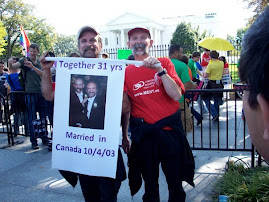
Robert and I had the pleasure of participating as speakers at the Marriage Equality Rally in NYC Sunday. The team from Broadway Impact did a fabulous job getting this together in 10 days time!! It was so well organized and filled with great entertainers and speakers.
The rally started off with the cast of "Hair" singing the signature song 'Aquarius". One of the performers Gavin Greel was one of the Broadway Impact organizers. That was followed by speeches from Sen.Tom Duane, Gov. Paterson, Danny O'Donnell and Mayor Bloomberg whom I have a bone to pick. His speech never gave any indication that at one time he opposed same-sex marriage and in fact appealed a ruling back in 2005 allowing marriage licenses to be issued. Who knows we could have had marriage by now in NY if it wasn't for that set back. But not to worry he is on board now. Better late then never.
Cynthia Nixon gave one of the most powerful speeches the "Sex in the City" star started off by saying, "I have a secret to tell you," she told the cheering crowd. "Last month, my girlfriend Christine and I got engaged. And I have a beautiful ring to prove it."
Nixon went on to call for the right for same-sex couples to get married in New York State, and talked about how Christine is a stay-at-home mom to their children, but has no legal right to them if Nixon dies (the children's father and Nixon's former husband, Danny Mozes, is also very involved in parenting them).
Nixon directed her remarks to the majority of people who oppose gay marriage not for religious reasons, but just because they "haven't caught up with us yet." She went on to say. "Now the main argument I hear against legalizing same-sex marriage is that in some way this will forever alter and mar traditional marriage, and what I want to know is: How? How will my girlfriend and I getting married have any affect on you and your wife, or you and your husband sitting at home? I also hear that the right to legal same-sex marriage is seen as an attack on traditional marriage, and I want to say that you are not the ones being attacked, we are.
And please believe I'm not being flippant when I say this: The right to marry is about us, it is not about you, any more than the fight for integration was about white people, or a women's right to vote was about men. It is only about you to the extent that you have to live with yourself knowing that you are depriving a significant portion of the population their basic civil rights."
Alan Van Cappelle of the Empire State Pride Agenda gave one of his as always magnificent motivational speeches.
Other celebrities in attendance were Cheyenne Jackson,Audra McDonald and David Hyde Pierce. David married his longtime partner of 26 years last year in California when it was legal.
There were also some heartwarming speeches from LGBT families impacted by not having all of the rights, privileges and responsibilities of marriage that rounded out the evening.
Kudos to the organizers Rory O'Malley, Jenny Kanelos,Anthony Hayes, Tom Viola and Heath Tucker
Sunday, May 17, 2009
The NY Marriage Equality Rally- Broadway Impact


Thursday, May 14, 2009
Q poll split on marriage
The Daily Politics - NY Daily News
Q Poll: Racial Divide Over Gay Marriage
May 14, 2009
Today's Q poll finds voters are evenly split - 46-46 - on whether same-sex marriage should be legalized in New York, with African Americans more opposed than whites.
Public opinion has clearly moved on this topic.
An April 2007 Q poll showed voters overwhelmingly opposed to gay marriage (55-37). The numbers for civil unions are considerably stronger, (65-27), but that's not an option under consideration in Albany at the moment.
Today, black voters oppose marriage for same-sex couples 35-57, while whites narrowly favor it 47-45. Hispanics are split, 45-48. (The margin of error for the poll of 2,828 registered voters is +/- 1.8 percent).
New Yorkers who attend religious services at least once a week are very much anti (66-26), and women are more open to the idea (49-42 in favor) than men (51-42 opposed).
Interestingly, the majority of voters aren't buying the argument that letting same-sex couples marry somehow poses a threat to traditional heterosexual marriage (63-32 disagree with that line of reasoning). That holds true among all demographics with the exception of Republicans, who are split 48-48.
Fifty-five percent of New Yorkers agree with Gov. David Paterson's claim that ending discrimination against gay men and women is as important as as the civil rights movement of the 1960s. Again, this holds true with everyone except Republicans (50-44 disagree).
However, the question of whether not allowing same-sex couples to marry is discrimination is a little trickier. Overall, voters say it is (49-46), but they are again split along racial lines on this one (49-47 in the affirmative for whites; 48-44 in the negative for blacks).
Good news for marriage advocates: The younger New Yorkers are, the more likely they are to think same-sex marriage should be legalized (the 34 and younger demographic is in favor, 61-33; while those 55 and older are opposed, 37-55).
"The age breakdown suggests that, if same-sex marriage proponents will wait, eventually they'll win," said Q pollster Mickey Carroll.
Advocates have made it clear, however, that they're not inclined to wait.
This Q poll was conducted May 5-11, with calls ending one day before the Assembly passed the governor's gay marriage program bill for the second time since 2007, this time widening the margin to 89-52.
Tags:
Albany , Assembly , David Paterson , Polls , Same-Sex Marriage , Senate
By Elizabeth Benjamin on May 14, 2009 7:16 AM |
Wednesday, May 13, 2009
What Motivated the Same-Sex-Marriage Switchers -- Daily Intel -- New York News Blog -- New York Magazine
What Motivated the Same-Sex-Marriage Switchers -- Daily Intel -- New York News Blog -- New York Magazine
What Motivated the Same-Sex-Marriage Switchers
5/13/09 at 1:36 PM
Last night a bill legalizing same-sex marriage passed the State Assembly with four more votes than it received just two years ago. Some seats had switched party hands, and some members were absent for one vote or the other, but the most interesting difference in the votes were the five legislators who had voted no in 2007 but voted yes this time around. What was behind their changes of heart on the issue?
An aide to Sandy Galef, a Democrat from Westchester, told us that the assemblywoman "always supported civil unions, not gay marriage, in the past, and then she saw [the December 2008 New Jersey Civil Union Review Commission] report that showed the problems with civil unions. So her goal was always — she always wanted to be fair, but she thought civil unions were the best way of accomplishing that for her. But then when she saw the flaws that New Jersey was having with civil unions, that’s what made her turn to vote yes yesterday."
For Tim Gordon, a member of the Independence Party from the capital region, the turnaround was based on a mix of political caution and a concern about civil unions. "When I was running for office in 2006, same-sex marriage wasn't one of my three main platform points, but during the campaign people would ask my opinion on it, and at that time my objective was not to charge into the assembly to redefine a 10,000-year-old institution," he told us. "So at that time I was voting consistent with what I told people during the campaign. But also, at that time, civil unions seemed to have more potential, and we’ve seen just in the last two years that civil unions have really been flawed and haven’t done what they were intended to do." He also decided that same-sex marriage was inevitable, and he might as well get onboard now. "It was clear that this measure, whether it passes this year or next, we’re clearly going to have same-sex marriage within the next — ten years from now, it’ll be hard to imagine we won’t have it."
Fred Thiele, a Republican representing Suffolk County, said in a press release last week, "I didn’t support the bill in 2007 because I thought equal rights could be guaranteed through civil unions. Since then, more states have experimented with civil unions as separate but equal, only to find that discrimination persisted in health care and other areas. The only way to ensure equality is by giving all couples access to the same civil right — the right to marry.” Thiele added that he had previously let his "judgment on this issue be clouded by the political implications of this vote," but that as he "reflected on this issue, there simply was no justification for a 'no' vote. I could not look into the eyes of friends and colleagues I have known for decades and tell them they were not entitled to the same pursuit of happiness as me because of their sexual orientation."
Bob Reilly, a Democrat representing Albany and Saratoga, told us that he's achieved a "greater awareness of the personal pain endured by gay men and women." "When I grew up, I, quite frankly, didn't even know that gay people existed," he admitted. "I wasn't aware of that. And early in my life, the concept of gay people marrying was just not even thought of by anybody. So there's a growth and a change of mindset that happens with individuals and with society as a whole." Recently, Reilly was moved after "hearing different members of the Assembly speak of their personal pain brought on by different forms of discrimination," especially Matt Titone, Daniel O'Donnell, and Deborah Glick. He added that he "has a sense" that his "constituents and the people of New York State as a whole are more accepting of gay marriage than they were two years ago."
Janet Duprey, a Republican from the Northeast corner of the state, has said that she was moved by conversations she had with parents of homosexual children. "To a person, these parents expressed their desire to see their gay and/or lesbian children share the same benefits, protection, and love with their partners as their heterosexual siblings do with their spouses." She added that civil unions could not provide the same rights as marriage, and that the "United States was founded on the principle of equal protection and rights for all, and I will cast my vote for the constitutional rights of same-sex couples."
Assembly Passes Gay Marriage Bill in New York; Senate Fight Awaits - NYTimes.com
Assembly Passes Gay Marriage Bill in New York; Senate Fight Awaits - NYTimes.com
By JEREMY W. PETERS
Published: May 12, 2009
ALBANY — The State Assembly approved legislation on Tuesday night that would make New York the sixth state to allow same-sex marriage — a pivotal vote that shifts the debate to the State Senate, where gay rights advocates and conservative groups alike are redoubling their efforts.
In a sign of how opinion in Albany has shifted on the issue, several members of the Assembly who voted against the measure in 2007 voted in favor of it on Tuesday.
The final vote was 89 to 52, including the backing of five Republicans.
Supporters of the bill aggressively sought new votes, particularly from Assembly members whose districts lie within Senate districts where a senator’s vote is believed to be in play. As a matter of strategy, same-sex marriage advocates said that they hoped to use those votes as a way to leverage support from senators who are worried that supporting the measure could cost them politically.
“The margin of victory and the balance of where the people come from who voted for this is broadening,” said Daniel J. O’Donnell, a Democratic assemblyman from the Upper West Side who led the effort in the Assembly to gain support for the bill. “The state is demanding that we provide equality, and that’s the message here.”
As the Assembly prepared to vote on Tuesday, advocates on both sides of the issue were gearing up for campaigns to sway undecided senators.
Gay rights groups, led by the Empire State Pride Agenda, will begin the first phase of a statewide advertising campaign on Wednesday. The first advertisement is a 30-second television spot featuring a woman from Cicero, N.Y., just outside Syracuse. She explains that she would like her two daughters — one who is a lesbian, one who is straight — to be treated equally under the law. It will be broadcast in the Albany, Syracuse and Buffalo areas.
The campaign’s organizers are planning more commercials in other cities across the state in the coming weeks, with an emphasis on areas where senators are believed to be on the fence.
“This is about putting a face on the people who are affected by this,” said Alan Van Capelle, executive director of the pride agenda. “Marriage equality should not be a political issue. It is too important; it affects too many people.”
Conservative religious organizations were mobilizing as well. In the hours leading up to the Assembly vote, lobbyists for New Yorkers for Constitutional Freedoms and the Alliance Defense Fund, an Arizona-based group that has sued the state for recognizing same-sex marriages performed elsewhere, were holding meetings with lawmakers.
“Certainly we want to keep the pressure on,” said the Rev. Jason J. McGuire, legislative director of New Yorkers for Constitutional Freedoms. Mr. McGuire’s organization is planning a rally in Albany for its supporters in June, and he added that he would continue meeting with senators in the hope of persuading them to vote against same-sex marriage.
“We all understand — both sides of the issue — that this fight is going to continue in the State Senate,” he said.
The Conservative Party is also applying pressure: it has threatened to strip its party affiliation and its ballot line from any politician who votes for same-sex marriage.
“We can’t look the other way,” said Michael R. Long, the party’s chairman, who added that he had informed the Republican leaders of the Senate and the Assembly of his threat to take away the Conservative ballot line — which in some elections can mean the difference of thousands of votes — from anyone who votes yes on the bill.
“We’re going to work as hard as we can in the next few weeks,” he said. “We intend to do everything we can possible with phone calls, memos, press releases, having our members call senators.”
Despite the conservative pressure, two Republicans spoke on Tuesday about why they dropped their opposition to granting same-sex couples the right to marry. Three Democrats who voted no in 2007 switched their votes to yes.
“There’s that little voice inside of you that tells you when you’ve done something right, and when you’ve done something wrong,” said Fred W. Thiele Jr., a Republican who represents the Hamptons. “That vote just never felt right to me. That little voice kept gnawing away at me.”
Mr. Thiele’s district overlaps with the Senate district of Kenneth P. LaValle, whom gay rights advocates consider to be among the half-dozen or so Republicans open to a yes vote.
Assemblywoman Janet L. Duprey said a lesbian couple who live on her street helped change her mind.
“They are asking only for equal protection under the law,” said Ms. Duprey, a Republican whose district along the Canadian border in the North Country overlaps with the Senate district of Elizabeth Little, another Republican who gay rights supporters believe is within reach.
“They deserve no less than to have the same rights and ability to share their love,” Ms. Duprey added.
Bob Reilly, a Democratic assemblyman whose district includes parts of Saratoga and Albany Counties, apologized to colleagues for voting no in 2007 before voting yes on Tuesday.
Opponents of the bill condemned same-sex marriage as a moral outrage and an affront to religious institutions in New York. Some, like James N. Tedisco, a Republican whose district includes Schenectady and Saratoga Springs, drew comparisons to polygamy.
“I think you can see the kind of slippery slope we’re going down here,” he said. “What I see here is individuals trying to change the definition of a longstanding institution called marriage to fit into their agenda.”
Some supporters insisted the bill was, in fact, nothing earth-shattering.
“We do nothing revolutionary or extraordinary today,” said Richard L. Brodsky, a Democrat from Westchester County.
The electronic display in the Assembly chamber that listed the bill number and a brief description suggested as much. It said, “Relates to individuals ability to marry.”
Viewing The NY State Assembly Proceedings Last Night
Robert and I were invited last night by Assemblyman Mike Spano to attend the NY State Assembly debate the NY Marriage Bill. We did not know we would be acknowledged as guests in the gallery that was kind of special. Well the debate went on for about three and half hours. Danny O'Donnell did a great job defending his bill using quotes from Mrs. Loving and Martin Luther King. There were many personal stories told and Assemblywomen Duprey gave her story of how she transitioned from voting no last time to yes this time. Educating herself on the issue and speaking to constituents that were impacted by not having the rights and protections of marriage.
Some of the opponents were clearly not educated on the issue. There were the usual religious based arguments that we are all used to hearing. There were very clear counter arguments that this is not a religious issue it is civil marriage and that our Constitutions both state and federal clearly state the separation of state. They used the the usually NOM arguments that our side was pretty much able to dispel. There were a few things that stuck out in my mind. A good number of our African American assembly members clearly resented that this was being framed as a civil rights issue. It just baffles me that these people faced with discrimination most of their lives could not identify with the discrimination we in the gay community face. There needs to be a lot of education to the Black communities they do not accept this as a civil rights issue.
The most outrageous argument was from Assemblyman Tedisco he wanted to know why we weren't protecting bisexuals and weren't we being discriminatory in our own bill. Mr. Tedisco's understanding of the bisexuality is that bisexuals date or have relationships with a man and a women at the same time. There is no excuse of an elected official not having a basic understanding of the subject matter they are voting on. Fortunately the only NY Bisexual assembly person spoke and did his best to clarify what a bisexual is UGH! This is what we are dealing with folks. Theresa Saywood gave a very personal speech again which was very moving.
We were also acknowledged by our friend Assemblyman Mike Benedetto a long time friend from the Bronx as he cast his vote.
Wednesday, September 24, 2008
Why Calif. marriage matters here - Southern Voice Atlanta
Why Calif. marriage matters here - Southern Voice Atlanta
Marriage vote called gay 'Gettysburg'
By LOU CHIBBARO JR.
Sep. 19, 2008
Evan Wolfson, one of the nation’s leading advocates for equal marriage rights for gays, compares the decision by California voters in November over whether same-sex marriage should remain legal in that state to the Battle of Gettysburg.
“I often use the historical lesson of the Civil War,” said Wolfson, the executive director of Freedom to Marry.
“The Civil War didn’t end with the Battle of Gettysburg,” he said. “It took another year and a half of bloody fighting and great uncertainty. But when we look in retrospect, with the eyes of history, we can see that Gettysburg was the turning point of the Civil War. California is Gettysburg.”
Officials with other advocacy organizations that support or oppose same-sex marriage don’t use comparisons as dramatic as the Civil War, but nearly all have said they couldn’t overemphasize the profound implications the California marriage vote is likely to have on advancing or curtailing same-sex marriage, as well as gay rights in general, throughout the nation.
Proposition 8, the center of all the attention, is an initiative on the California election ballot Nov. 4 that asks voters whether or not to amend the state constitution so that “only marriage between a man and a woman is valid or recognized in California.”
If approved, the amendment would overturn a decision earlier this year by the California Supreme Court that held that same-sex couples have a legal right to marry under the state’s constitution.
The court ruling opened the way for thousands of same-sex couples who reside in the state to marry over the past several months in California. Since state law allows non-residents to marry, an unknown number of same-sex couples from other states also have tied the marital knot in California.
Nan Hunter, a Georgetown University law professor and nationally recognized gay rights attorney, said a defeat of Proposition 8 would mean voters in the nation’s most populous state are endorsing the right of lesbians and gay men to marry.
“Culturally and politically, the impact is enormous,” she said. “California has a tradition of being the trend setter in the United States. Of any single development on this issue, legalizing it in California is the biggest single development short of a federal ruling that would render [same-sex marriage] legal nationwide.”
Other States to Follow?
Wolfson said a victory for gays on Proposition 8 in California also would have the immediate effect of boosting efforts to pass same-sex marriage bills in state legislatures in New York, New Jersey, Connecticut, Vermont, and possibly Iowa.
“Assuming we hold California and seize the opportunities that shimmer within reach elsewhere, by this time next year, 25 percent of the American people will live in a state where gay people can marry,” he said.
Other gay rights advocates weren’t as bold as Wolfson in predicting that five or six more states might soon legalize same-sex marriage.
But they joined Wolfson in predicting that a victory for gays in the California marriage fight would have dramatic and beneficial effects on efforts to pass non-discrimination legislation for gays and transgender people at the state and federal level.
Joe Solmonese, president of the Human Rights Campaign, said a victory in California would improve chances of passing non-marriage related gay rights legislation in the U.S. Congress as well as in state legislatures.
Solmonese noted that gay rights opponents haven’t been able to make same-sex marriage a “wedge issue” in the 2008 presidential and congressional elections. That development, he said, indicates public support for equal rights for gay people has discouraged efforts to demonize gays in election campaigns.
'Armageddon for the Right'
Officials with two of the nation’s largest conservative groups opposing same-sex marriage — the Family Research Council and Focus on the Family — did not respond to requests by the Blade for comment on the California marriage debate.
Literature published by the two groups on their web sites call same-sex marriage a threat to the family and a trend that would likely weaken the institution of marriage.
“Homosexual marriage is an empty pretense that lacks the fundamental sexual complementariness of male and female,” writes Timothy Dailey, a senior fellow at the Family Research Council, in an essay on the group’s web site. “And like all counterfeits, it cheapens and degrades the real thing.”
Citing what he describes as studies of worldwide cultures spanning thousands of years, Dailey writes that “virtually no society has ceased to regulate sexuality within marriage as traditionally defined and survived.”
Gay rights groups have disputed such assertions, pointing to what they say are scientifically sound studies showing that children raised by same-sex parents show no developmental differences from children raised by opposite-sex parents in heterosexual marriages.
Patrick Sammon, president of Log Cabin Republicans, a national gay group and one of the leaders of a coalition of Republicans opposed to Proposition 8, said views such as those promoted by Family Research Council have been discredited in most Republican circles.
“Their claim that same-sex marriage will hurt the family is absurd,” said Sammon, who described the studies cited by Family Research Council as “junk science.”
David Boaz, executive vice president of the Cato Institute, a Washington, D.C. based libertarian think tank, said deeply held views opposing same-sex marriage by groups such as the Family Research Council and other conservative religious groups are being played out in the debate over the California marriage initiative.
Boaz agrees that a victory for same-sex marriage in California would result in a dramatic boost in gay rights efforts throughout the country. But he said a loss, while representing a major setback, would not be as devastating for the gay rights movement as would a defeat for the conservative religious groups who oppose same-sex marriage.
“If they can’t win in California, I am sure that in their rallies they are saying we stand at Armageddon and we battle for the Lord,” Boaz said. “And if they lose at Armageddon, that’s a very big deal for them.”
Lawmakers See Progress Toward Gay Marriage Equality - September 15, 2008 - The New York Sun
Lawmakers See Progress Toward Gay Marriage Equality - September 15, 2008 - The New York Sun
By BENJAMIN SARLIN, Special to the Sun | September 15, 2008
City lawmakers are raising their voices in support of gay marriage, joining hundreds of New Yorkers yesterday in a march across the Brooklyn Bridge to boost awareness about the issue.
The marchers wore stickers bearing an equal sign, and the crowd cheered as lawmakers talked up the prospect of legal gay marriage in New York State. Speakers at the event included Comptroller William Thompson Jr., Manhattan's president, Scott Stringer, and the city's first gay City Council speaker, Christine Quinn.
"I don't think we are that far away," Mr. Thompson said at a rally in City Hall Park before the march.
Earlier this year, Governor Paterson ordered that New York recognize same-sex marriages from other states. Organizers of yesterday's event read a statement from the governor, in which he wrote: "The right to marry should be supported and protected equally."
The Assembly has passed a bill that would grant marriage rights to same-sex couples, but it has stalled in the Republican-controlled state Senate.
Speakers yesterday spoke of the efforts under way to unseat the Republican majority in the Senate this year, which they said could prove decisive in legalizing gay marriage in New York.
"There's nothing more important we could do for marriage equality than to win back the New York State Senate," Ms. Quinn said.
Same-sex couples can marry in Massachusetts and California.
Episcopal bishops oppose gay marriage ban - San Jose Mercury News
Episcopal bishops oppose gay marriage ban - San Jose Mercury News
SAN FRANCISCO—The Episcopal bishops of Los Angeles and the San Francisco Bay area are opposing a November ballot initiative to overturn the California Supreme Court decision that legalized same-sex marriage in the state.
The Right Rev. Marc Handley Andrus, Episcopal bishop of California, and the Right Rev. J. Jon Bruno, Episcopal bishop of Los Angeles, are scheduled to join other faith leaders and gay couples Wednesday in speaking out against Proposition 8.
The measure, which would amend the state constitution to limit marriage to unions between a man and woman, is also being opposed by individual churches and clergy through a group called California Faith for Equality.
Their work is designed to counter the huge organizational and financial push the amendment is receiving from leaders of the Roman Catholic and Mormon faiths.
Wednesday, September 3, 2008
Court Backs Paterson Regarding Gay Unions - NYTimes.com
Another consistent Victory!! The ADF loses again.
Court Backs Paterson Regarding Gay Unions - NYTimes.com
Court Backs Paterson Regarding Gay Unions
By NICHOLAS CONFESSORE
ALBANY — Gov. David A. Paterson was acting within his powers when he issued an executive order requiring government agencies to recognize same-sex marriages performed outside the state, a court ruled on Tuesday.
The decision, issued by Justice Lucy A. Billings of State Supreme Court in the Bronx, a trial-level court, is the latest in a string of rulings by state courts that have upheld the right of same-sex couples who were married in other jurisdictions to have their marital status recognized in New York, even though gay couples may not marry within the state. A bill to allow gay unions passed the State Assembly last year but has not come up for a vote in the Senate.
The suit was filed in June by lawmakers who opposed the governor’s order and by other opponents of same-sex marriage, who argued that Mr. Paterson had effectively usurped the Legislature’s role by issuing the order. The governor said the order, issued in May, was made to protect the state from litigation by gay couples legally married in places like Canada or Massachusetts.
But in her decision to dismiss the suit, Justice Billings rejected the plaintiffs’ reasoning, finding that Mr. Paterson’s order was consistent with state laws that generally require officials to recognize marriages from other jurisdictions and are silent on whether gay marriages should be excluded from that recognition.
“Furthermore,” she wrote, “when partners manifest the commitment to their relationship and family, by solemnizing that commitment elsewhere, through one of life’s most significant events, and come to New York, whether returning home or setting down roots, to carry on that commitment, nothing is more antithetical to family stability than requiring them to abandon that solemnized commitment.”
Jim Campbell, a spokesman for the Alliance Defense Fund — the Arizona group that represented the plaintiffs — said that it would appeal the ruling. “This decision enshrines the radical notion that the State of New York should forfeit its autonomy to define marriage for itself,” he said.
In a statement, Governor Paterson lauded the ruling as “a wise and fair determination of the policy that holds valid same-sex marriages legally performed in other states.” The decision was also praised by the Lambda Legal Defense and Education Fund, which joined Attorney General Andrew M. Cuomo in defending the executive order.
“There has been a steady drumbeat of courts recognizing longstanding New York law as it applies to same-sex couples,” Susan Sommer, a lawyer at the fund, said in a statement.
Wednesday, August 27, 2008
Lesbian activist Del Martin dies at 87 -- Queer Lesbian Gay News -- Gay.com
Such sad news. What a tribute to Gay activism! At least Phyllis and Del were legally able to marry. Now let us make sure her efforts are not wasted. LET's defeat Prop 8 in California and make sure her marriage is not annulled after her death.
Lesbian activist Del Martin dies at 87 -- Queer Lesbian Gay News -- Gay.com
World-renowned lesbian activist Dorothy L. (Del) Martin died Wednesday at UCSF Hospice in San Francisco.
An eloquent organizer for civil rights, civil liberties and human dignity, Del Martin created and helped shape the modern LGBT and feminist movements. She was a woman of extraordinary courage, persistence, intelligence, humor and fundamental decency who refused to be silenced by fear and never stopped fighting for equality.
Her last public political act, on June 16, 2008, was to marry Phyllis Lyon, her partner of 55 years. They were the first couple to wed in San Francisco after the California Supreme Court recognized that marriage for same-sex couples is a fundamental right in a case brought by plaintiffs including Martin and Lyon.
A broken arm two weeks ago exacerbated Martin's existing health problems, said Kate Kendell, executive director of the National Center for Lesbian Rights.
Martin is survived by her spouse, Lyon; daughter Kendra Mon, son-in-law Eugene Lane, granddaughter Lorraine Mon, grandson Kevin Mon, sister-in-law Patricia Lyon and a vast, loving and grateful LGBT family.
Born in San Francisco on May 5, 1921, Dorothy L. Taliaferro, or Del, as she would come to be known, was salutatorian of the first graduating class of George Washington High School and went on to study journalism at the University of California at Berkeley.
Wednesday, August 20, 2008
Poll: N.J. voters back marriage equality | Politicker NJ
Poll: N.J. voters back marriage equality | Politicker NJ
Poll: N.J. voters back marriage equalityBy Editor
Category: LocalTags: Zogby, same sex marriage, poll, marriage equality, Garden State Equality
Most New Jerseyans support same sex marriage and an even greater percentage have no problem if the state joins Massachusetts and California in passing a same sex marriage law, according to a Zogby International poll conducted by Garden State Equality, a civil rights organization that advocates marriage equality and other gay rights issues.
By a 50%-42% margin, likely New Jersey voters support allowing same sex couples to marry. 59% say they would be fine with a same sex marriage law, and 57% say New Jersey should recognize same sex marriages that took place outside New Jersey.
Asked if allowing same sex marriage would “hurt the institution of marriage for heterosexual couples,” 67% of voters said it would make no difference; 30% said same sex marriage would hurt the institution of marriage.
State legislators who vote in favor of same sex marriage would get re-elected, according to 71% of the likely voters surveyed.
“No one should doubt the meaning of these numbers,” said Steven Goldstein, chair of Garden State Equality. “New Jersey wants to end discrimination in marriage, and is ready for our public officials to do it right now. The civil union law is one the greatest civil rights failures of our time. New Jersey sees that, and understands that justice delayed is justice denied.”
Friday, August 8, 2008
Judge upholds ballot summary for gay-marriage measure - San Jose Mercury News
Judge upholds ballot summary for gay-marriage measure - San Jose Mercury News
Judge upholds ballot summary for gay-marriage measure
By Mike Swift
Mercury News
Article Launched: 08/08/2008 12:01:15 PM PDT
When the state's voters decide Proposition 8 this fall, it appears they will check "yes" or "no" next to a ballot title that reads: "Eliminates the Right of Same-Sex Couples to Marry."
A Superior Court judge this morning rejected a suit filed by Prop. 8 proponents against the ballot title proposed by Attorney General Jerry Brown. Judge Timothy M. Frawley said Brown's language was neither false nor misleading, handing a victory to gay rights supporters who want a clear statement of what a constitutional ban would mean for gay couples who have married in California this year.
Prop. 8 proponents said they will file an appeal today, but time is short: The ballot title, summary and partisan ballot arguments filed by each side are due at the state printer at 5 p.m. Monday.
Prop. 8 proponents had argued that using the word "eliminates" in a ballot title and summary was argumentative, misleading and prejudicial, because it was a negative, active transitive word - grammar that had rarely, if ever, been used in a state ballot title. They preferred "Limit on Marriage," the title on petitions signed by voters that placed Prop. 8 on the November ballot.
Frawley disagreed with those arguments.
"There is nothing inherently argumentative or prejudicial about transitive verbs, and the Court is not willing to fashion a rule that would require the Attorney General to engage in useless nominalization," Frawley ruled in a decision released today.
While it was the Attorney General's office who argued the case in a hearing in Sacramento on Thursday and won the legal victory, same-sex marriage advocates were pleased.
"We believe the title and summary is very accurate," Geoff Kors, executive director of Equality California, said following the decision today. "There's no disputing what this measure does. First and foremost, what it does is eliminate the right of same-sex couples to marry in the state of California."
Prop. 8 supporters argued that Brown failed in his statutory duty to draft an impartial title and summary for the ballot.
"We believe the Attorney General has attempted to influence voters against this measure," said Andrew Pugno, the lawyer who argued the case for Prop. 8 supporters. "It is our goal to ensure that voters have a fair opportunity to decide this measure for themselves on Election Day."
From Brown's point of view, the question was about who is engaging in politics.
"This lawsuit was more about politics than the law," the Attorney General said in a statement. "The court properly dismissed it."
Wednesday, August 6, 2008
The Associated Press: Gay couples use weddings to wage ballot fight
The Associated Press: Gay couples use weddings to wage ballot fight
By LAURA E. DAVIS – 1 day ago
LOS ANGELES (AP) — When Pamela Brown got married, the two bride figurines atop her wedding cake celebrated her newfound right in California to marry another woman. But one of the figurines had a tiny sign over its head with something more to say: "Vote No on 8."
Brown and her wife are one of many same-sex couples whose nuptials are made possible by the state Supreme Court's May 15 ruling that legalized gay marriage.
But as these couples say "I do," they are threatened by the prospect that California voters could undo the right to same-sex marriage by approving the ballot initiative called Proposition 8 in November. So many of them are using their weddings to do something about it.
"They're taking it very seriously," says Los Angeles wedding planner Pamela Yager. "It becomes, 'It's not just our union.' It becomes a political message they're trying to get out."
Brown and Shauna Rajkowski even inserted language into their ceremony in Berkeley that specifically referred to the fight against the proposition. And guests could take home pamphlets, bumper stickers, yard signs and postcards, all advocating "No on 8."
"If I had my preference, I wouldn't bring politics into it. But we just can't lose the moment and the opportunity when so many friends and family are together," said Brown, who is the policy director for Marriage Equality USA, a nonprofit organization dedicated to securing gay marriage rights nationwide.
But cake toppers and pamphlets aren't the only way same-sex couples are fighting Proposition 8, which would amend the state's constitution to recognize only marriage between a man and a woman.
Molly McKay plans to marry her partner on Sept. 1, and the two have decided to participate in one of the more popular anti-Proposition 8 wedding trends — replacing a traditional gift registry with a political version that accepts donations to the "No on 8" campaign in lieu of gifts.
So instead of pulling up a wedding registry at Macy's, friends and family can go online and give a donation in honor of the couple to a registry sponsored by gay rights organizations such as Equality California or the Human Rights Campaign.
"Nobody wants to be political about their wedding day," said McKay, media director for Marriage Equality USA. "But we have to do double duty. There's no other choice."
For many couples who have lived together in domestic partnerships or civil unions, it only makes sense to forego expensive gifts in favor of ensuring the long-term security of same-sex marriage.
"I couldn't bear the thought of getting more things to dust in our home," said Howard Bragman, a Los Angeles publicist who married his partner of five years on July 14. "We thought the best thing we could do is to direct people to give in honor of our wedding."
The money from most registries goes to Equality for All, which runs the "No on 8" campaign. So far, donations in honor of about 1,400 couples have generated approximately $300,000 for the campaign.
Allan Brauer, 50, and Norberto Laboy-Brauer, 54, were somewhat discouraged by the donations made in honor of their June 17 wedding in Sacramento.
"The only disappointing thing is that all of the people who donated to us were gay friends or couples," Brauer said. "And so far none of our blood relatives or straight friends have actually contributed any money."
Old-fashioned publicity is another way gay weddings are being used to support the fight against Proposition 8.
George Takei of "Star Trek" fame and his partner, Brad Altman, are working with the Gay & Lesbian Alliance Against Defamation to publicize their Sept. 14 wedding in an effort to put a "public face" on the gay marriage issue. The Human Rights Campaign, meanwhile, has listed them as the first couple on their online registry.
Takei, 71, and Altman, 54, have also asked friends and family to make donations in honor of the wedding to the Japanese-American National Museum in Los Angeles, where they are holding their ceremony.
"We don't need another toaster or another set of silverware," said Takei, who is of Japanese ancestry. "So we thought we'd have people who want to celebrate with a gift, do that with these two institutions."
Yager, the wedding planner, said same-sex couples have found other ways to provide monetary support to defeating Proposition 8, including purchasing wedding favors from vendors that will then donate the proceeds to gay rights organizations.
The Los Angeles Gay & Lesbian Center has made the process easier by creating an online resource for same-sex couples. The site lists more than 60 wedding businesses — providing everything from invitations to lighting — that donate to the center, which has given $200,000 to the No on 8 campaign, said spokesman Jim Key.
Then there is the final touch on any wedding — the thank-you note.
Yager says some of her gay clients will not just send notes to their guests but also to the California Supreme Court, expressing gratitude for making their weddings possible.
Not all gay couples are completely comfortable mixing nuptials and politics.
Bill Walker, 51, and Kelly Ziegler, 40, limited their activism to simple donation cards next to the guest book. But Walker acknowledges that politics weren't entirely absent from their Los Angeles ceremony.
"The very fact that we can get married, to some people is a political act," he said.
On the Net:
Equality for All: http://www.equalityforall.com
Equality California: http://www.eqca.org
Human Rights Campaign: http://www.hrc.org
L.A. Gay Wedding Guide: http://www.lagayweddingguide.com
VT and MA Now Compete for Gay Wedding Business; CT Next? :: EDGE Boston
VT and MA Now Compete for Gay Wedding Business; CT Next? :: EDGE Boston
by Kilian Melloy
EDGE Contributor
Friday Aug 1, 2008
Now that a racist 1913 law that had been used against gay families has been repealed in Massachusetts, will more gay and lesbian couples head to the Bay State to tie the knot?
Since the advent four years ago of marriage equality in MA, word has been spreading: same-sex weddings are big business, and states that allow marriage equality stand to reap the benefits not only of local residents wishing to head to the altar, but also out-of-state couples willing to travel in order to claim their right to family.
Those who are willing literally to go the distance and cross state lines in order to wed their life partners bring even more cash into the state economy than local gay families celebrating their weddings, because many of the tourist businesses also benefit.
As reported here at EDGE, a recent report from The Williams Institute suggests that states allowing marriage equality are not only standing up for the civil rights of their citizens, but exhibiting sound business sense as well: California, which recently became the second state in the U.S. to provide marriage equality to its gay and lesbian families, could rake in as much as $64 million over the next three years, assuming that an anti-gay ballot initiative to re-write the state constitution and strip gay families of their right to marry fails at the ballot box this Nov.
And if New Jersey, thought by some to be likely to become the third state offering equality to gay and lesbian families, should open the door to marriage also, it could enjoy a take of $19 million.
A separate report from the Congressional Budget Office projected that if all states in the Union were to provide their gay and lesbian families with marriage rights, the national profit on same-sex weddings would ring the (cash register) bells to the tune of a billion dollars per year.
All of which is starting to sink in, given these cash-strapped times.
Until recently, the only thing stopping gay and lesbian families from other states from making a trip over state lines and marrying in MA was a state law from 1913 that had originally been written to uphold anti-miscegenation laws in other locales.
The 1913 law said that no one whose marriage would be illegal in their home state would be allowed to marry in MA.
After marriage equality became a legal reality in America for the first time in 2004 in MA, the state’s then-governor Mitt Romney, already attempting to court a conservative base with an eye to the 2008 election, cited the 1913 law as a means of preventing gay and lesbian families from other states from entering MA, marrying, and then presenting a legal challenge to their home states’ governments.
The legality of such a scenario was in doubt already, thanks to a 1996 law, the federal "Defense of Marriage Act," which, rather than defend family rights for gay Americans, singles them out for exclusion from legal family recognition.
Now that current MA governor Deval Patrick has signed a bill to strike that antiquated and racist law from the books, out-of-state couples will be free to travel to the Bay State to tie the knot, and MA will reap the financial benefits. But will other states feel the sting of lost profits?
A story posted at the Web site for NBC affiliate WPTZ looked at the issue from a Vermont perspective, investigating whether VT--the first state to offer limited recognition of gay families by passing a civil unions law in 2000, under then-governor Howard Dean--would see tourist dollars flow away from the state. After all, why settle for a civil union when couples can go for true (if limited to state level) marriage?
The WPTZ article cited a VT bed and breakfast, Grunberg Haus, as an example; when the civil unions law took effect, that establishment immediately gained business, and over the years same-sex couples (and their guests) coming to the state to celebrate their civil union has remained a significant part of the business’ revenue stream.
Jeff Connor, who with his wife owns and operates Grunberg Haus, expressed the opinion that the repeal of the racist law from 1913 would not lead to a big drop in business.
VT, said Connor, remains "a magical place to have a wedding," regardless of the gender of the persons involved.
Connor, who also serves the Vermont Gay Tourism Association as its president, was quoted in the WPTZ article as saying, "Covered bridges, waterfalls, beautiful farms, the outdoors, the green mountains--there’s a lot of cache built up."
Connors cited what he called "The Vermont brand--clean, pure, wholesome."
But business could be better, reckoned Connor, whom the article cited as saying that VT ought to expand its civil unions law into the genuine article and allow marriage equality.
Said Connor of marriage among gay and lesbian couples, "It’s an even bigger market now than what it was six or seven years ago."
Seventy-five percent of the civil unions celebrated in VT involve couples who have come from another state, according to wedding magazine Vermont Vows editor Krista Washburn, who did not expect to see an immediate drop in business.
Said Washburn in the article, "Will we see an impact economically? I don’t think so."
Added Washburn, "Not right away."
Meantime, Connecticut may outpace NJ and become the third state to provide gay and lesbian families with equal recognition.
According to a July 30 article that appeared at Courant.com families in CT may be more willing to stay and fight for their rights at home than to make a trip to MA and get married there.
The Courant.com article quoted Love Makes a Family’s executive director, Anne Stanback, who said of the repeal of MA’s anti-miscegenation law, "It’s a wonderful and decisive vote, but I don’t think it will have a huge impact in Connecticut."
Added Stanback, "Same-sex couples here understand we will very likely have the ability to marry in our state in the near future, either through the court or through the legislature."
The CT Supreme Court is expected to rule in the case of eight couples whose suit, presented to the court over a year ago, posited the right of gay and lesbian families to wed.
Meantime, legislation that would have allowed marriages performed in other jurisdictions, such as MA or Canada, to be recognized in CT stalled in committee.
Such legislation would have echoed New York state policy, which acknowledges marriages of gays and lesbians performed in locales where marriage equality is permitted, even though NY law does not provide for in-state weddings between same-sex couples.
The executive director of the anti-gay Family Institute of Connecticut, Peter Wolfgang, hailed the snag, saying that in the wake of the MA law’s repeal, "We’re only now realizing how big a victory it was."
Despite the provisions of DOMA, which specifically allows states to refuse to recognize gay and lesbian marriages performed elsewhere, Wolfgang repeated the accusations that the right wing have adopted as a mantra since state lawmakers in MA voted to do away with the racist law from 1913, saying that MA is trying to export gay marriage and "impose" it on the rest of the country.
Aside from the civil rights arguments that favored repealing MA’s 1913 anti-miscegenation law, proponents of the repeal cited the financial upswing in the wedding industry that CA has seen since that state, which had no pre-existing laws limiting marriages for out-of-staters, became the second state to grant marriage equality, reported the Courant.com article.
UCLA's Williams Institute releases new study showing enthusiasm for marriage among same-sex couples - MarketWatch
UCLA's Williams Institute releases new study showing enthusiasm for marriage among same-sex couples - MarketWatch
LOS ANGELES, Jul 31, 2008 (BUSINESS WIRE) -- A new study published today by UCLA's Williams Institute finds that same-sex couples eagerly take advantage of the ability to marry or form civil unions when presented with the opportunity. More than 85,000 couples have already signed up for legal recognition in eleven states--40% of all same-sex couples in these states.
The report compiles data from the eleven states that recognize same-sex couples through marriage, civil unions, domestic partnerships, or other legal statuses. These data also show that same-sex couples who marry or register are more likely to be female couples than male couples, and same-sex couples tend to be younger than existing different-sex married couples.
The findings also shed new light on the current experience in California, where thousands of same-sex couples are reported to have already married.
"Marriage clearly gets the most enthusiastic response from same-sex couples, as we're seeing in California," explained co-author M. V. Lee Badgett, research director of the Williams Institute and director of the Center for Public Policy and Administration at the University of Massachusetts Amherst. "In Massachusetts, 37% of gay and lesbian couples got married within the first year that marriage was available, but only one in ten gay couples registered a civil union or domestic partnership in the first year after the introduction of those statuses."
The study predicts that if every state offered marriage to same-sex couples today, approximately 370,000 couples would marry in the next three years.
"Not only are same-sex couples getting legally partnered, but their relationships are just as stable as marriages of different-sex couples," noted co-author Gary Gates, senior research fellow of the Williams Institute. "Only 1-3% of same-sex couples dissolve their legal relationships each year, which is comparable to the 2% of those in different-sex marriages who divorce annually."
The US Census Bureau recently confirmed that they do not plan on counting same-sex married couples in the 2010 Census, instead relegating all of these couples to "unmarried partner" status. According to study co-author Gates, "This report demonstrates why it is so important for government agencies like the Census Bureau to find ways to count the more than 85,000 same-sex couples who are in legally recognized unions."
This study is the second in a series of four reports made possible by a grant from Merrill Lynch.
The Williams Institute for Sexual Orientation Law and Public Policy advances law and public policy through rigorous, independent research and scholarship, and disseminates its work through a variety of education programs and media to judges, legislators, lawyers, other policy makers, and the public. This study, well as findings from the first study on the cost impact of differential taxation between domestic partner and spousal health benefits for both employers and employees, can be accessed at the Williams Institute website:
www.law.ucla.edu/williamsinstitute
SOURCE: UCLA's Williams Institute
Tuesday, July 29, 2008
Out-of-state money floods to Prop. 8
Ok everyone lets keep that money coming to fight against Prop 8. Speical thanks to Bruce Bastian for donating $1 million dollars. Make your donations to one of the major gay organizations or to the umbrella group equalityforall.com
Out-of-state money floods to Prop. 8
07-27) 19:14 PDT -- When Bruce Bastian of Utah stood up Saturday night at a San Francisco dinner and wrote a $1 million check for the campaign against Proposition 8, he made it clearer than ever that November's ballot fight over a ban on same-sex marriage won't be a California-only affair.
Supporters of the effort to ban same-sex marriage already have taken in more than $1.2 million from out-of-state contributors for the fall campaign. And even before Bastian, a co-founder of the WordPerfect software company, opened his checkbook, gay and lesbian rights groups and their supporters from around the country had put more than $1.3 million into the fight against the ballot initiative.
"This is a campaign that's important to the entire country, not just California," said Brad Luna, a spokesman for the Human Rights Campaign, sponsor of the fundraising dinner that brought more than 750 people to the St. Francis Hotel on Saturday. "The result will have effects across the United States."
Those national concerns are echoed from the backers of the same-sex marriage ban.
When the state Supreme Court overturned Proposition 22's ban on same-sex unions, it opened the way for "nationwide legal chaos" and allowed gay rights groups "to force their radical redefinition of marriage upon the nation," according to a statement from the California Family Council, one of the supporters of Prop. 8.
The outside money is arriving in supersized chunks. Focus on the Family, a Colorado Springs group headed by James Dobson, has given more than $400,000 to the Prop. 8 campaign. The American Family Association, out of Tupelo, Miss., has contributed $500,000. The Knights of Columbus, a national Catholic men's organization headquartered in New Haven, Conn., has put $250,000 into the campaign.
The opponents also have cast a national net for donors. The Human Rights Campaign, which works for gay, lesbian, bisexual and transgender rights out of its Washington headquarters, has raised more than $570,000 for the fight against Prop. 8. Another Washington group, the National Gay and Lesbian Task Force, has given $200,000. David Maltz, a Cleveland businessman, has donated $500,000 to the anti-Prop. 8 effort.
With more than three months to go before election day, the outside money on both sides of the ballot battle will just keep coming.
Concerns about that money is what persuaded Bastian to get involved.
Bastian grew up in a conservative, Mormon family in Twin Falls, Idaho. He went on a mission for the church and received his bachelor's and master's degrees from Mormon-sponsored Brigham Young University. But he has been at odds with the church's view on homosexuality since coming out as a gay man.
The Mormon church has spoken strongly in favor of Prop. 8. In a June 20 letter, the church's top leaders called on California Mormons to "do all you can to support the proposed constitutional amendment by donating of your means and time."
That means something, Bastian said at Saturday night's dinner.
"One thing I learned as a Mormon was that preaching costs money," Bastian said. "The Mormons will raise a lot of money to support Proposition 8 in November."
Bastian, who lives in Orem, Utah, felt he had to level the financial playing field.
"You can't change people's minds. They have to change them for themselves," he said. "If people are shown the truth and have fear taken out of the equation, I believe they will stand up for what's good and fair."
Until the mid-1990s, Bastian was chairman of WordPerfect, a software company he founded with Alan Ashton, his faculty adviser, after he graduated from BYU. Since merging the company with Novell in 1994, he's spent much of his time working with arts groups in Utah and for gay rights.
He decided to make his $1 million contribution in the middle of the campaign dinner as a none-too-subtle challenge to others to step up and contribute to the anti-Prop. 8 effort.
"I know there are people waiting in the wings and I wanted to nudge them, to inspire them," he said.
Bastian has worked closely with the Human Rights Campaign, raising money for a number of its causes, said Joe Solmonese, president of the group. He even has an annual fundraiser for the group at his home in Orem, which Bastian described as the reddest of red counties, with a higher percentage of Mormons than Salt Lake City.
"He's always been there to help, even though he lives in what's probably going to be the last state in America to benefit from marriage equality," Solmonese said.
E-mail John Wildermuth at jwildermuth@sfchronicle.com.
Big Labor Move For Gay Marriage
GayCityNews - Big Labor Move For Gay Marriage
Big Labor Move For Gay Marriage
By: DUNCAN OSBORNE
07/24/2008
Email to a friendPost a CommentPrinter-friendlyA California labor group that represents 1,200 union locals and 2.1 million union members in that state voted unanimously on July 23 to oppose Proposition 8, a ballot initiative that would amend that state's constitution to bar same-sex marriages and could nullify the marriages that gay men and lesbians entered into starting on June 16.
"It's huge from a number of perspectives," said Steve Smith, a principal at the Dewey Square Group, a consulting firm, and the campaign manager of Equality for All, the coalition that opposes Proposition 8. "What you've got is somewhere between a million-and-a-half and two million households that are now going to be contacted about Proposition 8 by their unions and told why they should vote no... Needless to say, we are more than little excited."
The resolution from the California Labor Federation said the group will "put forth energy and resources to educate and mobilize its members to vote against Proposition 8, and encourage its twenty-three member Central Labor Councils to do the same."
Additionally, the voter guides and slate cards that the federation distributes to members will recommend a no vote on the proposition.
"I understand the power of the state labor federation," said Smith who once served as California's labor secretary. "I suspect this is the first time that any state federation has ever engaged in one of these battles."
When it comes to convincing voters, having union members talking to friends and colleagues is very powerful as those are some of the sources that voters trust the most.
"The most persuasive are friends, family," said D. Sunshine Hillygus, the author, along with Todd G. Shields, of "The Persuadable Voter: Wedge Issues in Presidential Campaigns" and a professor of government at Harvard University, in an interview earlier this year.
In 2004 exit polls, 28 percent of California voters said they had a union member in their household and 17 percent said they belonged to a union.
The resolution was introduced by members of Pride at Work, an LGBT union group affiliated with the AFL-CIO, the union umbrella organization, at the federation's biennial meeting.
"This is a major step toward beating the anti-gay and anti-union attack on marriage equality," said Hans Johnson, president of Progressive Victory, a consulting firm, and an officer of Pride at Work.
In 2006, the federation passed a resolution that supported the "rights of all California workers to access the full and equal rights of civil marriage." The 340,000-member California Teachers Association officially opposed the marriage initiative on June 7.
The stance this year is in contrast to labor's position in 2000 when California voters passed a law barring same-sex unions by a margin of 61 to 39 percent. Only a handful of labor groups in California's 58 counties took a stand on the 2000 initiative on their slate cards.
California's highest court struck down that 2000 law in a May ruling that also required the state to let gay men and lesbians wed.
"Working men and women in California have essentially said through their organization that they will not stand any longer for one group of Californians being treated differently under the law," Smith said. "Come November, all Californians are going to affirm that sentiment and we are going to defeat Proposition 8."
Wednesday, July 23, 2008
Field Poll: Ban on gay marriage getting more opposition than support | Inland News | PE.com | Southern California News | News for Inland Southern California
Field Poll: Ban on gay marriage getting more opposition than support | Inland News | PE.com | Southern California News | News for Inland Southern California
By JIM MILLER and DAVID OLSON
The Press-Enterprise
A proposed constitutional amendment to ban same-sex marriage is trailing in a new poll of Californians likely to vote in the November election.
The nonpartisan Field Poll released today found that 51 percent of likely voters oppose Prop. 8, while 42 percent are in favor.
"I have friends who are gay and I just feel they have the same rights I have," said Riverside poll respondent Ralph Satterberg, 57, a wildfire-management chief who described himself as a liberal Democrat. He said the proposed amendment "is just wrong."
Story continues below
Poll respondent Elena Frankovich, of Apple Valley, said gay and lesbian couples should have hospital visitation and other rights but not the right to marry.
"They should be allowed to do what they want to behind closed doors, but not have public recognition," said Frankovich, 57, a retired nurse who said she is a conservative Republican.
Opposition to Prop. 8 is highest in the San Francisco Bay Area, while support for the measure is greatest in the Central Valley. Likely voters in the survey area that includes Riverside and San Bernardino counties are almost evenly split.
The poll highlights a continuing deep rift on the issue two months after the California Supreme Court's May decision to overturn the 2000 law that defined marriage as between a man and a woman. Same-sex couples began marrying June 17.
Republican voters, those who live in the state's inland areas, and those who are older, Protestant or men are more likely to support Prop. 8.
Democrats and independent voters, coastal residents, women, baby boomers and people under 30 are more likely to oppose the initiative.
"It's a huge difference, almost mirror images of one another," poll director Mark DiCamillo said of the split. "It's become magnified over the last 10 years."
Only 7 percent of voters are undecided, according to the poll. Inland respondents interviewed Thursday said their minds are made up.
Poll respondent Bud Faulkner, a born-again Christian from Moreno Valley, said he believes homosexual behavior is unnatural and should not be condoned.
"Marriage has been between a man and a woman for thousands of years," said Faulkner, 41, a truck driver. "To change that definition would send the wrong signal to the world and to our kids."
Voter Hesitation
Likely voters' preferences on Prop. 8 are the same as in Field Poll survey in May. That poll found that, for the first time in three decades, more people supported marriage for same-sex couples.
DiCamillo said today's findings could reflect more than just people's opinions about gay marriage.
Prop. 22, approved by voters in March 2000, changed state law to define marriage as being between a man and a woman. But Prop. 8 would amend the state constitution.
The May survey indicated that most voters were hesitant to change the state constitution on the issue. A majority also opposed changing the U.S. Constitution to prohibit same-sex marriage, the poll found.
"I think there's a greater hurdle involved when you attempt to change the constitution," DiCamillo said.
Jennifer Kerns, a spokeswoman for the yes-on-Prop. 8 campaign, said she thinks support for the initiative and opposition to same-sex marriage is significantly higher than the poll has found.
In March 2000, 61 percent of voters backed Prop. 22. Earlier Field Polls showed support for that initiative in the low 50s.
"We believe the Field Poll understates support for our side by 7 to 10 points," Kerns said.
Steve Smith, the no-on-Prop. 8 campaign's senior consultant, said today's poll and the May findings mean most people are unwilling to limit marriage rights.
"From a campaign manager's perspective, trying to get to a yes vote when you're already 10 points behind is really difficult," he said.
$10 Million Raised
Both sides are preparing for a costly fall campaign. Almost $10 million has been raised this year so far, with opposition committees collecting about $2 million more than supporters, state reports show.
Annie Meairs, 46, married her partner of eight years, Ginny Jorgenson, 63, on June 17. Meairs, who is from Pedley, said she thinks more Californians support same-sex marriage today than in 2000 because gays and lesbians are more visible.
"Straight people have seen we're just like they are, that I want the same things in life that my straight neighbors do. It's less of a big deal," said Meairs, a home health care manager.
The survey of 672 likely voters was conducted for The Press-Enterprise and other California media subscribers. It took place July 8- 14 and has a margin of error of plus or minus 4 percentage points.
Reach Jim Miller at 916-445-9973 or jmiller@PE.com
Reach David Olson at 951-368-9462 or dolson@PE.com
Monday, July 21, 2008
The Associated Press: Census won't recognize gay marriages in 2010 count
The Associated Press: Census won't recognize gay marriages in 2010 count
By STEPHEN OHLEMACHER – 4 days ago
WASHINGTON (AP) — Same-sex marriage is legal in two states, but not a single one will show up in the 2010 census.
The Census Bureau says the federal Defense of Marriage Act bars the agency from recognizing gay marriages in the nation's 10-year count, even though the marriages are legal in Massachusetts and California.
The agency's director, Steven Murdock, said in an interview Thursday that the 1996 federal law "has that effect, in terms of being a federal agency. We are restricted by it."
The Census Bureau does not ask people about their sexual orientation, but it does ask about their relationships to the head of the household. Many gay couples are listed in census figures as unmarried, same-sex partners, though it is an imperfect tally of all gay couples.
Murdock said the bureau will strive to count same-sex couples in the 2010 census, just as it has in the past. But those people who say they are married will be reclassified as unmarried, same-sex partners.
Same-sex couples with no children will not be classified as families, according the bureau's policy. Those with children who are related to the head of the household will be classified as families.
Gay rights advocates complained that the Census Bureau is depriving them of a hard-fought legal recognition.
"To completely whitewash us out of existence is hurtful, discriminatory and shameful," said Molly McKay of Marriage Equality USA, a California-based group that advocates for same-sex marriage. "It's like the federal government is trying to say that we don't exist."
McKay said an accurate count of same-sex married couples would help policymakers determine the costs of providing benefits.
McKay, 38, said she plans to marry her partner of 12 years on Sept. 1, now that they are legally able to marry in California. She said they consider themselves "an old married couple," even if the government doesn't.
"This is a very sweet moment in our life. It really is an absolutely joyous time," McKay said. "The notion that the federal government is going to come in and erase our existence is un-American."
The Census Bureau is required by the Constitution to conduct a comprehensive count of the nation's residents every 10 years. Every question is either mandated by federal law or used to administer a federal program, Murdock said.
Same-sex marriage was not an issue in the 2000 census because it wasn't legal in any state. The Census Bureau's policy on same-sex marriages was first reported in the San Jose (Calif.) Mercury News.
The bureau relies almost entirely on people's responses to classify them by race, ethnicity, age and income. But not marital status — at least not in 2010.
"It really should be what you say you are, not what I perceive you to be," Murdock said. But, the agency director added, "We have some limitations. This particular act limits us in regards to this issue."
SignOnSanDiego.com > News > State -- Calif. high court denies marriage ban challenge
SignOnSanDiego.com > News > State -- Calif. high court denies marriage ban challenge
By Lisa Leff
ASSOCIATED PRESS
2:22 p.m. July 16, 2008
SAN FRANCISCO – The California Supreme Court refused Wednesday to take up a case by gay rights advocates that sought to keep a same-sex marriage ban off the November ballot.
The justices' unanimous decision to reject the petition means that barring further legal action, voters will consider a constitutional amendment that would again limit marriage in California to a union between a man and a woman.
If it passes, the amendment, known as Proposition 8, would overrule the Supreme Court decision that legalized same-sex marriage in the state as of June 16.
“This was a frivolous lawsuit. It was a desperate attempt to try to keep the voter initiative off the ballot in November,” said Glen Lavy, an attorney with the Alliance Defense Fund representing the measure's sponsors.
The court did not give a reason for deciding not to accept the case.
Equality California filed a petition last month arguing that the signature petitions used to put the proposal on the ballot, printed up before the court struck down the state's marriage laws, were misleading because they stated that the initiative would have no legal or financial effect.
The gay rights group also claimed that Proposition 8 would so drastically alter the promise of equality written into the California Constitution that it was improper to put it before voters as an amendment.
Equality California and other gay rights groups issued a statement Wednesday saying they were confident that the initiative, similar to gay marriage bans enacted in 26 other states, will fail.
“We're disappointed, but this ruling does not affect the campaign against Prop. 8 in any way,” the groups said. “We have been focused on continuing the election and moving forward.”