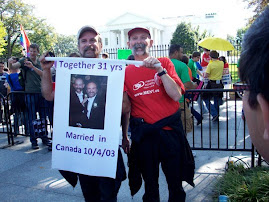
this article is great It shows that legislators get financial support regardless of party from the LGBT community if they vote in support of LGBT issues. This is an excellent tool to take to legislative visits.
Assembly's Gay Rites Backers Reap Benefits - August 7, 2008 - The New York Sun
Assembly's Gay Rites Backers Reap Benefits
Donations Pour In for Republicans
By JACOB GERSHMAN, Staff Reporter of the Sun | August 7, 2008
http://www.nysun.com/new-york/assemblys-gay-rites-backers-reap-benefits/83387/
Assembly Republicans who bucked party leaders and voted to legalize same-sex marriage in New York have been rewarded with an outpouring of donations from gay rights advocates across the nation.
The lawmakers, who before voting for the measure had a relatively low profile in the Assembly and rarely raised money from ZIP codes outside their districts, have benefited from a fund-raising network stretching to at least nine other states.
The money has flowed in at such a rapid pace that these Republicans have seen more than half of their individual contributions in the latest filing cycle come from donors with addresses outside the state.
Their donations also far surpassed political giving from the national gay rights movement to Assembly Democrats who voted for the bill, including Democratic members in upstate districts with conservative leanings.
"It was very shocking to me to watch it come in," a Republican assemblywoman, Teresa Sayward, one of four Republicans who voted in favor of gay marriage, said.
During the most recent six-month campaign-finance filing period that ended July 15, Ms. Sayward, a former dairy farmer who represents a district in the state's North Country, received 30 out-of-state contributions from individuals out of a total of 68 donors.
About two-thirds of the money she raised from individuals came from donors in California, Colorado, North Carolina, Illinois, Arizona, Florida, Ohio, Massachusetts, and Pennsylvania.
"The night I took the vote in June, I was told I would never be elected again. I'm running unopposed," Ms. Sayward said. "If I were to have a major challenger, that money could have played an important role in being able to get out the message."
Two of her donors were William Lewis and his partner Richard Underwood, who each gave Ms. Sayward $1,000 after they heard her speak about her vote at a gay rights conference in Miami this spring that was organized by the Gill Action Fund, an advocacy group founded by a philanthropist and computer software entrepreneur, Tim Gill.
At the conference, Ms. Sayward, who is Catholic, spoke about how over time she came to accept her son's homosexuality after conducting research into sexual orientation, and came to believe that gay marriage was a civil rights issue.
"She took a huge risk with what she did," Mr. Lewis, a real estate investor from Phoenix, said. "I think people who do the right thing should remain in office."
Another Republican who voted for gay marriage, Assemblywoman Dierdre Scozzafava of Saint Lawrence County, received 26 out-of-state donations out of 34 individuals, making up $15,000 of her total haul of $18,700.
The show of solidarity comes as the campaign to make New York the third state to legalize gay marriage has hit a roadblock in the Republican-led Senate; the Democrat-led Assembly approved same-sex unions in an 85- 61 vote more than a year ago.
Yesterday, the Republican majority leader of the Senate, Dean Skelos, who represents a district on Long Island, reaffirmed his conference's opposition, telling The New York Sun that Republicans are "not supportive" of the measure.
A Republican senator of Brooklyn, Martin Golden, said the support received by Assembly Republicans would not influence his conference. "It's a strong belief among many Republicans that it's not the way to go. It's a core belief that we have. We stick with our core beliefs," he said.
"Many of them are a bunch of fossils from a bygone day," a Republican assemblyman of Dutchess County, Joel Miller, who also backed the bill, said of the Senate Republicans. "Constituents have changed. More of us represent a district in which there's a lot more people of diverse views."
Said Mr. Miller: "That's why these donations come in. They want to send a message that you can be a Republican, you can vote for gay marriage, and you can be re-elected."
About 65% of his $23,000 in individual contributions in the latest cycle came from out-of-state supporters.
"I'm very appreciative of it. It makes it easier for other legislators in other states to stand up and do what's right," Mr. Miller said. "This is money I would never have been able to raise."
Mr. Miller, a dentist who is facing a Democratic challenger, said his Republican colleagues last year urged him not to speak out in favor of gay marriage on the Assembly floor and to wait until the Democrats voted — and the bill's passage was a foregone conclusion — before placing his vote.
"I wanted it recognized that my vote counted. I told them I was prepared to leave the conference," Mr. Miller said.
He said in the days after the vote, he received only a handful of e-mail messages from people expressing disapproval. A few Republicans, he said, also refused to collect petition signatures for him.
"Has anyone threatened me? Has anyone called and told me they're not going to vote for me because of this vote? No one has done that," he said.
Thursday, August 7, 2008
Assembly's Gay Rites Backers Reap Benefits - August 7, 2008 - The New York Sun


Gay relationships can be as good as marriage, says the Archbishop of Canterbury | Mail Online
Gay relationships can be as good as marriage, says the Archbishop of Canterbury | Mail Online
By Nick Mcdermott
Last updated at 11:54 AM on 07th August 2008
Controversial: The Archbishop of Canterbury, Dr Rowan Williams, with his wife Jane
The Archbishop of Canterbury has equated gay sexual relationships to heterosexual marriage.
Leaked private letters from eight years ago reveal Rowan Williams's innermost thoughts on gay partnerships, which he says can 'reflect the love of God'.
The revelations come just days after the Anglican Communion reached an uneasy truce over the issue, with the row over ordaining gay priests threatening to permanently split the Church.
At the end of the once-a-decade Lambeth Conference, Dr Williams called for an Anglican rulebook to keep the Church of England and its warring sister churches together.
In a decision aimed at appeasing orthodox bishops, he recommitted the Church to a more hardline stance saying there should be no more gay bishops until the rules are agreed.
But despite supporting the conservative majority, Dr Williams's view in private is much more closely aligned to the liberal factions of the Anglican church.
In correspondence with an evangelical Christian written while still Archbishop of Wales, Dr Williams claims the Bible does not criticise people who are gay by nature and in a committed relationship, but promiscuous gay sex.
In excerpts of the letters published in The Times, he writes: 'I concluded that an active sexual relationship between two people of the same sex might therefore reflect the love of God in a way comparable to marriage, if and only if it had about it the same character of absolute covenanted faithfulness.'
Despite being in 2000, two years before taking up the post as head of the Anglican church, Dr Williams writes that his view in the letters are his 'definitive conclusion'.
Considered a liberal before his appointment as Archbishop of Canterbury, Dr Williams has since faced criticism for backtracking to a more traditionalist stance.
The church, which has 70million worshippers worldwide, has been in deep division since an openly gay priest, Jeffrey John, was nominated as Bishop of Reading in 2003.
Dr Williams forced Canon Jeffrey John to give up the post, but was unable to prevent to stop American Anglicans from endorsing actively homosexual Gene Robinson from being appointed bishop of the diocese of New Hampshire.
In the correspondence with Dr Deborah Pitt, a psychiatrist who lives within his former archdiocese in south Wales, Dr Williams distinguishes between his personal views as a theologian, and his position as a church leader for which he must consider the more conservative views of the majority of Anglicans.
He wrote: 'If I'm asked for my views, as a theologian rather than a church leader, I have to be honest and admit that they are as I've said.'
Dr Williams describes in the letters how his opposition to gay relationships softened in 1980 when he as a university teacher he became 'unsettled' by conversations with Christian students who believed the Bible forbade promiscuity not gay sex.
Ordained a priest in 1978, he later became a lecturer at Cambridge and was appointed Dean of Clare College in 1984.
In the correspondence, he says that by the end of the 1980s he had 'definitely come to the conclusion' the Bible was not opposed to faithful relationships between gay people.
One of the academics cited by Dr Williams as pivotal in influencing his more liberal view is ironically Dr Jeffrey John.
He also says he regrets that the issue of homosexuality and the church has become 'very much politicised' and is treated by many as 'the sole or primary marker of Christian orthodoxy'.
In 1989, Dr Williams' hinted at his liberal views on homosexuality in a paper called The Body's Grace, where he argued that the Church's acceptance of contraception meant it recognised the virtues of sex for non-reproductive purposes.
This was interpreted in some quarters to be a tacit approval of gay sex.
Lambeth Palace last night responded to the revelations by quoting a recent interview made Dr Williams where he stated:
'When I teach as a bishop I teach what the Church teaches. In controverted areas it is my responsibility to teach what the Church has said and why.'
Wednesday, August 6, 2008
The Associated Press: Gay couples use weddings to wage ballot fight
The Associated Press: Gay couples use weddings to wage ballot fight
By LAURA E. DAVIS – 1 day ago
LOS ANGELES (AP) — When Pamela Brown got married, the two bride figurines atop her wedding cake celebrated her newfound right in California to marry another woman. But one of the figurines had a tiny sign over its head with something more to say: "Vote No on 8."
Brown and her wife are one of many same-sex couples whose nuptials are made possible by the state Supreme Court's May 15 ruling that legalized gay marriage.
But as these couples say "I do," they are threatened by the prospect that California voters could undo the right to same-sex marriage by approving the ballot initiative called Proposition 8 in November. So many of them are using their weddings to do something about it.
"They're taking it very seriously," says Los Angeles wedding planner Pamela Yager. "It becomes, 'It's not just our union.' It becomes a political message they're trying to get out."
Brown and Shauna Rajkowski even inserted language into their ceremony in Berkeley that specifically referred to the fight against the proposition. And guests could take home pamphlets, bumper stickers, yard signs and postcards, all advocating "No on 8."
"If I had my preference, I wouldn't bring politics into it. But we just can't lose the moment and the opportunity when so many friends and family are together," said Brown, who is the policy director for Marriage Equality USA, a nonprofit organization dedicated to securing gay marriage rights nationwide.
But cake toppers and pamphlets aren't the only way same-sex couples are fighting Proposition 8, which would amend the state's constitution to recognize only marriage between a man and a woman.
Molly McKay plans to marry her partner on Sept. 1, and the two have decided to participate in one of the more popular anti-Proposition 8 wedding trends — replacing a traditional gift registry with a political version that accepts donations to the "No on 8" campaign in lieu of gifts.
So instead of pulling up a wedding registry at Macy's, friends and family can go online and give a donation in honor of the couple to a registry sponsored by gay rights organizations such as Equality California or the Human Rights Campaign.
"Nobody wants to be political about their wedding day," said McKay, media director for Marriage Equality USA. "But we have to do double duty. There's no other choice."
For many couples who have lived together in domestic partnerships or civil unions, it only makes sense to forego expensive gifts in favor of ensuring the long-term security of same-sex marriage.
"I couldn't bear the thought of getting more things to dust in our home," said Howard Bragman, a Los Angeles publicist who married his partner of five years on July 14. "We thought the best thing we could do is to direct people to give in honor of our wedding."
The money from most registries goes to Equality for All, which runs the "No on 8" campaign. So far, donations in honor of about 1,400 couples have generated approximately $300,000 for the campaign.
Allan Brauer, 50, and Norberto Laboy-Brauer, 54, were somewhat discouraged by the donations made in honor of their June 17 wedding in Sacramento.
"The only disappointing thing is that all of the people who donated to us were gay friends or couples," Brauer said. "And so far none of our blood relatives or straight friends have actually contributed any money."
Old-fashioned publicity is another way gay weddings are being used to support the fight against Proposition 8.
George Takei of "Star Trek" fame and his partner, Brad Altman, are working with the Gay & Lesbian Alliance Against Defamation to publicize their Sept. 14 wedding in an effort to put a "public face" on the gay marriage issue. The Human Rights Campaign, meanwhile, has listed them as the first couple on their online registry.
Takei, 71, and Altman, 54, have also asked friends and family to make donations in honor of the wedding to the Japanese-American National Museum in Los Angeles, where they are holding their ceremony.
"We don't need another toaster or another set of silverware," said Takei, who is of Japanese ancestry. "So we thought we'd have people who want to celebrate with a gift, do that with these two institutions."
Yager, the wedding planner, said same-sex couples have found other ways to provide monetary support to defeating Proposition 8, including purchasing wedding favors from vendors that will then donate the proceeds to gay rights organizations.
The Los Angeles Gay & Lesbian Center has made the process easier by creating an online resource for same-sex couples. The site lists more than 60 wedding businesses — providing everything from invitations to lighting — that donate to the center, which has given $200,000 to the No on 8 campaign, said spokesman Jim Key.
Then there is the final touch on any wedding — the thank-you note.
Yager says some of her gay clients will not just send notes to their guests but also to the California Supreme Court, expressing gratitude for making their weddings possible.
Not all gay couples are completely comfortable mixing nuptials and politics.
Bill Walker, 51, and Kelly Ziegler, 40, limited their activism to simple donation cards next to the guest book. But Walker acknowledges that politics weren't entirely absent from their Los Angeles ceremony.
"The very fact that we can get married, to some people is a political act," he said.
On the Net:
Equality for All: http://www.equalityforall.com
Equality California: http://www.eqca.org
Human Rights Campaign: http://www.hrc.org
L.A. Gay Wedding Guide: http://www.lagayweddingguide.com
VT and MA Now Compete for Gay Wedding Business; CT Next? :: EDGE Boston
VT and MA Now Compete for Gay Wedding Business; CT Next? :: EDGE Boston
by Kilian Melloy
EDGE Contributor
Friday Aug 1, 2008
Now that a racist 1913 law that had been used against gay families has been repealed in Massachusetts, will more gay and lesbian couples head to the Bay State to tie the knot?
Since the advent four years ago of marriage equality in MA, word has been spreading: same-sex weddings are big business, and states that allow marriage equality stand to reap the benefits not only of local residents wishing to head to the altar, but also out-of-state couples willing to travel in order to claim their right to family.
Those who are willing literally to go the distance and cross state lines in order to wed their life partners bring even more cash into the state economy than local gay families celebrating their weddings, because many of the tourist businesses also benefit.
As reported here at EDGE, a recent report from The Williams Institute suggests that states allowing marriage equality are not only standing up for the civil rights of their citizens, but exhibiting sound business sense as well: California, which recently became the second state in the U.S. to provide marriage equality to its gay and lesbian families, could rake in as much as $64 million over the next three years, assuming that an anti-gay ballot initiative to re-write the state constitution and strip gay families of their right to marry fails at the ballot box this Nov.
And if New Jersey, thought by some to be likely to become the third state offering equality to gay and lesbian families, should open the door to marriage also, it could enjoy a take of $19 million.
A separate report from the Congressional Budget Office projected that if all states in the Union were to provide their gay and lesbian families with marriage rights, the national profit on same-sex weddings would ring the (cash register) bells to the tune of a billion dollars per year.
All of which is starting to sink in, given these cash-strapped times.
Until recently, the only thing stopping gay and lesbian families from other states from making a trip over state lines and marrying in MA was a state law from 1913 that had originally been written to uphold anti-miscegenation laws in other locales.
The 1913 law said that no one whose marriage would be illegal in their home state would be allowed to marry in MA.
After marriage equality became a legal reality in America for the first time in 2004 in MA, the state’s then-governor Mitt Romney, already attempting to court a conservative base with an eye to the 2008 election, cited the 1913 law as a means of preventing gay and lesbian families from other states from entering MA, marrying, and then presenting a legal challenge to their home states’ governments.
The legality of such a scenario was in doubt already, thanks to a 1996 law, the federal "Defense of Marriage Act," which, rather than defend family rights for gay Americans, singles them out for exclusion from legal family recognition.
Now that current MA governor Deval Patrick has signed a bill to strike that antiquated and racist law from the books, out-of-state couples will be free to travel to the Bay State to tie the knot, and MA will reap the financial benefits. But will other states feel the sting of lost profits?
A story posted at the Web site for NBC affiliate WPTZ looked at the issue from a Vermont perspective, investigating whether VT--the first state to offer limited recognition of gay families by passing a civil unions law in 2000, under then-governor Howard Dean--would see tourist dollars flow away from the state. After all, why settle for a civil union when couples can go for true (if limited to state level) marriage?
The WPTZ article cited a VT bed and breakfast, Grunberg Haus, as an example; when the civil unions law took effect, that establishment immediately gained business, and over the years same-sex couples (and their guests) coming to the state to celebrate their civil union has remained a significant part of the business’ revenue stream.
Jeff Connor, who with his wife owns and operates Grunberg Haus, expressed the opinion that the repeal of the racist law from 1913 would not lead to a big drop in business.
VT, said Connor, remains "a magical place to have a wedding," regardless of the gender of the persons involved.
Connor, who also serves the Vermont Gay Tourism Association as its president, was quoted in the WPTZ article as saying, "Covered bridges, waterfalls, beautiful farms, the outdoors, the green mountains--there’s a lot of cache built up."
Connors cited what he called "The Vermont brand--clean, pure, wholesome."
But business could be better, reckoned Connor, whom the article cited as saying that VT ought to expand its civil unions law into the genuine article and allow marriage equality.
Said Connor of marriage among gay and lesbian couples, "It’s an even bigger market now than what it was six or seven years ago."
Seventy-five percent of the civil unions celebrated in VT involve couples who have come from another state, according to wedding magazine Vermont Vows editor Krista Washburn, who did not expect to see an immediate drop in business.
Said Washburn in the article, "Will we see an impact economically? I don’t think so."
Added Washburn, "Not right away."
Meantime, Connecticut may outpace NJ and become the third state to provide gay and lesbian families with equal recognition.
According to a July 30 article that appeared at Courant.com families in CT may be more willing to stay and fight for their rights at home than to make a trip to MA and get married there.
The Courant.com article quoted Love Makes a Family’s executive director, Anne Stanback, who said of the repeal of MA’s anti-miscegenation law, "It’s a wonderful and decisive vote, but I don’t think it will have a huge impact in Connecticut."
Added Stanback, "Same-sex couples here understand we will very likely have the ability to marry in our state in the near future, either through the court or through the legislature."
The CT Supreme Court is expected to rule in the case of eight couples whose suit, presented to the court over a year ago, posited the right of gay and lesbian families to wed.
Meantime, legislation that would have allowed marriages performed in other jurisdictions, such as MA or Canada, to be recognized in CT stalled in committee.
Such legislation would have echoed New York state policy, which acknowledges marriages of gays and lesbians performed in locales where marriage equality is permitted, even though NY law does not provide for in-state weddings between same-sex couples.
The executive director of the anti-gay Family Institute of Connecticut, Peter Wolfgang, hailed the snag, saying that in the wake of the MA law’s repeal, "We’re only now realizing how big a victory it was."
Despite the provisions of DOMA, which specifically allows states to refuse to recognize gay and lesbian marriages performed elsewhere, Wolfgang repeated the accusations that the right wing have adopted as a mantra since state lawmakers in MA voted to do away with the racist law from 1913, saying that MA is trying to export gay marriage and "impose" it on the rest of the country.
Aside from the civil rights arguments that favored repealing MA’s 1913 anti-miscegenation law, proponents of the repeal cited the financial upswing in the wedding industry that CA has seen since that state, which had no pre-existing laws limiting marriages for out-of-staters, became the second state to grant marriage equality, reported the Courant.com article.
UCLA's Williams Institute releases new study showing enthusiasm for marriage among same-sex couples - MarketWatch
UCLA's Williams Institute releases new study showing enthusiasm for marriage among same-sex couples - MarketWatch
LOS ANGELES, Jul 31, 2008 (BUSINESS WIRE) -- A new study published today by UCLA's Williams Institute finds that same-sex couples eagerly take advantage of the ability to marry or form civil unions when presented with the opportunity. More than 85,000 couples have already signed up for legal recognition in eleven states--40% of all same-sex couples in these states.
The report compiles data from the eleven states that recognize same-sex couples through marriage, civil unions, domestic partnerships, or other legal statuses. These data also show that same-sex couples who marry or register are more likely to be female couples than male couples, and same-sex couples tend to be younger than existing different-sex married couples.
The findings also shed new light on the current experience in California, where thousands of same-sex couples are reported to have already married.
"Marriage clearly gets the most enthusiastic response from same-sex couples, as we're seeing in California," explained co-author M. V. Lee Badgett, research director of the Williams Institute and director of the Center for Public Policy and Administration at the University of Massachusetts Amherst. "In Massachusetts, 37% of gay and lesbian couples got married within the first year that marriage was available, but only one in ten gay couples registered a civil union or domestic partnership in the first year after the introduction of those statuses."
The study predicts that if every state offered marriage to same-sex couples today, approximately 370,000 couples would marry in the next three years.
"Not only are same-sex couples getting legally partnered, but their relationships are just as stable as marriages of different-sex couples," noted co-author Gary Gates, senior research fellow of the Williams Institute. "Only 1-3% of same-sex couples dissolve their legal relationships each year, which is comparable to the 2% of those in different-sex marriages who divorce annually."
The US Census Bureau recently confirmed that they do not plan on counting same-sex married couples in the 2010 Census, instead relegating all of these couples to "unmarried partner" status. According to study co-author Gates, "This report demonstrates why it is so important for government agencies like the Census Bureau to find ways to count the more than 85,000 same-sex couples who are in legally recognized unions."
This study is the second in a series of four reports made possible by a grant from Merrill Lynch.
The Williams Institute for Sexual Orientation Law and Public Policy advances law and public policy through rigorous, independent research and scholarship, and disseminates its work through a variety of education programs and media to judges, legislators, lawyers, other policy makers, and the public. This study, well as findings from the first study on the cost impact of differential taxation between domestic partner and spousal health benefits for both employers and employees, can be accessed at the Williams Institute website:
www.law.ucla.edu/williamsinstitute
SOURCE: UCLA's Williams Institute
How Gay Marriage Politics Would Change Under Obama - Beyond the Dome
How Gay Marriage Politics Would Change Under Obama - Beyond the Dome
By David Nather | July 31, 2008 5:35 PM
Could gay marriage become an issue again in the next Congress — in a different context?
It seems possible if Democrats keep control of the House and Senate and Barack Obama wins the White House, since Obama wants to repeal the Defense of Marriage Act, the 1996 law that bans any federal recognition of same-sex marriages and allows states to refuse to recognize marriages performed in another state.
Obama recently said that the marriage issue should be decided at the state and local level and that his job as president would be to “make sure that the federal government is not discriminating.”
Guess he’s not going to get Dr. James Dobson’s vote. More importantly, though, he’d have the support of House Speaker Nancy Pelosi of California, who voted against the legislation when it passed Congress. It’s not clear how actively she would help, though. When Pelosi was asked at a press conference today if she would support Obama in pushing for repeal, she simply said, “yes” — and quickly moved on to the next question.
Is it the first thing a House speaker would want to put on the agenda for next year? Probably not. But the idea that a repeal of the law could even be on the table shows how radically the politics of gay marriage, under a Democratic president and a Democratic Congress, would change from the days of a Republican president and a Republican Congress.
Remember, it wasn’t that long ago when Senate Republicans were pushing for a constitutional amendment to ban gay marriage — and always seemed to schedule the votes during even-numbered years. (John McCain, who supports the 1996 law, voted against the constitutional amendment in 2004 and 2006, saying he’d only support it if state initiatives to ban same-sex marriage were struck down by the courts.)
Still, Obama shouldn’t count on much help from Senate Majority Leader Harry Reid of Nevada. Reid voted for the 1996 law, a fact that would probably dampen his enthusiasm for repealing it.
Sunday, August 3, 2008
New York Gay Couples Head to Massachusetts With Marriage in Mind - NYTimes.com
Our friend Roseann's son and his family were featured in the NY Times today they are off to Mass to get married.
New York Gay Couples Head to Massachusetts With Marriage in Mind - NYTimes.com
By TINA KELLEY
Published: August 2, 2008
Gabriel Blau and Dylan Stein will be heading to Amherst, Mass., in a matter of weeks to complete a marriage ceremony they started two years ago.
Nicole Bengiveno/The New York Times
Gabriel Blau, left, and Dylan Stein, both 28, live in an apartment in the East Village with their son, Elijah, 5 ½ months. They plan to get married in Massachusetts.
At the couple’s Jewish wedding in a Hell’s Kitchen loft in 2006, they had a floral-embroidered chuppah, stomped on a glass in front of 175 friends and relatives, and were hoisted on chairs amid a hora-dancing throng. But one thing was missing: a marriage certificate.
This week, they called their rabbi to arrange another service, this one in Massachusetts, which on Thursday repealed a century-old law preventing out-of-state residents from marrying there if their home states would not recognize the union.
Because Gov. David A. Paterson directed New York State agencies in May to recognize gay marriages performed in other jurisdictions, Mr. Blau and Mr. Stein are among scores of couples expected to tie — or retie — the knot in coming months.
While some New Yorkers have flown across the country to marry in California since May, when that state became the nation’s second to approve same-sex marriage, gay-rights advocates expect many more to do the same in Massachusetts, since it is so much closer.
“We call it the Amtrak option, as opposed to the Jet Blue option,” said Cathy Renna, a communications consultant to gay and lesbian organizations.
Alan Van Capelle, executive director of Empire State Pride Agenda, a leading gay-rights group, said, “I think this is an incredible opportunity for same-sex New York couples who are hungry for some of the 1,324 rights and responsibilities married couples receive to obtain them.”
Governor Paterson’s decision placed New York alongside Rhode Island and New Mexico in recognizing same-sex marriages performed in Massachusetts, according to a Boston-based advocacy group, Gay and Lesbian Advocates and Defenders.
A June memo from the Massachusetts Office of Housing and Economic Development estimated that 21,000 gay couples from New York might go there to marry if the state allowed. That is about 43 percent of the estimated 49,000 same-sex couples in New York. About 9,600 same-sex couples from Massachusetts married in the first three years after the state legalized such unions in 2004.
With Governor Paterson’s blessing, New Yorkers who get married in Massachusetts — or Canada or California — will be eligible for a host of benefits that they cannot receive now, according to Mr. Van Capelle of the Pride Agenda. Firefighters and police officers in particular have a lot to gain, because the state gives significant benefits to the spouses of emergency workers killed in the line of duty.
For Darcy Rickard, 39, of Albany, one of the main benefits of a marriage certificate will be a tax break. After her Massachusetts wedding, planned for October in Provincetown, her partner, Debbie Rodrigues, 44, will be eligible for coverage under Ms. Rickard’s health insurance, without having to pay state tax on the value of those benefits.
(Federal tax will have to be paid, since the federal government does not recognize gay marriages at all.)
And when they travel with Ms. Rickard’s 13-year-old daughter, they will no longer need to carry a ream of legal papers to prove their relationship at hospitals if one of them becomes ill or is injured in an accident. In addition, Ms. Rickard said, legally married partners have more rights in the case of a breakup.
“But really, the driving reason to get married is because we love each other,” she said. “When you’re committed, you want to show it.”
Ms. Rickard fretted that by not yet allowing same-sex marriages, New York is missing out.
“It’s money we’re going to spend in Massachusetts, not in New York,” she said of the wedding they are planning.
The New York City comptroller’s office estimated in a June 2007 report that allowing gay marriage could bring $142 million to the local economy in the first three years. The state would collect an additional $8 million in taxes and the city would collect an additional $7 million, and companies in New York would benefit from a wider pool of possible employees attracted by the change in marriage laws, the report projected.
A June analysis by the Williams Institute at the U.C.L.A. School of Law, on the other hand, estimated that Massachusetts could add $111 million to the economy over three years by taking the step it did this week to allow out-of-state couples to marry there. The report also suggested that the move could result in 330 new jobs and increase state and local revenues by $5.1 million.
Figures about how many New York couples have traveled out of state to get married or enter into civil unions are nearly impossible to come by, advocates said.
Assemblyman Daniel J. O’Donnell, a Democrat who represents the Upper West Side, expressed concern that New York might now have a caste system, with gay couples who can afford to go to Massachusetts or California enjoying more rights than those who cannot do so. But he also said that more married gay couples living in the state could help his efforts to pass a gay marriage law.
“Local officials will see that no harm comes to anyone for their constituents’ having access to a marriage license,” he said.
But a Christian group that sued Governor Paterson over his gay-marriage directive questioned whether the Massachusetts marriages would be valid in New York before resolution of the lawsuit, which is scheduled for a court hearing on Thursday.
“The people have not had a voice in this, either in Massachusetts or New York,” said Glen Lavy, senior counsel with the group, the Alliance Defense Fund, based in Scottsdale, Ariz. “So this is simply short-circuiting the democratic process.”
Assemblyman O’Donnell is one of many gay-marriage advocates waiting to be able to marry in their own states.
Evan Wolfson, executive director of Freedom to Marry, a national advocacy group based in New York, said that many people he talked to wanted to be able to marry at home, “and I count myself among them.”
“I don’t think New Yorkers should have to go to Niagara Falls, Canada, to have what we should have in Niagara Falls, New York,” he said.
But Deborah and Mia Jacoby-Twigg of Highland Mills, N.Y., were tired of waiting. At 1:15 p.m. on Friday, they became the first out-of-state gay couple to marry in Provincetown, Mass., the clerk in charge told them.
Already on vacation on Cape Cod, they drove to the town of Orleans, a half-hour away, to get a waiver of the standard three-day waiting period for a marriage license and find a solemnizer, who conducted the service as their 3-year-old sons, Noah and Nate, ran around in the municipal auditorium.
“The solemnizer asked if we had rings, and I said I’d been wearing mine for 10 years and don’t think I can get it off,” said Deborah Jacoby-Twigg, 51.
For her, the marriage means the end of the perpetual confusion she faced when filling out official forms.
“I can check ‘married’ in New York, and that means a lot,” she said. “Our boys have two legally married moms, and that’s a beautiful thing.”
Mor