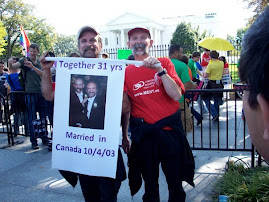
Married with children: an option for more gay men - International Herald Tribune
NEW YORK: The cost remains high, and a good lawyer is essential. Yet despite complications, the idea of becoming a biological dad with help from a surrogate mother is gaining allure among gay men as the status of "married with children" grows ever more possible.
With same-sex marriage now legal in California even to nonresidents, and Massachusetts extending its 4-year-old gay-marriage policy to out-of-staters, in-wedlock parenting is suddenly a realistic option for gays and lesbians nationwide, even if their home state won't recognize the union.
Fertility clinics and surrogacy programs report increased interest from gay men, while couples who already have children are getting married — or considering it — to provide more security for those kids.
"We wanted our daughter to know her parents were married — that was the big thing for us," said Tommy Starling of Pawley's Island, S.C., who wed his partner of 12 years, Jeff Littlefield, on July 11 in Hollywood.
Among those at the ceremony was their daughter, Carrigan, who was born in California two years ago.
CLICK LINK ABOVE FOR FULL STORY
Saturday, August 16, 2008
Married with children: an option for more gay men - International Herald Tribune


Friday, August 15, 2008
Queers United: The Heterosexual Questionnaire
Queers United: The Heterosexual Questionnaire
Tuesday, July 15, 2008
The Heterosexual Questionnaire
The Heterosexual Questionnaire was created back in 1972 to put heterosexual people in the shoes of a gay person for just a moment. Questions and assumptions made of Gays and Lesbians that are unfair, are reversed and this time asked to the straight people.
This is a fun survey, but also an activist survey. Please repost this to your email list, myspace bulletin, use it in a group setting, have fun with it but also let the point be made.
1. What do you think caused your heterosexuality?
2. When and where did you decide you were a heterosexual?
3. Is it possible this is just a phase and you will out grow it?
4. Is it possible that your sexual orientation has stemmed from a neurotic fear of others of the same sex?
5. Do your parents know you are straight? Do your friends know- how did they react?
6. If you have never slept with a person of the same sex, is it just possible that all you need is a good gay lover?
7. Why do you insist on flaunting your heterosexuality... can’t you just be who you are and keep it quiet?
8. Why do heterosexuals place so much emphasis on sex?
9. Why do heterosexuals try to recruit others into this lifestyle?
10. A disproportionate majority of child molesters are heterosexual... Do you consider it safe to expose children to heterosexual teachers?
11. Just what do men and women do in bed together? How can they truly know how to please each other, being so anatomically different?
12. With all the societal support marriage receives, the divorce rate is spiraling. Why are there so few stable relationships among heterosexuals?
13. How can you become a whole person if you limit yourself to compulsive, exclusive heterosexuality?
14. Considering the menace of overpopulation how could the human race survive if everyone were heterosexual?
15. Could you trust a heterosexual therapist to be objective? Don't you feel that he or she might be inclined to influence you in the direction of his orher leanings?
16. There seem to very few happy heterosexuals. Techniques have been developed that might enable you to change if you really want to.
17. Have you considered trying aversion therapy?
- Martin Rochlin, Ph.D., 1972
Tuesday, August 12, 2008
More gay men 'married with children'-Health/Sci-The Times of India
More gay men 'married with children'-Health/Sci-The Times of India
NEW YORK: The cost remains high, and a good lawyer is essential. Yet despite complications, the idea of becoming a biological dad with help from a surrogate mother is gaining allure among gay men as the status of "married with children" grows ever more possible.
With same-sex marriage now legal in California even to non-residents, and Massachusetts extending its 4-year-old gay-marriage policy to out-of-staters, in-wedlock parenting is suddenly a realistic option for gays and lesbians nationwide, even if their home state won't recognize the union.
Fertility clinics and surrogacy programs report increased interest from gay men, while couples who already have children are getting married — or considering it — to provide more security for those kids.
"We wanted our daughter to know her parents were married — that was the big thing for us," said Tommy Starling of Pawley's Island, South Carolina, who wed his partner of 12 years, Jeff Littlefield, on July 11 in Hollywood.
Among those at the ceremony was their daughter, Carrigan, who was born in California two years ago.
Starling said he and Littlefield had tried previously to adopt a child in South Carolina, but encountered anti-gay hostility and instead opted to become parents through a surrogacy program run by Los Angeles-based Growing Generations. Since 1996, it has matched hundreds of gay men with surrogate mothers who are paid to carry an implanted embryo produced from a donor egg fertilized with the client's sperm.
"Our journey to parenthood was not easy, cheap or fun," Starling and Littlefield wrote in an account of their family. "The result, however, has been the most amazing experience in the world; being called Daddy and Dad by our loving daughter."
For lesbian couples, biological parenthood is usually a far simpler proposition than for gay men, since there's no need for surrogacy and there are various options for becoming pregnant. A lesbian couple faces neither the cost of surrogacy, which can run as high as $150,000, nor the legal complications which call for a carefully negotiated contract with the surrogate mother.
"All the realms involved with men are much more complex," said Gail Taylor, president and founder of Growing Generations. But Taylor believes the option of marriage will, over time, lead to more biological gay dads. "For future generations, knowing they can fall in love, get married, have a child — absolutely, that will become a way of life more than it is," she said.
Starling, 36, and Littlefield, 52, face the likelihood that their marriage will not be recognized anytime soon in South Carolina. In contrast, Joe and Brent Taravella, who are raising three children in South Orange, New Jersey, already have a civil union and are optimistic that New Jersey will soon legalize same-sex marriages.
Prop. 8 backers drop challenge on wording
Prop. 8 backers drop challenge on wording
08-11) 13:15 PDT SAN FRANCISCO -- The state's official description of Proposition 8 on the November ballot will remain as is, a statement that the measure would eliminate same-sex couples' right to marry in California.
Sponsors of the measure argued that the title and summary drafted by Attorney General Jerry Brown were argumentative and designed to encourage voters to oppose Prop. 8. But after two defeats in court last week, the Yes on 8 campaign said Monday that it would not appeal to the state Supreme Court.
"We intend to leave the final outcome to the voters," said campaign spokeswoman Jennifer Kerns.
The initiative would amend the state Constitution to ban same-sex marriage. Brown titled it "Limit on Marriage" when the measure was circulated for signatures.
But after the state's high court ruled in May that gay and lesbian couples have the right to marry under the state Constitution, the Democratic attorney general changed the title, saying Prop. 8 would now eliminate rights that the court had established. The new title states the measure "eliminates (the) right of same-sex couples to marry."
Sponsors of Prop. 8 filed suit, claiming Brown's title was one-sided. They argued that the measure should bear no title at all except for its brief text: "Only marriage between a man and a woman is valid or recognized in California."
But a Sacramento Superior Court judge ruled Friday that Brown's reference to an elimination of rights was an accurate description of the purpose and effect of Prop. 8, and a state appeals court in Sacramento turned down an emergency appeal by the Yes on 8 campaign late Friday.
Monday was the deadline for court action on the wording of ballot summaries and arguments in the voter pamphlet, which are due at the state printer's office after the close of business this afternoon.
E-mail Bob Egelko at begelko@sfchronicle.com.
Gay marriage: Not if, but when - NJ.com
Gay marriage: Not if, but when - NJ.com
Gay marriage: Not if, but when
Monday, August 11, 2008
Backers of same-sex marriage in New Jersey believe they have the wind at their backs. They are confident the state will replace civil unions for gay couples with full civil-marriage rights.
They also believe it will be done not by court order, which is the way gay marriage became legal in Massachusetts and California, but by legislative action.
Their only uncertainty is when the change will come.
"Late this year or sometime next year," predicts Steven Goldstein, chairman of Garden State Equality, a gay-rights group that has been at the forefront of the lobbying campaign.
That may be too optimistic, says Assemblyman Reed Gusciora, D-Princeton Borough, the sponsor of a bill to authorize civil marriage for same-sex couples. New Jersey is "a progressive state" and the bill will pass "sooner rather than later," he says, but its backers first will have to persuade hesitant lawmakers that the change is not only right but politically safe.
Driving their efforts is the fact that civil unions, which are supposed to provide participants with all the rights of marriage except the name, have "failed miserably to provide equality," in Goldstein's words. A review commission reported last February that civil unions are "not clear to the general public" and confer "second-class status" on the partners.
"The law has wreaked havoc on same-sex couples' lives because too many employers, hospitals and others throughout the state do not recognize a civil union as marriage," said Goldstein, who is vice chairman of the review commission. "They don't believe the Legislature intended it to be equal."
The Legislature created civil unions after the state Supreme Court ruled in 2006 that the state and federal constitutions entitle same-sex couples to all the rights of marriage but not necessarily the institution of marriage itself. (In a dissent that argued for full marriage rights, then-Chief Justice Deborah Poritz wrote prophetically: "What we name things matters.")
Most distressing, Goldstein said, has been the testimony of gay couples that their children are teased by schoolmates because their parents aren't married.
"Kids are pretty smart, and they hurt easily," he said. "When they are taunted or asked in a hostile way why their parents have something inferior, why they aren't equal, that's psychologically damaging.
"The irony is that New Jersey was the national leader in letting gay couples adopt. Why would the state then turn around and send a signal to those children that their parents can't marry? It's been our biggest heartbreak."
The opponents' principal argument is that allowing people of the same sex to marry will "damage the institution of marriage." But they are unable to explain how.
"It's not going to affect Britney Spears' ability to continuously get married," said Gusciora. "[Republican leader] Newt Gingrich has been married three times, and it wasn't because of same-sex marriage."
"There are threats to the institution of marriage," Goldstein said. "The threats are unemployment, a bad economy, financial pressures, emotional pressures. But marriage is not a threat to marriage! I've asked opponents to show me one straight couple, just one, whose marriage would fall apart because a gay couple got married. They can't.
"Interestingly, the state with the lowest divorce rate in the country is Massachusetts, the first state that allowed same-sex couples to marry. Canada, which allows same-sex marriage [and where Goldstein and his partner were married] has a divorce rate one-half the U.S. rate."
His belief that change in New Jersey will come within a year stems from a growing consensus for it. He points out that this is the only state in which the governor and the leaders of both houses of the Legislature endorse marriage equality. And his head count of legislators shows that the bill would win a majority in the Assembly and is one or two votes shy of the 21 votes needed in the Senate.
He believes an additional push will come from a follow-up report by the Civil Union Review Commission that is expected later this year. It could have the same kind of effect as the powerful report from the Death Penalty Study Commission that led New Jersey to pioneer on another front by becoming the first state to abolish capital punishment by legislative action.
In a Zogby poll a year ago, respondents said, 63 percent to 31 percent, that they would be "fine" with gay marriage if officials decided it was needed to fix the civil-union system. "New Jerseyans care about the economy, which affects them personally," Goldstein said. "They care about gas prices. They care about property taxes. They care about government corruption. Do they care about depriving me and my partner of equality? No -- they don't. The state is much fairer than that."
Gov. Jon Corzine, who has promised to sign the bill if it reaches his desk, would prefer that it happen after the November presidential election. Corzine and other Democrats well remember 2004, when Republicans in Ohio and 10 other states organized anti-gay-marriage referendums to bring out the conservative vote for President Bush.
Waiting until after November could help in another way, Goldstein suggested. Although opposition is centered in the Republican Party, he said "several" GOP senators have indicated that they would vote yes later, but would be reluctant to do so now because it would undercut the anti-gay-marriage position of their party's presidential candidate, John McCain.
A related complaint by advocates is that gay couples that have been legally married elsewhere aren't recognized as such when they move to New Jersey, thanks to a ruling by then-Attorney General Stuart Rabner, now chief justice of the state Supreme Court. Instead, their marriages automatically turn into civil unions.
Corzine could change that by an executive order, just as New York Gov. David Paterson decreed earlier this year that his state would recognize same-sex marriages performed in other states. So far, Corzine hasn't chosen to take that route.
"It would help if he did," Goldstein said. "It would be another nail in the coffin of the idea that marriage by gay people would hurt straight marriage."
Contact George Amick at
gamick@njtimes.com.
Gay marriage: Not if, but when - NJ.com
Gay marriage: Not if, but when - NJ.com
Gay marriage: Not if, but when
Monday, August 11, 2008
Backers of same-sex marriage in New Jersey believe they have the wind at their backs. They are confident the state will replace civil unions for gay couples with full civil-marriage rights.
They also believe it will be done not by court order, which is the way gay marriage became legal in Massachusetts and California, but by legislative action.
Their only uncertainty is when the change will come.
"Late this year or sometime next year," predicts Steven Goldstein, chairman of Garden State Equality, a gay-rights group that has been at the forefront of the lobbying campaign.
That may be too optimistic, says Assemblyman Reed Gusciora, D-Princeton Borough, the sponsor of a bill to authorize civil marriage for same-sex couples. New Jersey is "a progressive state" and the bill will pass "sooner rather than later," he says, but its backers first will have to persuade hesitant lawmakers that the change is not only right but politically safe.
Driving their efforts is the fact that civil unions, which are supposed to provide participants with all the rights of marriage except the name, have "failed miserably to provide equality," in Goldstein's words. A review commission reported last February that civil unions are "not clear to the general public" and confer "second-class status" on the partners.
"The law has wreaked havoc on same-sex couples' lives because too many employers, hospitals and others throughout the state do not recognize a civil union as marriage," said Goldstein, who is vice chairman of the review commission. "They don't believe the Legislature intended it to be equal."
The Legislature created civil unions after the state Supreme Court ruled in 2006 that the state and federal constitutions entitle same-sex couples to all the rights of marriage but not necessarily the institution of marriage itself. (In a dissent that argued for full marriage rights, then-Chief Justice Deborah Poritz wrote prophetically: "What we name things matters.")
Most distressing, Goldstein said, has been the testimony of gay couples that their children are teased by schoolmates because their parents aren't married.
"Kids are pretty smart, and they hurt easily," he said. "When they are taunted or asked in a hostile way why their parents have something inferior, why they aren't equal, that's psychologically damaging.
"The irony is that New Jersey was the national leader in letting gay couples adopt. Why would the state then turn around and send a signal to those children that their parents can't marry? It's been our biggest heartbreak."
The opponents' principal argument is that allowing people of the same sex to marry will "damage the institution of marriage." But they are unable to explain how.
"It's not going to affect Britney Spears' ability to continuously get married," said Gusciora. "[Republican leader] Newt Gingrich has been married three times, and it wasn't because of same-sex marriage."
"There are threats to the institution of marriage," Goldstein said. "The threats are unemployment, a bad economy, financial pressures, emotional pressures. But marriage is not a threat to marriage! I've asked opponents to show me one straight couple, just one, whose marriage would fall apart because a gay couple got married. They can't.
"Interestingly, the state with the lowest divorce rate in the country is Massachusetts, the first state that allowed same-sex couples to marry. Canada, which allows same-sex marriage [and where Goldstein and his partner were married] has a divorce rate one-half the U.S. rate."
His belief that change in New Jersey will come within a year stems from a growing consensus for it. He points out that this is the only state in which the governor and the leaders of both houses of the Legislature endorse marriage equality. And his head count of legislators shows that the bill would win a majority in the Assembly and is one or two votes shy of the 21 votes needed in the Senate.
He believes an additional push will come from a follow-up report by the Civil Union Review Commission that is expected later this year. It could have the same kind of effect as the powerful report from the Death Penalty Study Commission that led New Jersey to pioneer on another front by becoming the first state to abolish capital punishment by legislative action.
In a Zogby poll a year ago, respondents said, 63 percent to 31 percent, that they would be "fine" with gay marriage if officials decided it was needed to fix the civil-union system. "New Jerseyans care about the economy, which affects them personally," Goldstein said. "They care about gas prices. They care about property taxes. They care about government corruption. Do they care about depriving me and my partner of equality? No -- they don't. The state is much fairer than that."
Gov. Jon Corzine, who has promised to sign the bill if it reaches his desk, would prefer that it happen after the November presidential election. Corzine and other Democrats well remember 2004, when Republicans in Ohio and 10 other states organized anti-gay-marriage referendums to bring out the conservative vote for President Bush.
Waiting until after November could help in another way, Goldstein suggested. Although opposition is centered in the Republican Party, he said "several" GOP senators have indicated that they would vote yes later, but would be reluctant to do so now because it would undercut the anti-gay-marriage position of their party's presidential candidate, John McCain.
A related complaint by advocates is that gay couples that have been legally married elsewhere aren't recognized as such when they move to New Jersey, thanks to a ruling by then-Attorney General Stuart Rabner, now chief justice of the state Supreme Court. Instead, their marriages automatically turn into civil unions.
Corzine could change that by an executive order, just as New York Gov. David Paterson decreed earlier this year that his state would recognize same-sex marriages performed in other states. So far, Corzine hasn't chosen to take that route.
"It would help if he did," Goldstein said. "It would be another nail in the coffin of the idea that marriage by gay people would hurt straight marriage."
Contact George Amick at
gamick@njtimes.com.
Gay divorce cases complicated by differences in state, federal law - Online Extras - Myrtle Beach Sun News
the gay divorcee may encouter problems. Because of the DOMA in place even getting a divorce leaves gays not having access to the laws for straight couples. Do we need to fight for "divorce equality"
Gay divorce cases complicated by differences in state, federal law - Online Extras - Myrtle Beach Sun News
By Rob Hotakainen - Washington Bureau
1/83/8
BOSTON | Sometimes the joy of same-sex marriage is followed by the pain of divorce, but Peter Zupcofska is there to help.
In Boston, he's become known as "the master of gay divorce." For a $25,000 retainer, he can lead couples through the intricacies of how best to break up. Zupcofska said divorces presented gay couples with a new opportunity "to make things right" when a relationship ended.
"Divorce is a critical part of marriage," he said.
Gay divorces are bringing many new wrinkles to the field of family law, raising questions that are sure to be litigated for years. While no one tracks how many same-sex couples have divorced in Massachusetts, lawyers in the Boston area are competing for cases in the budding cottage industry.
The cases are complicated because of vast differences in state and federal law. In short, federal law trumps state law and can eliminate benefits that a state might want to extend.
Tax issues are a good example.
The Internal Revenue Service Gay doesn't recognize same-sex marriages, which means that spouses can't take advantage of federal tax breaks, including the basic deduction for a dependent.
Gay spouses are eligible for alimony and child support, but such payments can't be deducted from federal taxes. Gay spouses must file federal tax returns as individuals, and only one of them can claim a child as a dependent.
If a couple split and one spouse wants to transfer a house to the other, it can result in a higher federal tax, which wouldn't apply to divorcing heterosexual couples.
Pension issues also get messy.
Because Massachusetts recognizes gay marriages, state workers can get their spouses covered by their pensions. But gay federal employees aren't eligible for Social Security under their partners' plans, as heterosexual couples are. Any other retirement plan governed by federal law doesn't have to recognize a same-sex spouse.
Zupcofska, who's gay and married, doesn't like to leave things to chance: He has a prenuptial agreement, and he advises his clients to do the same.
Zupcofska said the poorer spouse could suffer when a marriage breaks up if the issues aren't ironed out in advance. Without a prenuptial agreement, he said, the primary breadwinner can walk away with more money in his or her pocket, even if it's been a relationship of 20 years or more.
Courts also will have to address the rights of parents and who's responsible for raising children.
For example, if two gays are married and both are recognized as the parents of a child in Massachusetts, that won't necessarily apply in a state that doesn't recognize gay marriage. Zupcofska said that raised questions regarding who'd be legally liable for child support or what would happen if children inherited money from their grandparents: Can someone be a grandchild in one state and not in another?
Getting divorced also can be tricky.
Two lesbians who married in Massachusetts moved to Rhode Island and tried to divorce there, but the Rhode Island Supreme Court wouldn't allow it because the state defines marriage as a union between one man and one woman. One of the women had to move back to Massachusetts to establish residency and qualify for a divorce.
Lisa Cukier, another Boston lawyer who handles divorce cases, said that legal issues stemming from gay divorces were being handled on a case-by-case basis. She predicted that a gay rights group will challenge the federal law against gay marriage at some point and the Supreme Court will be forced to resolve the differences.
However, Joyce Kauffman, a Cambridge lawyer who represents divorcing gays and lesbians, said that most same-sex activists thought that now wasn't the time to try to get a gay marriage case before the nation's highest court. Many activists hope that their chances will improve if Illinois Democratic Sen. Barack Obama wins the presidency and appoints more liberal justices, who might view gay marriage more favorably.
In the meantime, Cukier said, gays and lesbians who marry must be vigilant to protect their rights.
"When people get married now, they are lulled into the belief that the rights that their straight neighbors have are going to carry over to them, as if marriage somehow magically eliminates the discrimination in the law," Cukier said.