Lambda Legal: California Will Continue to Honor Marriages of Same-Sex Couples Who Married Before the Possible Passage of Prop 8
California Will Continue to Honor Marriages of Same-Sex Couples Who Married Before the Possible Passage of Prop 8
Initiative Would Only Apply to Future Marriages
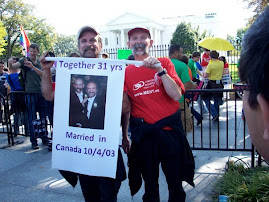
(SAN FRANCISCO) — The California Attorney General, Equality California, and the nation's leading LGBT legal groups agree that the marriages of the estimated 18,000 same-sex couples who married between June 16, 2008 and the possible passage of Proposition 8 are still valid in the state of California and must continue to be honored by the state.
As Attorney General Jerry Brown has stated in previous court papers and as he reaffirmed to the San Francisco Chronicle, those marriages should remain valid notwithstanding Proposition 8's possible passage. On August 5, 2008, Brown told the Chronicle, "I believe that marriages that have been entered into subsequent to the May 15 Supreme Court opinion will be recognized by the California Supreme Court,' He noted that Proposition is silent about retroactivity, and said, 'I would think the court, in looking at the underlying equities, would most probably conclude that upholding the marriages performed in that interval before the election would be a just result.'"
There is absolutely nothing in the language of Proposition 8 to suggest that the initiative would apply to couples who have already legally married. Unless the language of an initiative specifically says that it is to be applied retroactively, California's courts have been very reluctant to do so, especially when the newly passed measure is in such stark conflict with existing constitutional provisions.
Although it is extremely unlikely that California courts would apply the initiative retroactively, the proponents of Proposition 8 may file a legal challenge trying to invalidate the marriages of those who married before Proposition 8 possibly passed. The LGBT legal groups remain committed to ensuring that all the couples who married in California continue to receive the legal protections and to have their marriages respected as required under California law and will vigorously fight any attempts to take rights away from couples and families.
Wednesday, November 5, 2008
Lambda Legal: California Will Continue to Honor Marriages of Same-Sex Couples Who Married Before the Possible Passage of Prop 8


Lambda Legal: Legal Groups File Lawsuit Challenging Proposition 8, Should It Pass
Lambda Legal: Legal Groups File Lawsuit Challenging Proposition 8, Should It Pass
Legal Groups File Lawsuit Challenging Proposition 8, Should It Pass
Legal Papers Claim Initiative Procedure Cannot Be Used To Undermine the Constitution's Core Commitment To Equality For Everyone
SAN FRANCISCO — The American Civil Liberties Union, Lambda Legal and the National Center for Lesbian Rights filed a writ petition before the California Supreme Court today urging the court to invalidate Proposition 8 if it passes. The petition charges that Proposition 8 is invalid because the initiative process was improperly used in an attempt to undo the constitution's core commitment to equality for everyone by eliminating a fundamental right from just one group — lesbian and gay Californians. Proposition 8 also improperly attempts to prevent the courts from exercising their essential constitutional role of protecting the equal protection rights of minorities. According to the California Constitution, such radical changes to the organizing principles of state government cannot be made by simple majority vote through the initiative process, but instead must, at a minimum, go through the state legislature first.
The California Constitution itself sets out two ways to alter the document that sets the most basic rules about how state government works. Through the initiative process, voters can make relatively small changes to the constitution. But any measure that would change the underlying principles of the constitution must first be approved by the legislature before being submitted to the voters. That didn't happen with Proposition 8, and that's why it's invalid.
"If the voters approved an initiative that took the right to free speech away from women, but not from men, everyone would agree that such a measure conflicts with the basic ideals of equality enshrined in our constitution. Proposition 8 suffers from the same flaw — it removes a protected constitutional right — here, the right to marry — not from all Californians, but just from one group of us," said Jenny Pizer, Senior Counsel with Lambda Legal. "That's too big a change in the principles of our constitution to be made just by a bare majority of voters."
"A major purpose of the constitution is to protect minorities from majorities. Because changing that principle is a fundamental change to the organizing principles of the constitution itself, only the legislature can initiate such revisions to the constitution," added Elizabeth Gill, a staff attorney with the ACLU of Northern California.
The lawsuit was filed today in the California Supreme Court on behalf of Equality California and 6 same-sex couples who did not marry before Tuesday's election but would like to be able to marry now.
The groups filed a writ petition in the California Supreme Court before the elections presenting similar arguments because they believed the initiative should not have appeared on the ballot, but the court dismissed that petition without addressing its merits. That earlier order is not precedent here.
"Historically, courts are reluctant to get involved in disputes if they can avoid doing so," said Shannon Minter, Legal Director of NCLR. "It is not uncommon for the court to wait to see what happens at the polls before considering these legal arguments. However, now that Prop 8 may pass, the courts will have to weigh in and we believe they will agree that Prop 8 should never have been on the ballot in the first place."
This would not be the first time the court has struck down an improper voter initiative. In 1990, the court stuck down an initiative that would have added a provision to the California Constitution stating that the "Constitution shall not be construed by the courts to afford greater rights to criminal defendants than those afforded by the Constitution of the United States." That measure was invalid because it improperly attempted to strip California's courts of their role as independent interpreters of the state's constitution.
In a statement issued earlier today, the groups stated their conviction, which is shared by the California Attorney General, that the state will continue to honor the marriages of the 18,000 lesbian and gay couples who have already married in California. A copy of the statement as well as the writ petition filed today is available a www.aclu.org/lgbt, www.lambdalegal.org, and www.nclrights.org.
California voters approve constitutional ban on same-sex marriage, opponents refuse to concede defeat - San Jose Mercury News
California voters approve constitutional ban on same-sex marriage, opponents refuse to concede defeat - San Jose Mercury News
By Mike Swift
After an intense campaign that cost more than $75 million, California's voters have approved a constitutional ban on same-sex marriage, dealing a huge blow to the gay rights movement and setting the stage for another round of court battles over the volatile issue.
Opponent this morning refused to concede the outcome, saying there may be as many as four million uncounted ballots.
"We are not in a position to call this. Really this is just fundamental,'' said Kate Kendell, executive director for the National Center for Lesbian Rights. "We really need to wait until there is something authoritative issued by the Secretary of State's office. Until that happens, we do not feel it is appropriate for us to make our own call, absent the counting of millions of ballots.''
While the Yes on 8 campaign claimed victory just before midnight, the numbers continued to play out in their favor this morning. Still, advocates of same-sex marriage had clung to hopes that a surge of support from uncounted votes could still overcome the ban.
But this morning, with 95 percent of precincts reporting, the measure passed with 52 percent in favor, and 47.9 percent opposed. There are an untold number of absentee and provisional ballots left to be counted, according to the Associated Press, but it will be hard to overcome the 5 percent margin. The San Francisco City Attorney's office says he plans to file the legal challenge in the California Supreme Court to challenge the validity of the measure. Also, the first lesbian couple to be married in Los Angeles County after the Supreme Court threw out the gay marriage ban plans to announce a lawsuit arguing that the proposition is unconstitutional.
"I think the story is that a strong majority of Californians support traditional marriage and they want to see it protected," said Frank Schubert, manager of the Yes on 8 campaign. "I think the story is we ran a far better campaign than the other side. I think we had 100,000 people that gave of their resources and their time."
The measure trims the number of states in which gays and lesbians can legally marry from three to two. But in striking the most populous and culturally influential state from that list, social conservatives and religious leaders have scored a much broader victory, likely limiting for years the hopes of gay rights leaders to allow same-sex couples to marry across the United States.
For same-sex marriage supporters, it was a bitter loss, after major polls had consistently shown the measure losing through the fall.
In San Jose, Ronni Pahl, a member of one of the first two same-sex couples married in Santa Clara County, watched the returns with her wife, Hannah, and son Isaiah with a potent mix of emotion.
"It's bittersweet right now because we just watched the first African-American president elected. We were watching it with our African-American son, there were tears coming out of our eyes, and we went to look at what's happening at 8," Pahl said. "We're speechless right now."
In Santa Clara County, Proposition 8 was soundly defeated, losing by a 10 percent margin. The measure also trailed in Alameda, San Mateo and Santa Cruz counties, as well as in San Francisco.
But as election evening wore on, that opposition was overwhelmed by more conservative areas of the state, particularly in the inland counties. The same-sex marriage ban had attracted more than 60 percent of the vote in Riverside County, and two-thirds of the vote in San Joaquin County, with more than half of precincts reporting in those counties.
And despite the decisive win of Democratic nominee Barack Obama, in California and the rest of the country, polls were wrong in another way: They had predicted that the tide of Obama voters would block Proposition 8 from passing. But even in Santa Clara County, Obama captured a much higher share of the vote than the proportion who voted against Proposition 8.
Schubert said the Yes on 8 campaign never trusted the polls.
"We've always felt that if we were tied going into Election Day, or a few points behind, we were going to win," he said. The decision "is something that I think will reverberate across the nation and around the world."
While the new constitutional ban goes into effect immediately, it's less clear what the effect will be on same-sex couples who married from June 16 through Tuesday. While Attorney General Jerry Brown has said he does not believe Proposition 8 is retroactive, that issue is likely to wind up back in the courts, as well as an anticipated challenge to whether it is constitutional for California to revive its ban on same-sex marriage.
The race began to tighten when the Yes on 8 campaign began running ads that suggested that churches could lose their tax-exempt status if clergy refused to do gay weddings and that second-graders would be taught about gay marriage.
The figurehead of those ads: San Francisco Mayor Gavin Newsom, proclaiming in a speech that gay marriage was now legal in California "whether you like it or not."
Yes on 8 supporters were feeling confident Tuesday night, even as the polls began to close.
"The momentum has really been with us," said Chip White, the press secretary for the Yes on 8 campaign. "The trend has been in our direction ever since we went with that Gavin Newsom ad on Sept. 29."
David McCuan, a political-science professor at Sonoma State University, said the move to victory for the Yes on 8 campaign might have begun here, when a campaign pushing for passage of an initiative began to behave like a classic "No" campaign — by injecting doubt about the effect of a proposed "change" into the minds of voters.
Because gay marriage was so new in California, it allowed Yes on 8 campaign manager Frank Schubert to operate as if what was technically the status quo was actually a proposed change, and trying to inject doubt into the minds of voters about that "change."
Schubert "essentially ran a No side campaign on the Yes side of this ballot measure and that has made it more sophisticated and less faith-based message," McCuan said.
Given Obama's victory, "it's a stunning, stinging defeat," McCuan said. "This is a Democratic blue wave and standing out in one of the bluest of the blue states is this huge red result."
The Associated Press contributed to this report. Contact Mike Swift at mswift@mercurynews.com or at (408) 271-3648.
Conn. voters decide not to change constitution -- Newsday.com
a bit of good new CT marriage is safe. A proposal to
Conn. voters decide not to change constitution -- Newsday.com
Conn. voters decide not to change constitutionBy PAT EATON-ROBB | Associated Press Writer
November 4, 2008
HARTFORD, Conn. - Voters in Connecticut decided Tuesday against holding a convention to amend the state's constitution, dealing a major blow to opponents of same-sex marriage.
With 59 percent of votes counted, the question failed 60 percent to 40 percent.
Connecticut voters are asked every 20 years whether the state should hold convention during which delegates can rewrite the entire constitution. The last constitutional convention was held in 1965 to correct a flawed system of apportioning representatives to the General Assembly.
This time, proponents had hoped to change the constitution to allow citizens the opportunity to bypass the legislature and petition for changes in state law through direct ballot initiatives.
Various proponents had hoped to use initiative and referendum to amend the state's eminent domain laws, cap property taxes, impose term limits, or impose mandatory life sentences for certain violent crimes.
But the biggest support for the question came from those who viewed a convention as the easiest path toward overturning last month's state Supreme Court ruling that found banning gay marriage unconstitutional. Connecticut is the third state, after Massachusetts and California, to offer gay marriage, with the first unions scheduled as early as Nov. 12.
"All of our joy had been a little bit tempered waiting for these results," said Anne Stanback, executive director of the gay-rights group Love Makes a Family. "You're going to see a lot of celebration tonight, and leading up to Nov. 12."
Supporters of the constitutional convention included Gov. M. Jodi Rell, who has said citizens should have more opportunities for referendums, with thresholds and guidelines about what can be on the ballots.
Matthew Daly of Glastonbury, who headed the effort to approve the convention, said opponents were able to frame the issue as being about special interests and gay marriage.
"We did our best to convey to the voters that we were not about a single issue, and that we were about direct initiative," he said. "When you are carpet bombed by a litany of negative ads, and you don't have the resources to respond, it makes it very difficult."
Opponents included Attorney General Richard Blumenthal, who argued a constitutional conventions would lead to "a costly open-ended free-for-all that could well be dominated by special interests."
He pointed out the constitution can be more easily amended through legislation. Any amendment needs a three-quarters vote of both General Assembly houses to go on the ballot, or a simple majority in two consecutive legislative sessions.
There have been 31 amendments passed since 1965, including one on Tuesday. It will allow people who turn 18 years old between the primary and general elections should be allowed to vote in those primaries.
With 59 percent of votes cast, voters were supporting the proposal 65 percent to 35 percent.
Voters approve proposal to ban gay marriage
Another loss.
Voters approve proposal to ban gay marriage
by Mary Jo Pitzl - Nov. 5, 2008 12:00 AM
The Arizona Republic
The second time around proved the charm, as Arizona voters approved a constitutional amendment that bans same-sex marriage.
Proposition 102 proposed a 20-word amendment to the state Constitution to define marriage as between one man and one woman. It's an attempt to do what backers couldn't do in 2006: ensure that Arizona's existing law banning same-sex marriages will not be overturned by a judge.
"Prop. 102's victory shows that a simple and timeless value like marriage unites people of all ethnic, religious and political backgrounds," said Cathi Herrod, president of the Center for Arizona Policy, which lobbied heavily to get lawmakers to refer the matter to the ballot.
In 2006, Arizona voters rejected a same-sex marriage amendment, making it the only state ever to turn down such a ban. However, that measure included a provision that would have barred state and local governments from offering domestic-partner benefits to their employees, and many felt that doomed the measure two years ago.
The marriage amendment returned to the political arena this year after a contentious debate in the state Senate that mirrored the passions the marriage issue creates in society.
Its immediate effect is no change: Same-sex marriage already is against the law in Arizona and the ban has been upheld by the courts.
But proponents, many of them coming from Arizona's churches, argued that the constitutional amendment is needed to guard against a potential legal turnabout.
A similar ban passed in Florida and appeared to be winning in California.
The Associated Press: Florida voters pass amendment banning gay marriage
THEY CHOOSE TO DISCRIMINATE AGAINST A PROTECTED CLASS AND THEIR FELLOW AMERICANS. WE HAVE TO WORK HARD AND CONTINUE THE FIGHT THIS IS THE FIRST OF THREE DEFEATS CALIFORNIA BEING THE MOST DEVESTATING.
THIS DEFIES OUR CONSTITUTION. NOW WE NEED TO FIGHT TO OVERTURN DOMA!
The Associated Press: Florida voters pass amendment banning gay marriage
MIAMI (AP) — Florida voters have narrowly approved adding language to the state constitution that bans same-sex marriage.
The constitution will define marriage as only between a man and a woman. Florida already has a prohibition against gay marriage in state law, but supporters say the new definition was important to prevent court rulings allowing same-sex marriage like those in Massachusetts, California and Connecticut.
With 99 percent of the expected vote counted early Wednesday, the amendment had just over 62 percent support. It needed 60 percent to pass.
Opponents had argued that the amendment's language was flawed and that passing it would create problems. Florida will now be one of approximately 30 states with a definition of marriage in its constitution.
Monday, November 3, 2008
Debunking the myths used to promote the ban on same-sex marriage No on Proposition 8
This is excellent too bad this wasn't stated earlier
No on Proposition 8 - Los Angeles Times
November 2, 2008
Clever magicians practice the art of misdirection -- distracting the eyes of the audience to something attention-grabbing but irrelevant so that no one notices what the magician is really doing. Look over at that fuchsia scarf, up this sleeve, at anything besides the actual trick.
The campaign promoting Proposition 8, which proposes to amend the state Constitution to ban same-sex marriages, has masterfully misdirected its audience, California voters. Look at the first-graders in San Francisco, attending their lesbian teacher's wedding! Look at Catholic Charities, halting its adoption services in Massachusetts, where same-sex marriage is legal! Look at the church that lost its tax exemption over gay marriage! Look at anything except what Proposition 8 is actually about: a group of people who are trying to impose on the state their belief that homosexuality is immoral and that gays and lesbians are not entitled to be treated equally under the law.
That truth would never sell in tolerant, live-and-let-live California, and so it has been hidden behind a series of misleading half-truths. Once the sleight of hand is revealed, though, the campaign's illusions fall away.
Take the story of Catholic Charities. The service arm of the Roman Catholic Church closed its adoption program in Massachusetts not because of the state's gay marriage law but because of a gay anti-discrimination law passed many years earlier. In fact, the charity had voluntarily placed older foster children in gay and lesbian households -- among those most willing to take hard-to-place children -- until the church hierarchy was alerted and demanded that adoptions conform to the church's religious teaching, which was in conflict with state law. The Proposition 8 campaign, funded in large part by Mormons who were urged to do so by their church, does not mention that the Mormon church's adoption arm in Massachusetts is still operating, even though it does not place children in gay and lesbian households.
How can this be? It's a matter of public accountability, not infringement on religion. Catholic Charities acted as a state contractor, receiving state and federal money to find homes for special-needs children who were wards of the state, and it faced the loss of public funding if it did not comply with the anti-discrimination law. In contrast, LDS (for Latter-day Saints) Family Services runs a private adoption service without public funding. Its work, and its ability to follow its religious teachings, have not been altered.
San Francisco field trip? The children who attended the wedding had their parents' signed permission, as law requires. A year ago, with the same permission, they could have traveled to their teacher's domestic-partnership ceremony. Proposition 8 does not change the rules about what children are exposed to in school. The state Education Code does not allow schools to teach comprehensive sex education -- which includes instruction about marriage -- to children whose parents object.
Another "Yes on 8" canard is that the continuation of same-sex marriage will force churches and other religious groups to perform such marriages or face losing their tax-exempt status. Proponents point to a case in New Jersey, where a Methodist-based nonprofit owned seaside land that included a boardwalk pavilion. It obtained an exemption from state property tax for the land on the grounds that it was open for public use and access. Events such as weddings -- of any religion -- could be held in the pavilion by reservation. But when a lesbian couple sought to book the pavilion for a commitment ceremony, the nonprofit balked, saying this went against its religious beliefs.
The court ruled against the nonprofit, not because gay rights trump religious rights but because public land has to be open to everyone or it's not public. The ruling does not affect churches' religious tax exemptions or their freedom to marry whom they please on their private property, just as Catholic priests do not have to perform marriages for divorced people and Orthodox synagogues can refuse to provide space for the weddings of interfaith couples. And Proposition 8 has no bearing on the issue; note that the New Jersey case wasn't about a wedding ceremony.
Much has been made about same-sex marriage changing the traditional definition of marriage. But marriage has evolved for thousands of years, from polygamous structures in which brides were so much chattel to today's idealized love matches. In seeking to add a sentence to California's Constitution that says, "Only marriage between a man and a woman is valid or recognized," Proposition 8 supporters seek to enforce adherence to their own religious or personal definition. The traditional makeup of families has changed too, in ways that many religious people find immoral. Single parents raise their children; couples divorce and blend families. Yet same-sex marriage is the only departure from tradition that has been targeted for constitutional eradication.
Religions and their believers are free to define marriage as they please; they are free to consider homosexuality a sin. But they are not free to impose their definitions of morality on the state. Proposition 8 proponents know this, which is why they have misdirected the debate with highly colored illusions about homosexuals trying to take away the rights of religious Californians. Since May, when the state Supreme Court overturned a proposed ban on same-sex marriage as unconstitutional, more than 16,000 devoted gay and lesbian couples have celebrated the creation of stable, loving households, of equal legal stature with other households. Their happiness in no way diminishes the rights or happiness of others.
Californians must cast a clear eye on Proposition 8's real intentions. It seeks to change the state Constitution in a rare and terrible way, to impose a single moral belief on everyone and to deprive a targeted group of people of civil rights that are now guaranteed. This is something that no Californian, of any religious belief, should accept. Vote no to the bigotry of Proposition 8.