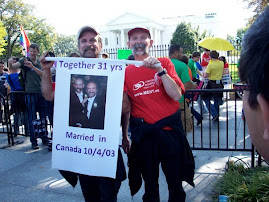
The Associated Press: Hollywood joins the furor over gay marriage ban
By DERRIK J. LANG – 3 days ago
LOS ANGELES (AP) — Thousands of protesters are angry about California's ban on gay marriage — and so are the stars.
Many celebrities grieved the passing of Proposition 8 in California this week. Some — such as Wanda Sykes, Rose McGowen and Lance Bass — attended a Wednesday protest criticizing the state's gay marriage ban. Others — like Ellen DeGeneres, Rosie O'Donnell, Samantha Ronson and Melissa Etheridge — vented their frustrations online, on TV, and onstage.
Blocks away from the Thursday rally of more than 2,000 gay-rights advocates outside the gates of a Mormon temple, several stars — including James Cromwell, Patricia Clarkson, Anjelica Huston and Sean Penn — said they supported the protesters while walking the red carpet at the BAFTA L.A. Brittania Awards at Hyatt Regency Century Plaza Hotel.
"I think it might be an idea to go out and join them shortly," Penn said. "It was a shameful decision that was made."
Etheridge, who exchanged vows with her longtime partner in a 2003 ceremony, declared she wouldn't pay her taxes in a blog entry posted Thursday on TheDailyBeast.com. The gay Oscar- and Grammy-winning singer-songwriter said without the right to marry in California, she didn't think she should have to pay taxes because "I am not a full citizen."
"I don't mean to get too personal here," Etheridge wrote. "But there is a lot I can do with the extra half a million dollars that I will be keeping instead of handing it over to the state of California. Oh, and I am sure Ellen will be a little excited to keep her bazillion bucks that she pays in taxes, too."
DeGeneres posted a brief message of support for President-elect Barack Obama and the gay-rights advocates protesting against Proposition 8 on her show's Web site Friday. The talk show host, who married actress Portia de Rossi in August, previously donated $100,000 against the ballot initiative and starred in a commercial lamenting the measure.
"So there was a demonstration here on Wednesday night," DeGeneres wrote, "and just before I walked out here, I was watching the news and there is a huge, huge, peaceful demonstration going on in the streets, and I say, good for you, and I support you, and if I weren't here, I'd be out there with you."
O'Donnell, who lives in New York, responded to comments and questions about her stance on the issue on her Web site. When one person said he understood why she didn't come out against the proposition, O'Donnell responded: "I AM AGAINST PROP 8. DUH." She also wrote she believes the estimated 18,000 gay marriages would be annulled "like mine was years ago."
The former talk show host, who lives in New York with partner Kelli Carpenter and their four children, publicly wed Carpenter in San Francisco in 2004, two weeks after Mayor Gavin Newsom authorized granting marriage licenses to same-sex couples. The licenses were later voided by the California Supreme Court.
Also ranting online was celebrity disc jockey Samantha Ronson. Lindsay Lohan's gal pal blogged Thursday that she was shocked California voters approved an animal-rights initiative but that ballot measures about gay marriage and adoption in California, Florida, Arizona and Arkansas were shot down.
"I guess people care more about farm animals than they do their fellow man, that's really sad to me," Ronson wrote on her MySpace blog. "Yes, I am glad that the chickens will have more room and better conditions as they wait to die, but I just think it's frightening that people show more compassion for tomorrow's dinner than for the chef."
Other celebs used time in the spotlight to decry the decision. Madonna took a moment during her concert at Dodger Stadium to declare to the audience that she was sad "because African-Americans are equal finally, but gay marriage is not." Former teen queen Christina Aguilera also spoke out against the ban.
"I think it's discrimination," Aguilera said in a Thursday interview with MTV News. "I don't understand how people can be so close-minded and so judgmental. We chose an African-American president who means so much in a time in history of great change and open-mindedness. Why is this any different? It just doesn't make sense to me."
Tuesday, November 11, 2008
Hollywood joins the furor over gay marriage ban


Gay bans embolden conservative religious groups | 365 Gay News
Beware they are headed in our direction. Time to fight back!
Gay bans embolden conservative religious groups | 365 Gay News
By The Associated Press
11.08.2008 3:38pm EST
(Los Angeles, California) Energized by a comeback win, conservative activists want to apply the same formula they used to outlaw same-sex marriage in California to prevent other states from recognizing gay unions and President-elect Barack Obama from expanding the rights of gays and lesbians.
Send / ShareAdd CommentLeaders of the successful Proposition 8 campaign say an unusual coalition of evangelical Christians, Mormons and Roman Catholics built a majority at the polls Tuesday by harnessing the organizational muscle of churches to a mainstream message about what school children might be taught about gay relationships if the ban failed.
Same-sex marriage bans also won in Arizona and Florida. But in putting together the California victory, the coalition overcame opposition from the state’s political establishment and assumptions about how voters in the famously tolerant state would respond to taking away the rights the state’s highest court granted this spring.
“Everyone told me it could not be done, people do not care about this enough, you will be overwhelmed and you will lose,” said Maggie Gallagher, executive director of the National Organization for Marriage, a New Jersey group that provided seed money early this year to qualify the measure for the ballot.
“This is an issue people care about when they understand what is at stake and we mount a vigorous and visible defense of marriage,” Gallagher said.
Same-sex couples are expected to start marrying next week in Connecticut, the third state after Massachusetts and California where courts have held it was unconstitutional to bar same-sex couples from marrying.
Unlike California, Connecticut does not have an initiative process that would allow voters to override the judicial decision there. So Gallagher said anti-gay marriage groups plan to focus next on New Jersey and New York, where the state legislatures are being lobbied to pass laws legalizing same-sex marriage.
The plan is to mobilize the same religious factions that joined forces in California to deter lawmakers from “taking on this divisive social issue while we are in the middle of a huge financial crisis,” Gallagher said.
Campaign operatives attribute their success to the churches, which served as voter registration centers, phone banks and volunteer recruitment hubs.
Religious institutions also gave Proposition 8’s sponsors an avenue to a range of ethnic voters, including many Democrats, said Mat Staver, who heads the Florida-based Christian legal group Liberty Counsel.
Catholic and evangelical Hispanics and African-American Baptists stood alongside conservative white evangelicals in arguing for traditional marriage. Exit polls showed 70 percent of blacks supported the ban, a far higher percentage than any other race.
“This is an issue that … transcends political ideology, religious affiliations, races and time and history,” said Staver. “It brings people together who ordinarily wouldn’t be sitting at the same table together.”
Gay-right activists attribute their loss in California in large part to overconfidence among Proposition 8 opponents. Although polls showed the measure far behind in mid-September, the Yes-on-8 campaign was raising far more money than its opponents.
“There was a lot of complacency. People didn’t believe it could have been this close, so we had to scramble to raise money.” said Yvette Martinez, political director for Equality for All, the coalition of gay, civil rights and liberal religious groups formed to fight the initiative.
Martinez also blamed a Yes-on-8 TV ad featuring a little girl telling her mother she had learned in school that she could grow up to marry a princess. Spanish-language ads were released on the same theme.
Proposition 8 says nothing about education, but gay-marriage opponents say allowing same-sex weddings would have affected what California public-school students are taught. Gay-rights groups disputed that, noting that the schools already are required to teach tolerance of gays and lesbians.
“Those lies penetrated,” said Martinez. “People believed that we were going to force gay marriage into the classroom, and there is no getting around people wanting to protect their children and to make decisions for their own family.”
Perhaps the most crucial faith-based ingredient of the California campaign was the Church of Jesus Christ of Latter-day Saints. The Mormon church was invited into the coalition by San Francisco’s Roman Catholic Archbishop George Neiderauer, who previously spent 11 years as bishop of the Catholic diocese of Utah.
Mormons make up less than 2 percent of the California population with a religious preference, but it is widely believed that church members around the country were responsible for a major share of the more than $36 million raised to pass the gay marriage ban.
Gay-marriage opponents say the bipartisan, multiracial alliance that helped Proposition 8 pass could be instrumental in fighting any steps Obama takes as president to expand the rights of gays and lesbians.
“Those can be activated and pressure can be put on senators and congressional leaders who are not as left-leaning as Barack Obama to not follow his agenda,” Staver said.
During his campaign for the White House, Obama pledged to work for repeal of the 1996 federal Defense of Marriage Act, which prevents the federal government from affording Social Security and other benefits to same-sex couples. He also vowed to reverse the Defense Department policy that prevents openly gay people from serving in the military.
Kate Kendell, executive director of the National Center for Lesbian Rights, said she isn’t worried the Proposition 8 campaign has produced a new political juggernaut, noting that the religious denominations that worked together in California have deep theological and spiritual differences.
Kendell, who was raised Mormon, said she was astonished to see black pastors working alongside members of a religion that did not allow blacks to serve as priests until she was in high school.
“Any time a coalition is formed for the expediency of one issue, it is very hard to hold it together,” Kendell said.
Friday, November 7, 2008
Thousands in Los Angeles protest gay-marriage ban | National news | Chron.com - Houston Chronicle
Thousands in Los Angeles protest gay-marriage ban | National news | Chron.com - Houston Chronicle
LOS ANGELES — Outside the gates of a Mormon temple, Kai Cross joined more than 2,000 gay-rights advocates in a chorus of criticism of the church's role in a new statewide ban on same-sex marriage.
Once a devout Mormon who graduated from Brigham Young University, the 41-year-old Cross was disowned by his family and his church after he was outed as a gay man in 2001.
"They are on the losing side of history," Cross said Thursday of the church's opposition to gay marriage. Cross and other protesters blame leaders of the Church of Jesus Christ of Latter-day Saints for encouraging Mormons to funnel millions of dollars into television ads and mailings in favor of Proposition 8.
The ballot measure passed Tuesday, which was sponsored by a coalition of religious and social conservative groups, amends the California Constitution to define marriage as a heterosexual act. It overides a state Supreme Court ruling that briefly gave same-sex couples the right to wed.
The protest came amid questions about whether attempts to overturn the prohibition can succeed and whether the 18,000 same-sex marriages performed in California over the past four months are in any danger.
For Cody Krebs, 27, four months was not enough time to fulfill his "intense hope" to marry one day; he and his boyfriend have been together for little more than a year, so they aren't ready to wed.
On Thursday, Krebs dodged eggs hurled at protesters from an apartment building. He said he'd seen worse growing up in Salt Lake City.
"It's important to come out like this because it gets the gay community into the public eye," Krebs said. "I feel like this has started a lot of conversations that had to get started."
The demonstration began outside the temple in the Westwood section of Los Angeles and noisily spilled through the western side of the city, with chants of "Separate church and state" and "What do we want? Equal rights." Some protesters waved signs saying "No on H8" or "I didn't vote against your marriage," and many equated the issue with the civil rights struggle.
Two people were arrested after a confrontation between the crowd and an occupant of a pickup truck that had a banner supporting Proposition 8. One demonstrator ended up with a bloody nose in the fracas. Seven arrests occurred during Los Angeles-area street marches late Wednesday.
The temple protest was organized by the L.A. Gay & Lesbian Center. Its chief executive, Lorri Jean, announced a Web-based effort dubbed InvalidateProp8.org to raise money to fight the constitutional amendment.
Gay-marriage proponents filed three court challenges Wednesday against the ban. The lawsuits raise a rare legal argument: that the ballot measure was actually a dramatic revision of the California Constitution rather than a simple amendment. A constitutional revision must first pass the Legislature before going to the voters.
Andrew Pugno, attorney for the groups that sponsored the amendment, called the lawsuits "frivolous and regrettable."
"It is time that the opponents of traditional marriage respect the voters' decision," he said.
The high court has not said when it will act. State officials said the ban on gay marriage took effect the morning after the election.
"We don't consider it a `Hail Mary' at all," said Kate Kendell, executive director of the National Center for Lesbian Rights. "You simply can't so something like this — take away a fundamental right at the ballot."
With many gay newlyweds worried about what the amendment does to their vows, California Attorney General Jerry Brown said he believes those marriages are still valid. But he is also preparing to defend that position in court.
The amendment does not explicitly say whether it applies to those already married. Legal experts said unless there is explicit language, laws are not normally applied retroactively.
"Otherwise a Pandora's Box of chaos is opened," said Stanford University law school professor Jane Schacter. Still, Schacter cautioned that the question of retroactivity "is not a slam dunk."
An employer, for instance, could deny medical benefits to an employee's same-sex spouse. The worker could then sue the employer, giving rise to a case that could determine the validity of the 18,000 marriages.
Supporters of the ban said they will not seek to invalidate the marriages already performed and will leave any legal challenges to others.
A 2003 California law already gives gays registered as domestic partners nearly all the state rights and responsibilities of married couples when it comes to such things as taxes, estate planning and medical decisions. That law is still in effect.
___
Associated Press writer Paul Elias in San Francisco contributed to this report
Gay-Marriage Ban Sets Up Host of Battles - WSJ.com
There is hope
Gay-Marriage Ban Sets Up Host of Battles - WSJ.com
Gay-Marriage Ban Sets Up Host of Battles
California's Proposition 8 Is Challenged in State Court; What Happens to Previously Wed Couples?By ASHBY JONES
Voters on Tuesday approved Proposition 8, which adds to the state constitution the following sentence: "only marriage between a man and a woman is valid or recognized in California."
While the wording is simple, the situation quickly became complicated. For example, what happens to those same-sex couples who married before the ruling? Legal challenges filed Wednesday raised other questions: Was the referendum process itself lawful? Does the new language conflict with other parts of the state constitution? Separately, should Proposition 8 opponents have filed challenges saying the proposition violated the U.S. Constitution?
David Cruz, a constitutional-law expert at the University of Southern California, has some answers.
WSJ: Please explain the grounds upon which Proposition 8 is being challenged in court.
Mr. Cruz: The lawsuits challenge the procedure by which the referendum was passed. Under California law, there are two categories of changes that can be made to the state constitution: amendments and revisions. Amendments are more minor changes; revisions are larger in effect. This is important because each has its own process for taking effect, essentially different ways they go before the voters. An amendment can go in the form of a ballot initiative, which requires a certain number of signatures to make its way on. Constitutional revisions, however, have to have a two-thirds blessing from each house of the state legislature to make the ballot.
Now, the problem, at least from the point of view of Proposition 8 supporters, is that the legislature had previously indicated a willingness to support same-sex marriage. So the proposition's supporters were unwilling to treat this bill as a revision and send it to the legislature, opting instead to treat it as an amendment. So the Proposition 8 opponents are arguing that this change actually constitutes a revision, not an amendment, and therefore needed to go through the legislature.
WSJ: Were any other issues raised in the suits?
Mr. Cruz: Yes. A same-sex couple that was married before the election made another argument. Remember, the California Supreme Court in May ruled that bans on same-sex marriage were not allowed under the state's constitution. (That ruling prompted Proposition 8.) Now, in that ruling, the Supreme Court essentially said two things: that same-sex couples had a fundamental right to marry and that the underlying law violated the state's equal protection clause.
The suit filed Wednesday argues that while Proposition 8 squarely addressed the marriage half of the Supreme Court's ruling, it didn't address the equal-protection half. In other words, the couple argues that the state constitution is now in conflict with itself -- part of it says that same-sex marriage is flatly illegal, and the Supreme Court has interpreted another part to say that a ban on same-sex marriage violates the state's equal protection clause.
WSJ: And a constitution can't be in conflict with itself?
Mr. Cruz: Right. There's a common principle in constitutional jurisprudence called "harmonization," which says that no part of a constitution can conflict with any other.
WSJ: Provided that the state Supreme Court rejects all these arguments and the constitutional amendment is allowed, you still have this issue as to what happens to the marriages that took place before Proposition 8 was passed, right?
Mr. Cruz: On that question the state Supreme Court would likely look at what the intent of the voters was in passing the law.
WSJ: How would the court determine that? By asking voters?
Mr. Cruz: It would likely look at the language of the proposition itself, in addition to the title, official ballot literature, and to the advertisements that were run during the campaign. Supporters of Proposition 8 point to language on the ballot that explained that voters would be defining marriage as between a man and woman, "regardless of when or where performed." That seems to argue for invalidating the earlier marriages. But the attorney general, Jerry Brown, will likely raise the official title of the proposition, which mentions the elimination of the "right of same-sex couples to marry." Here, there's no mention of the earlier marriages, and it seems to indicate that it's the right to get married going forward that's being taken away.
Write to Ashby Jones at ashby.jones@wsj.com
Letters - A Setback for Same-Sex Marriage - NYTimes.com
Letters - A Setback for Same-Sex Marriage - NYTimes.com
Letters
A Setback for Same-Sex Marriage
The public speaks
On Election Day, we as a nation were able to exclaim a phrase uttered by the late, great Tim Russert: “What a country!” The election of our nation’s first African-American president was indeed historic.
Yet while we helped close the book on one ugly chapter of our nation’s history, we left unfinished another.
To see three states pass bans on gay marriage and one state bar gay people from becoming adoptive and foster parents was disheartening.
I believe it to be a travesty that two people would be denied the chance to be married and become parents based solely on their sexual orientation.
In an election that ushered in a new era of change, apparently some bigotry remains.
I am amazed at how far we have come, yet also how far we still have to go. Bryce Hopkins
Buffalo, Nov. 6, 2008
•
To the Editor:
Straight people are allowed to marry and divorce multiple times. They can get drunk and get married in the middle of the night in Las Vegas by going to a drive-through chapel. They can get on a show like “The Bachelor” and sell themselves on national television to find a spouse.
But somehow my 25-year relationship with my partner is a threat to the “sanctity” of the institution of marriage.
The vote in California on Proposition 8 was more than just wrong. It was immoral and pathetic. Mitch Kohn
West Hollywood, Calif., Nov. 6, 2008
•
To the Editor:
That the passing of Proposition 8 in California was pushed so forcefully by religious organizations underscores that marriage as a governmental contract goes against the principle of the separation of church and state.
If this nation truly supports the separation of church and state, the only governmental piece of paper available to any couple, gay or straight, should be a certificate for civil union, giving equal rights to all.
A marriage certificate, issued by a church and including no civil rights in the eyes of the government, should be available as a separate contract.
Elizabeth Lundgren
Somerville, Mass., Nov. 6, 2008
•
To the Editor:
“Equality’s Winding Path” (editorial, Nov. 6) reveals the true rift over the divisive issue of gay-marriage bans.
You refer to the “ugly outcomes” of the votes, the “defeat for fairness” and “unfair treatment” of “vulnerable groups” — all terms indicative of the fact that you see this issue as one of rights.
The fact that 30 states have now passed similar bans on same-sex marriage should perhaps alert you to the fact that not everyone has accepted that version of the issue, and that many Americans have chosen to define gay marriage not as an issue of rights but as one of morality.
As a country, we are still firmly rooted in a Judeo-Christian ethic that leaves certain unions outside of the pale of acceptability. Aaron Ross
Bergenfield, N.J., Nov. 6, 2008
To the Editor:
Even as we celebrate Barack Obama’s historic election, it should be noted that according to exit polls in California, 70 percent of African-American voters supported the gay-marriage ban.
I hope that the African-Americans who voted against marriage equality will eventually take to heart the lesson it took white Americans so long to learn: when we deny the rights we treasure to others, we only diminish ourselves. Jack Drescher
New York, Nov. 6, 2008
The writer, a psychiatrist, is emeritus editor of The Journal of Gay and Lesbian Mental Health.
•
To the Editor:
As your editorial notes, progress doesn’t come in a straight line.
One bright light in this somber season for marriage equality is Connecticut. Last month its high court ruled that it is unconstitutional to bar same-sex couples from the state’s marriage laws. Starting next Wednesday, same-sex couples will be able to marry.
On that day, when couples approach the town clerk’s counter, we’ll see not only happy, committed partners for life, but also citizens coming before their government as equals.
With hard work, and leadership at the national level, I firmly believe that Californians and every gay and lesbian citizen of this country will get there, too.
Lee Swislow
Boston, Nov. 6, 2008
The writer is executive director of Gay and Lesbian Advocates and Defenders, which represented the couples in both the Connecticut and Massachusetts marriage equality cases.
•
To the Editor:
Yes, true equality for gays has a long way to go, with Florida, Arizona and California enshrining discrimination in their constitutions.
There is a silver lining to Tuesday’s results, however, with the election of Barack Obama and an increase in Democratic Party representation in Congress: it is very unlikely that an amendment to the United States Constitution to ban gay marriage will be passed during his, let’s hope, eight years in office.
It was especially heart-warming that President-elect Obama mentioned a united America that includes gay and straight people in his victory speech in Chicago. That is a major step forward toward ensuring rights for all people, regardless of their sexual orientation.
Claude M. Gruener
Austin, Tex., Nov. 6, 2008
Farm animals have more rights than Gays'
the people of California have voted on Prop 2 and 8 and the results give farm animals more rights and protections than tax paying Gay citizens.
As the minutes pass by I find myself getting more and more angry about the Prop 8 defeat. The LGBT community now knows the experience of outright discrimination. Pray that judges ultimately do the right thing and invalidate this discriminatory proposition. After all the judicial system is set up to interpret the law and the constitution. To protect the rights of the minorities to insure that the minority is not discriminated by popular vote of the majority.
Stay strong, keep fight for our rights and our lives. Keep up the protests.
Michael
Thursday, November 6, 2008
Same-sex marriage issue back to state top court
Same-sex marriage issue back to state top court
(11-05) 18:16 PST SAN FRANCISCO -- A day after California voters approved a state constitutional ban on same-sex marriage, the incendiary issue returned to the state Supreme Court, where gay and lesbian couples and the city of San Francisco filed lawsuits Wednesday seeking to overturn Proposition 8.
And Attorney General Jerry Brown, who represents the state in court, said he would defend the legality of the thousands of same-sex marriages conducted in the 5 1/2 months leading up to election day - even though sponsors of Prop. 8 say the measure was intended to invalidate those marriages. That controversy is also likely to end up before California's high court and could reach the U.S. Supreme Court.
"It is my belief that the courts will hold that these same-sex marriages entered into are valid," Brown said in a statement. He said he would defend Prop. 8 against legal challenges, but would also defend "the marriages contracted during the time that same-sex marriage was the law in California."
A research institute at UCLA has estimated that 18,000 same-sex couples have married in California since the state Supreme Court's ruling legalizing such marriages took effect June 16. In a victory statement Tuesday night, the Yes on 8 campaign asserted that from now on, "only marriage between a man and a woman will be valid or recognized in California, regardless of when or where performed."
Campaign manager Frank Schubert said Wednesday, however, that his organization has no plans to challenge any of those marriages in court. The question will have to be decided by "the court that created that problem" by refusing to suspend its ruling until after the election, he said, without describing how it might reach the court.
Prop. 8 would overturn the court's 4-3 ruling May 15 that declared same-sex couples had the right to marry under the California Constitution on the grounds of privacy and equal protection. Backers of the measure made the court a focus of their campaign, accusing "activist judges" of thwarting the will of voters who had approved a similar measure as an initiative statute in 2000.
Three lawsuits were filed directly with the state Supreme Court on Wednesday, seeking orders immediately blocking enforcement of Prop. 8 and ultimately striking it down as a violation of fundamental rights in the California Constitution.
The plaintiffs are six unmarried same-sex couples and the advocacy group Equality California; another couple who married shortly after the May 15 ruling took effect; and the cities of San Francisco and Los Angeles, joined by Santa Clara County.
Although their lawyers would not discuss their strategy publicly, each suit seeks to overturn Prop. 8 on the basis of state law and avoids federal constitutional claims that could send the case to the U.S. Supreme Court. Gay-rights advocates have tried to keep such disputes away from the nation's high court, out of fear that the justices would issue a nationwide ruling rejecting any right of same-sex marriage under the U.S. Constitution.
That leaves the plaintiffs with the difficult task of showing that Prop. 8, a state constitutional amendment, violates other, more basic provisions of California's Charter. The court has almost always rejected such challenges to other constitutional amendments.
Some of the same legal organizations filing suit Wednesday offered similar arguments this summer to try to remove Prop. 8 from the ballot, but the court refused, while leaving room for a postelection challenge.
The couples' lawsuits contend Prop. 8 is so far-reaching that it is not merely a constitutional amendment but a revision, which requires a two-thirds vote of the Legislature to reach the ballot. Such a vote would be unlikely with the Legislature's houses overwhelmingly controlled by Democrats.
Plaintiffs argued the measure offends constitutional principles by taking important rights away from a historically persecuted minority - gays and lesbians - while stripping judges of their power to protect that group.
"A major purpose of the Constitution is to protect minorities from majorities," said Elizabeth Gill, a lawyer with the American Civil Liberties Union, one of the groups suing on behalf of the six unmarried couples. "Because changing that principle is a fundamental change to the organizing principles of the Constitution itself, only the Legislature can initiate such revisions."
The suit by San Francisco, Los Angeles and Santa Clara County argues that any measure allowing a majority of the public to take away minority rights violates principles of equality at the heart of the state Constitution.
"If allowed to stand, Prop. 8 so devastates the principle of equal protection that it endangers the fundamental rights of any potential electoral minority," said San Francisco City Attorney Dennis Herrera.
Sponsors of the initiative were unimpressed. Andrew Pugno, lawyer for the Prop. 8 campaign, called the legal challenges "an insult to California voters and an attack on the initiative process."
E-mail Bob Egelko at begelko@sfchronicle.com