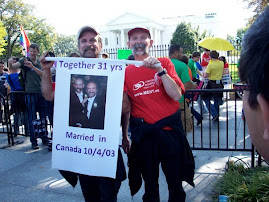
lenghty but informative
Peter Dreier: Gay Marriage: The Tide is Turning And There's No Going Back: "- Sent using Google Toolbar"
Major court decisions on controversial social issues are sometimes ahead of their times. That was certainly the case with judicial rulings decades ago that struck down laws banning interracial marriage. But despite conservative claims that U.S. District Court Judge Vaughn Walker's ruling Wednesday to overturn California's Proposition 8 ban on same-sex marriage is outside the mainstream, the reality is that his decision is in sync with public sentiment.
The gay rights movement has won Americans' hearts and minds. The tide has turned. Opponents can try, but they can't push it back.
Although nobody believes that homophobia has disappeared, polls show that public support for gay rights - including marriage - has increased dramatically in the past decade, especially in the last few years. Moreover, support for gay marriage is much higher among younger Americans, indicating that the future belongs to the advocates, not the opponents, of same-sex marriage. Soon, conservative politicians and groups will no longer be able to use gay marriage as a "wedge" issue to stir controversy and win elections.
The battle for gay marriage is often compared with the struggle to end the prohibition against marriage between blacks and whites. In fact, Americans' attitudes about same-sex marriage changed much more quickly.
In 1948, when California's Supreme Court legalized interracial marriage (the first state to do so) in Perez v Sharp, most Americans opposed it. In the 1950s, when half the states still had laws prohibiting interracial marriage, over 90% of Americans still considered it wrong. By 1967, when the U.S. Supreme Court, in Loving v. Virginia, knocked down state anti-miscegenation laws everywhere, 16 states still had such laws on the books and 72% of the public still opposed interracial marriages.
CLICK LINK ABOVE FOR FULL ARTICLE
Monday, August 9, 2010
Peter Dreier: Gay Marriage: The Tide is Turning And There's No Going Back


Thursday, August 5, 2010
Mexican court upholds capital's gay marriage law - Oroville Mercury Register
Mexican court upholds capital's gay marriage law - Oroville Mercury Register: "- Sent using Google Toolbar"
By MARK STEVENSON Associated Press Writer
Posted: 08/05/2010 12:16:47 PM PDT
MEXICO CITY—The Mexican Supreme Court ruled Thursday that a fledgling law allowing same-sex marriages in Mexico City is constitutional, rejecting an appeal by federal prosecutors who argued that it violated the charter's guarantees to protect the family.
The justices have not yet determined the scope of their 8-2 ruling, however, saying they still need to decide whether it will impact states outside of the capital.
The court must also still rule on the constitutionality of a provision of the Mexico City law that allows same-sex couples to adopt children. It is expected to address that issue next Monday.
Justices who voted on the majority side stressed that while Mexico's constitution enshrines protection for families, it does not define what a "family" is.
Hundreds of couples have been married so far under Mexico City's 6-month-old law, which was the first of its kind to be enacted in Latin America when it went into effect March 4.
"It does not appear to me to be unconstitutional," Justice Jose Gudino said during Thursday's session. "The concept of the family established in the constitution ... is an open concept."
Justice Guillermo Ortiz, who argued against the law, said that "marriage is reserved exclusively for couples who can procreate, because one of the big issues of marriage is the protection of children."
Federal prosecutors had cited an article in Mexico's constitution that suggests—but does not state—that
Advertisement
Quantcast
families are constituted by men, women and children. The article states: "Men and women are equal before the law. This protects the organization and development of the family."
The justices who voted to uphold the law differed in their reasons why: Some stressed the constitution's protection of an individual's right to choose a marriage partner, and others the right of local legislatures to enact laws governing the issue.
Mexico City authorities said that, as of earlier this week, 320 couples had been married: 173 of them male and 147 female.
YouTube - Chad Griffin, AFER Board President, Speaks on Prop 8 Victory
THIS REALLY SUMS IT UP
YouTube - Chad Griffin, AFER Board President, Speaks on Prop 8 Victory: "- Sent using Google Toolbar"
Prop 8 Ruled Unconstitutional, New York City Activists Celebrate - DNAinfo.com
Prop 8 Ruled Unconstitutional, New York City Activists Celebrate - DNAinfo.com
By Jill Colvin and Heather Grossmann
DNAinfo News Editor
MANHATTAN — Hundreds of supporters waving rainbow flags and white carnations gathered outside the Manhattan Supreme Court Wednesday evening to celebrate a federal judge's decision overturning California's ban on gay marriage.
Two same-sex couples and the City of San Francisco filed the successful lawsuit in response to Prop 8, a state voter initiative which barred gay marriage in California in November 2008, only a few months after the State Supreme Court legalized it.
Judge Vaughn Walker's decision in favor of the couples was announced just before 5 p.m. on Wednesday.
Hours after the decision was announced, revellers in New York began gathering at the steps of the courthouse to celebrate the decision, which they hope will pave the way for legalization in New York.
Prop 8 Unconstitutional Judge Rules, New York City Pols and Activists Celebrate"The country got it right today!," City Council Speaker Christine Quinn told the crowd. (Juan Carlos Mosquera/Zoma Rosa Magazine)
"The courts got it right today," City Council Speaker Christine Quinn told the joyful crowd as they waved signs calling for marriage equality in New York.
"This is not just a win for same sex couples in California; it's a victory for all of those who believe in full equality for all Americans," Quinn said.
Marriage Equality New York's Brian Silva, 31, which organized the rally along with activist group Queer Rising, said the ball is now in New York's court.
"We wanted to celebrate the decision and focus New Yorkers' attention in the upcoming election, which is how we'll finally achieve marriage equality," he said.
Michael Sabatino, 59, who has been with his partner Robert Voorheis, 55, for 32 years, cheered as local politicians took to the stage.
"It is justice. It is really justice," Sabatino said as he waved a sign reading, "Our Love Wins!!"
Prop 8 Unconstitutional Judge Rules, New York City Pols and Activists CelebrateCelebrants left white carnations on the court steps to symbolize that the battle has not been won yet. (DNAinfo/Jill Colvin)
"We've been fighting this battle for 13 years," he said. "We're on our way."
A message delivered to the crowd from Gov. David Paterson praised the decision, calling it "one important step in a long struggle and that struggle must continue until equality is achieved."
Civil rights lawyer and former City Council candidate Yetta Kurland, who ran against Quinn in 2009, noted that California's decision comes just six weeks before New York's primary, which she says brings "very significant" publicity to the issue during a key point in the election cycle.
"It's incredible. I feel so proud and this is why I love the United States Constitution," said Kurland. "It's a beautiful and profound statement that makes clear that we don't tolerate discrimination."
Several New York City officials have tried repeatedly to get a marriage equality law passed in New York State, but have so far been unsuccessful.
The executive director of the Empire State Pride Agenda, Ross D. Levi, issued a statement saying that the organization was emboldened by the news that Prop 8 had been struck down, but warning that there was still a long road ahead in New York.
"Our movement is not only about lawyers in a far away courtroom; it’s about everyday New Yorkers who support the freedom to marry and are willing to fight until we achieve it," Levi said.
"The victory in California provides continued momentum here in New York that will allow the Pride Agenda and our community to continue pushing equality and justice on all fronts and with every tool at our disposal."
Supporters of Prop 8 are likely to appeal the judge's decision. If it is appealed, the case will go to the Ninth U.S. Circuit Court of Appeals in San Francisco, and may eventually reach the U.S. Supreme Court.
Read more: http://www.dnainfo.com/20100804/manhattan/prop-8-decision-spurs-gathering-of-new-york-city-pols-activists#ixzz0vjTfazq6
Leonard Link: Federal Trial Court Rules That Proposition 8 Violates the 14th Amendment
Friend Art Leonard gives an analysis below
Leonard Link: Federal Trial Court Rules That Proposition 8 Violates the 14th Amendment: "- Sent using Google Toolbar"
U.S. District Judge Vaughn R. Walker has ruled that Proposition 8, the 2008 California ballot measure that enacted an amendment to the California Constitution providing that only the union of one man and one woman would be valid or recognized as a marriage in California, violates the 14th Amendment of the U.S. Constitution. In a 138 page opinion summarizing the trial record in excruciating detail, Judge Walker found that there was absolutely no rational basis for California to exclude same-sex couples from the same right to marry that is provided for different-sex couples, thus violating the plaintiffs’ fundamental right to marry as well as their right to equal protection of the laws. Perry v. Schwarzenegger, No. C 90-2292 VRW (August 4, 2010).
The official proponents of Proposition 8, who were allowed to intervene as defendants in the case after Attorney General Gerry Brown indicated he agreed with plaintiffs and the other named defendants, including Governor Arnold Schwarzenegger, refused to take a position on the merits of the case, had filed an application for a stay even before the ruling was announced on the afternoon of August 4, and indicated their intention to appeal promptly. Judge Walker’s opinion ended with a directive to the clerk to enter judgment against the defendants, in the form of a permanent injunction against the enforcement of Proposition 8. Unless the defendants secure a stay from Judge Walker or the 9th Circuit Court of Appeals, same-sex marriages can resume in California.
The case was filed by the American Foundation for Equal Rights on behalf of two same-sex couples, eager to marry but denied that right as a result of the passage of Proposition 8. The Foundation enlisted two of the most prominent appellate litigators in the country, Ted Olson and David Boies, with their respective law firms, to present the plaintiffs’ case. The Proponents secured the services of Charles Cooper, a leading conservative appellate litigator, on their behalf. The trial was conducted in January, and additional post-trial arguments were submitted in June. The Supreme Court cut off Judge Walkers’ plan to have the trial webcast or at least closed-circuit broadcast at several federal courthouses, based on the defendants’ argument that such broadcasting could deter their witnesses from testifying due to their perception of danger at the hands of same-sex marriage proponents. In the event, however, Judge Walker noted somewhat acerbically, most of the witnesses on the defendants’ pretrial list were never presented in court.
The nub of Judge Walker’s ruling can be found in his one-paragraph Conclusion: "Proposition 8 fails to advance any rational basis in singling out gay men and lesbians for denial of a marriage license. Indeed, the evidence shows Proposition 8 does nothing more than enshrine in the California Constitution the notion that opposite-sex couples are superior to same-sex couples. Because California has no interest in discriminating against gay men and lesbians, and because Proposition 8 prevents California from fulfilling its constitutional obligation to provide marriages on an equal basis, the court concludes that Proposition 8 is unconstitutional."
Walker began his opinion with a history of the same-sex marriage issue in California leading up to the enactment of Proposition 8, including the California Supreme Court’s ruling earlier in 2008 that denying marriage rights to same-sex couples violated California constitutional protection of fundamental rights and guarantee of equal protection of the laws. He noted the California Supreme Court’s subsequent ruling that the enactment of Proposition 8 did not violate the state constitution’s procedures for enacting initiative amendments, observing that the state court had ruled that Proposition 8 deprived same-sex couples of the right to marry but not of the rights accompanying marriage, leaving the state’s domestic partnership law intact.
Then Walker described all the parties and summarized the trial record at great length, concluding with a detailed list of factual findings, each documented with references to the record. He paid particular attention to the "expert" testimony presented by the proponents, because he found that neither of those witnesses, David Blankenhorn and Kenneth Miller, was really qualified to offer relevant expert testimony on the central questions in the case. As a result, Walker concluded, their testimony should receive no weight, and he generally did not refer to it, although in summarizing he noted that at many points their testimony actually bolstered the plaintiffs’ case.
The factual findings cut against the defendants’ case in every particular, especially as defendants had focused heavily on the contention that the state could be concerned to protect children by seeking to privilege different-sex couples with the right to marry. In this regard, Walker’s findings were consistent with those of several state supreme courts that have ruled on the same-sex marriage question, including California, Connecticut, Massachusetts and Iowa.
In this sense, the long section of factual findings may seem redundant, but Walker had indicated several times during the proceedings his concern to compile a detailed record, realizing that the case would be appealed no matter which side won, and by pinning down a wide range of potentially relevant factual findings, he would be providing a strong basis for the winning party to defend his ruling on appeal. Appellate courts rarely reject factual findings that are documented by extensive references to a detailed trial record, and factual findings can be the most significant part of a case involving significant disputes about public policy.
Finally, at page 109 of the opinion, Walker reached his legal analysis, divided into two parts: Due Process and Equal Protection.
Walker rejected the defendants’ argument that plaintiffs were asking for the court to recognize some new right of same-sex marriage. "Plaintiffs do not seek recognition of a new right," he wrote. "To characterize plaintiffs’ objective as ‘the right to same-sex marriage’ would suggest that plaintiffs seek something different from what opposite-sex couples across the state enjoy – namely, marriage. Rather, plaintiffs ask California to recognize their relationships for what they are: marriages."
This conclusion follows several pages tracing the legal history of marriage in American law, noting how it has evolved from an institution based on distinctly different gender rules and racial exclusion into an egalitarian institution. Having embraced the idea that plaintiffs were seeking essentially the same thing that is made available to different-sex couples, Walker concluded that this was a "fundamental rights" case, because the Supreme Court has frequently spoken of marriage in terms of a fundamental right. Consequently, it is a "strict scrutiny" case, in which the state can only deprive a group of citizens of a fundamental right if it has a compelling interest that can only be achieved through this exclusion.
"That the majority of California voters supported Proposition 8 is irrelevant," wrote Walker, "as ‘fundamental rights may not be submitted to [a] vote; they depend on the outcome of no elections," citing the Supreme Court’s 1943 decision West Virginia State Board of Education v. Barnette, the famous World War II flag salute case.
"As explained in detail in the equal protection analysis," Walker continued, "Proposition 8 cannot withstand rational basis review. Still less can Proposition 8 survive the strict scrutiny required by the plaintiffs’ due process claim. The minimal evidentiary presentation made by proponents does not meet the heavy burden of production necessary to show that Proposition 8 is narrowly tailored to a compelling governmental interest. Proposition 8 cannot, therefore, withstand strict scrutiny. Moreover, proponents do not assert that the availability of domestic partnerships satisfies plaintiffs’ fundamental right to marry; proponents stipulated that ‘there is a significant symbolic disparity between domestic partnership and marriage.’ Accordingly, Proposition 8 violates the Due Process Clause of the Fourteenth Amendment."
Walker then turned to the alternative argument, Equal Protection. He could have simply found that since Proposition 8 discriminates based on sexual orientation with respect to a fundamental right – the right to marry – the Equal Protection analysis is also a strict scrutiny analysis. Or he could have found that sexual orientation is a "suspect classification," mandating strict scrutiny on that basis. But his opinion was written with a canny regard for the appellate process and the possibility that as this case goes up through the appellate route, possibly landing before the Supreme Court, it is possible that higher courts would disagree as to both the fundamental right and suspect classification conclusions. Thus, although he indicated that the trial record would support a finding that sexual orientation is a suspect classification, he decided to conduct his analysis using the rational basis test, making his ruling defensible under that standard as well.
This is where the detailed factual findings were crucial to the outcome, because they provided a firm basis for rejecting all the arguments that Proposition 8 might serve some rational policy goal of the state. "Proposition 8 cannot withstand any level of scrutiny under the Equal Protection Clause, as excluding same-sex couples from marriage is simply not rationally related to a legitimate state interest," he wrote. "One example of a legitimate state interest in not issuing marriage licenses to a particular group might be a scarcity of marriage licenses or county officials to issue them. But marriage licenses in California are not a limited commodity, and the existence of 18,000 same-sex marriage couples in California shows that the state has the resources to allow both same-sex and opposite-sex couples to wed."
Walker systematically considered and rejected the six different rationales that had been proposed by the proponents of Proposition 8: (1) reserving marriage as a union between a man and woman and excluding any other relationship from marriage; (2) proceeding with caution when implementing social changes; (3) promoting opposite-sex parenting over same-sex parenting; (4) protecting the freedom of those who oppose marriage for same-sex couples; (5) treating same-sex couples differently from opposite-sex couples; and (6) any other conceivable interest. In brief, Walker found most of these arguments were merely another way of saying that the state could legitimately seek to treat same-sex couples as inferior to different-sex couples, and that the arguments were contrary to the overwhelming weight of the record showing that children raised in households headed by same-sex couples turn out as well as children raised in households headed by different-sex couples.
Walker’s conclusions were not novel. As indicated above, they followed the path now well-worn blazed by several state supreme courts. But they are stated with such clarity and directness that they take on enhanced effectiveness and authority, especially since many the state court decisions were not based on extensive trial records but instead were decided on motions for summary judgment based on affidavits and legal arguments. Walker’s conclusions, bolstered by a lengthy trial record featuring eminent experts on the most salient points, have added weight as a result. Among other things bearing on the rationality argument, he found that the record showed that California as a whole and gay and lesbian couples as a class would be benefitted by allowing same-sex marriage, and would be disadvantaged by forbidding it.
After rejecting the proponent’s argument, Walker devoted a brief section of his opinion to what, at bottom, seems the real objection to same-sex marriage by the defendants. "In the absence of a rational basis, what remains of proponents’ case is an inference, amply supported by evidence in the record, that Proposition 8 was premised on the belief that same-sex couples simply are not as good as opposite-sex couples. Whether that belief is based on moral disapproval of homosexuality, animus towards gays and lesbians or simply a belief that a relationship between a man and a woman is inherently better than a relationship between two men and or two women, this belief is not a proper basis on which to legislate."
Walker reviewed the evidence about the campaign to enact Proposition 8, showing that it was really about moral disapproval, which has been discredited as a ground for discriminatory legislation, in a series of Supreme Court cases. "Proponents’ purported rationales are nothing more than post-hoc justifications," Walker asserted. "While the Equal Protection Clause does not prohibit post-hoc rationales, they must connect to the classification drawn. Here, the purported state interests fit so poorly with Proposition 8 that they are irrational, as explained above. What is left is evidence that Proposition 8 enacts a moral view that there is something ‘wrong’ with same-sex couples."
Walker concluded that the campaign was all about advancing the belief "that opposite-sex couples are morally superior to same-sex couples. The campaign relied heavily on negative stereotypes about gays and lesbians and focused on protecting children from inchoate threats vaguely associated with gays and lesbians.. . . The evidence shows. . . that Proposition 8 played on a fear that exposure to homosexuality would turn children into homosexuals and that parents should dread having children who are not heterosexual."
"Moral disapproval is an improper basis on which to deny rights to gay men and lesbians," wrote Walker. "The evidence shows conclusively that Proposition 8 enacts, without reason, a private moral view that same-sex couples are inferior to opposite-sex couples. Because Proposition 8 disadvantages gays and lesbians without any rational justification, Proposition 8 violates the Equal Protection Clause of the Fourteenth Amendment."
After noting that California officials had not sought to defend Proposition 8 on the merits, Walker imposed his remedy: "Because Proposition 8 is unconstitutional under both the Due Process and Equal Protection Clauses, the court orders entry of judgment permanently enjoining its enforcement; prohibiting the official defendants from applying or enforcing Proposition 8 and directly the official defendants that all persons under their control or supervision shall not apply or enforce Proposition 8. The clerk is DIRECTED to enter judgment without bond in favor of plaintiffs and plaintiff-intervenors and against defendants and defendant-intervenors."
Judge Walker did not mention the pending motion for a stay by the defendant-intervenors, which presumably would be dealt with in a separate ruling. However, from the tone of his opinion it seemed unlikely that he would be inclined to stay his ruling. On the other hand, the defendants could seek a stay from the 9th Circuit Court of Appeals, based in San Francisco, where defendant-intervenors promptly announced they would bring the case on appeal.
Wednesday, August 4, 2010
Prop 8 Decision Day FAQ - Poliglot
Prop 8 Decision Day FAQ - Poliglot: "- Sent using Google Toolbar"
Prop 8 Decision Day FAQ
Posted by Chris Geidner on August 4, 2010 1:01 AM | Permalink
It's deja vu all over again for California and across the nation, as the court released word that the decision in Perry v. Schwarzenegger will be handed down later today, Wednesday, August 4.
So, what does this mean?
Here are the eight basics (with only a little cheating) on what's going to happen and what to look for when it does happen. This is a primer related to the lawsuit and the legal decision; I will leave for other times and other posts any political or "movement" implications or consequences.
1. What, who, when & where?
U.S. District Court Judge Vaughn Walker, the chief judge of the U.S. District Court for the Northern District of California, held the trial in January and June of this year in the federal courthouse in San Francisco. He will not be announcing his decision from the bench. The decision will simply appear online between 1 p.m. and 3 p.m. PDT (4 p.m. and 6 p.m. EDT) today. A limited number of paper copies also will be made available at various California federal courthouses.
2. Why is this happening?
Chad Griffin, a politico with Hollywood ties, convinced some heavy hitters -- including Oscar-nominated director Rob Reiner and Oscar-winning Milk screenwriter Dustin Lance Black -- that more needed to happen in the wake of the passage of Proposition 8 than Equality California and the trio of legal groups -- the ACLU, Lambda Legal and NCLR -- were willing to do to fight the state constitutional amendment banning same-sex marriages. The group recruited Ted Olson, a conservative, and David Boies, a liberal, to serve as the lead lawyers in a federal court challenge to the amendment. After a trial that lasted three weeks in January and concluded with closing arguments in June, the decision is set for today.
3. What is going to happen later today?
Today, regardless of the decision, not much -- in terms of actual change -- will likely happen. Because both sides have made clear -- and Judge Walker has acknowledged -- that they plan to appeal should they lose on Wednesday, it is likely that a temporary stay would be granted, which would halt the enforcement of the ruling until an appeal can be heard by the U.S. Ninth Circuit Court of Appeals. AFER's spokesman confirmed to Metro Weekly that the Proposition 8 proponents, who intervened in the case to oppose the plaintiffs, have filed a conditional motion to stay the trial court decision pending the outcome of the appeal.
4. What could the judge decide?
Judge Walker has been asked to rule on whether the U.S. Constitution prohibits the enactment of California's Proposition 8. Although Walker could decide that the amendment is constitutional, the questions he asked at the closing arguments lead me to believe that is unlikely. If that's correct, then it is the scope of Judge Walker's legal conclusions that will be the key element to watch tomorrow. The other key area to watch will be the specificity of the findings of fact.
5. The findings of fact?
Court decisions, whether aided by juries or, like here, handled without a jury, involve two types of decisions. One type are findings of fact; the other are conclusions of law. On appeal, the conclusions of law are considered de novo, or considered anew -- without deference to the decision below. The judge or jury who makes the findings of fact, however, is given deference because factual determinations are aided by the direct benefit of the judge or jury at trial. On appeal, Judge Walker's findings of fact will only be disturbed if the appellate court finds any to be clearly erroneous.
As such, it will be important to see what points Judge Walker advances -- regardless of the legal conclusions -- in the findings of fact because they are far more likely to "stick" all the way up to and including at the U.S. Supreme Court, should it accept the case eventually.
6. The scope of the ruling?
There are two main claims made by the plaintiffs in the case: (A) Proposition 8 violates the Equal Protection Clause of the U.S. Constitution as an impermissible classification based on sexual orientation (or sex) and (B) Proposition 8 violates the Due Process Clause of the U.S. Constitution as an impermissible restriction on the fundamental right of marriage. In each there are subsets and secondary questions, the resolution of which are important both in California and, if upheld on the same basis on appeal, elsewhere.
A. Under equal protection, the scrutiny of classifications based on sexual orientation
One of the first issues for the judge to decide is what level of scrutiny applies to classifications -- such as Proposition 8 -- based on sexual orientation. The plaintiffs argued that a heightened scrutiny should apply; the proponents argued that rational basis would suffice. If Judge Walker decides that heightened scrutiny should apply, then it would be more difficult to uphold Proposition 8 as constitutional because it would have to be proven to serve an important governmental objective and be substantially related to that objective. If a rational basis would suffice, then the amendment merely needs to be found to be rationally related to a legitimate government interest.
The discussion at trial about the political powerlessness of gays and lesbians, the history of discrimination and the immutability of sexual orientation all are factual considerations that will go into Judge Walker's conclusion about the level of scrutiny under which the case will be considered.
Regardless of the decision, however, the plaintiffs argued that Proposition 8 should be struck down. The plaintiffs argue that there was not even a rational basis that supports Proposition 8.
B. Under due process, the definition of "marriage," in terms of its status as a fundamental right
The U.S. Supreme Court has found marriage to be a fundamental right previously, and the parties in this case aren't asking Judge Walker to change that. They do, however, differ on their view of what the definition of "marriage" is. As has played out in ballot campaigns, the proponents argue that the very definition of marriage means only a man and a woman. As Olson put the plaintiffs' argument at the closing, it "isn't changing the institution of marriage. It is correcting a restriction based upon sex and sexual orientation." In many ways, the way marriage is defined here almost inevitably leads to one result or the other.
If Judge Walker concludes it is expanding the definition, then he is unlikely to decide that "same-sex marriages" are a fundamental right. If, however, he concludes that Proposition 8 restricts who can marry, then he is likely to decide that "marriage" is a fundamental right from which same-sex couples cannot be excluded.
7. What impact will the specific circumstances in California relating to the passage of Proposition 8 have on the case?
The California Supreme Court had held in early 2008 that same-sex couples could not be discriminated against under the state's marriage laws. This decision led to 18,000 same-sex marriages -- and the passage of Proposition 8 in November 2008. These specific facts (along with literature related to the Proposition 8 campaign), the plaintiffs argue, make California a nearly unique or unique situation when it comes to proving that the passage of the amendment is based on animus -- or hatred. If so, the plaintiffs argue, then this case is similar to Romer v. Evans, in which the U.S. Supreme Court held that animus alone could not be a legitimate basis for passing a law that prohibited the ability of Colorado cities and other political subdivisions from passing sexual orientation nondiscrimination ordinances. This is the primary basis under which I would expect to see the law struck down if it is struck down under rational basis.
8. What about the Defense of Marriage Act?
Finally, any mention of the federal law, although not technically at issue in the case, is sure to raise eyebrows all across the country. Judge Walker asked about DOMA in written questions to the parties before the closing arguments, asking whether he could strike down Proposition 8 and not address DOMA. Although the parties did not ask for him to address DOMA, it obviously will be noteworthy should he decide to do so.
Tags:
Thursday, July 29, 2010
College Inc. - Study: Same-sex couples can thrive as adoptive parents
College Inc. - Study: Same-sex couples can thrive as adoptive parents: "- Sent using Google Toolbar"
Study: Same-sex couples can thrive as adoptive parents
A groundbreaking study by researchers at the University of Virginia and George Washington University finds that children adopted by lesbian and gay male couples develop just as well as those adopted by heterosexual parents.
The findings, published in the August issue of the journal Applied Developmental Science, are important because of the debate surrounding gay parenting. Same-sex couples are barred from adopting children in Florida, Mississippi and Utah. A similar case is in the Arkansas courts.
All this is rooted in "the deeply entrenched belief that children need one male and one female parent for optimal development," the authors write. Numerous studies have affirmed the parenting skills of lesbian parents -- less is known about the capabilities of gay male parents -- but the studies have been criticized for using self-reported data or for lacking comparison groups of heterosexual couples.
There are no such deficiencies in the current study, titled "Parenting and Child Development in Adoptive Families: Does Parental Sexual Orientation Matter?" It was penned by U-Va. researchers Rachel Farr and Charlotte Patterson and GWU scholar Stephen Forssell.
They studied the development of preschool-age children adopted at birth by 27 lesbian couples, 29 gay male couples and 50 heterosexual couples, most in the D.C. and Mid-Atlantic region. The researchers gathered data on child development from parents, teachers and care-givers. Their hypothesis: The development of both child and adult would hinge more on each couple's parenting abilities -- stress, cooperation, laundry skills -- than on their sexual orientation.
And that is what they found. Same-sex parents, and their adoptive children, fared just as well as heterosexual families. It's worth noting that this study apparently represents the first time that independent reports from teachers on children's development and behavior have been considered alongside the self-reported data from the parents themselves.
"Research suggests that family processes, such as parenting quality and attachment, are more important predictors of child outcomes than is family structure," the study says. "These associations have been found both in biological and adoptive families, and among families with lesbian, gay parents and heterosexual parents."
Even the gender development of children adopted by same-sex couples -- perhaps the greatest concern of some critics -- mirrored that of children adopted by heterosexual couples.
"Regardless of whether their parents were lesbian, gay or heterosexual, most boys exhibited behavior typical of other same-aged boys, and most girls exhibited behavior typical of other same-aged girls," the authors write.
The implication: From a public policy stance, the study suggests there is "no justification for denying lesbian and gay prospective adoptive parents the opportunity to adopt children," Patterson, the lead researcher, said.