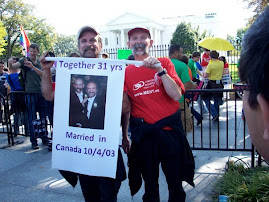
The Associated Press: Gays decry Obama's stand on gay marriage case
By LINDA DEUTSCH and LISA LEFF – 54 minutes ago
LOS ANGELES (AP) — Gay rights groups expressed dismay with the Obama administration Friday over its championing of the Defense of Marriage Act, a law the president pledged to try to repeal while on the campaign trail.
The government filed a motion late Thursday to dismiss the case of Arthur Smelt and Christopher Hammer, who are challenging the 1996 federal act. The law prevents couples in states that recognize same-sex unions from securing Social Security spousal benefits, filing joint taxes and other federal rights of marriage.
U.S. Department of Justice lawyers argued that the act — known informally as DOMA — is constitutional and contended that awarding federal marriage benefits to gays would infringe on the rights of taxpayers in the 30 states that specifically prohibit same-sex marriages.
"The president made very explicit and emphatic campaign promises that he opposes DOMA and would provide leadership calling on Congress to repeal it," said Jennifer Pizer, marriage project director for Lambda Legal. "This brief is not consistent with that promise."
Justice spokeswoman Tracy Schmaler said Friday that the department is abiding by its standard practice of defending existing law and that the filing doesn't mean Obama has changed his mind about wanting to see gay couples win federal recognition.
"Until Congress passes legislation repealing the law, the administration will continue to defend the statute when it is challenged in the justice system," Schmaler said.
More than four months into his first term, Obama has been under growing pressure from gay rights activists who supported his candidacy to move forward on repealing DOMA and the "don't ask, don't tell" policy that prevents gays from serving openly in the military.
Joe Solmonese, president of the Human Rights Campaign, a gay rights lobbying group based in Washington, called on Obama to reassure his supporters by sending Congress a bill to lift the federal marriage law.
"The Administration apparently determined that it had a duty to defend DOMA in the courts. The President has just as strong a duty to put his principles into action," Solmonese said in a statement.
In the papers, Justice Department lawyers said federal court was not the right venue to tackle legal questions raised by Hammer and Smelt, who got married in California last year during the five-month window in which the state sanctioned same-sex unions.
Lambda Legal's Pizer said the government's stance in some ways marks an improvement from Justice Department positions taken on the Defense of Marriage Act when George W. Bush was president.
The brief acknowledges that gay couples who tie the knot in the six states where same-sex marriages are permitted are legally married and does not cite the oft-used argument that children fare better in households headed by a married man and woman, Pizer said.
At the same time, it repeated several arguments made under Bush, including the argument that a union between a man and a woman is "the traditional, and universally recognized, version of marriage."
The Obama administration will have more opportunities in coming weeks to weigh in on the subject. Another challenge to DOMA brought on behalf of married couples in Massachusetts and a lawsuit seeking to overturn California's gay marriage ban under the U.S. Constitution are making their way through the courts.
Leff reported from San Francisco.
Friday, June 12, 2009
Gays decry Obama's stand on gay marriage case


D.C. att’y gen’l says marriage referendum illegal
D.C. att’y gen’l says marriage referendum illegal
Ballot measure said to violate human rights law
By LOU CHIBBARO JR, Washington Blade | Jun 11 2009, 5:46 PM [Bookmark and Share]
D.C. Attorney General Peter Nickles issued a legal opinion Thursday saying a voter referendum seeking to overturn a city law recognizing same-sex marriages from other jurisdictions would violate the city's human rights law and should not be allowed.
Nickles submitted his four-page opinion to the D.C. Board of Elections & Ethics, which is deliberating whether to approve or deny a request by the pastor of a Maryland church and six other District residents that the board allow voters to decide on the same-sex marriage law in a referendum.
"As expressed in the [Human Rights Act], the established public policy of the District of Columbia is to treat individuals as equals, whatever their gender, sexual orientation, or marital status my be," Nickles said in his opinion.
Nickles said the D.C. City Council reflected the policy established in the Human Rights Act in the measure it passed May 5 authorizing city recognition of same-sex marriages from other states and countries.
"The effect of the proposed referendum, however, would be to negate that action," Nickles said in his opinion. "Therefore, the proposed measure is not a proper subject for a referendum under District law, and the proposer's petition should be denied."
Nickles' action places the city government in opposition to the proposed marriage referendum one day after the election board heard arguments over whether such a referendum is allowed under the city law governing initiatives and referenda.
click link above for whole story
DOJ moves to dismiss first fed gay marriage case
DOJ moves to dismiss first fed gay marriage case
By LINDA DEUTSCH, AP Special Correspondent
Friday, June 12, 2009
(06-12) 00:41 PDT Los Angeles, CA (AP) --
The U.S. Justice Department has moved to dismiss the first gay marriage case filed in federal court, saying it is not the right venue to tackle legal questions raised by a couple already married in California.
The motion, filed late Thursday, argued the case of Arthur Smelt and Christopher Hammer does not address the right of gay couples to marry but rather questions whether their marriage must be recognized nationwide by states that have not approved gay marriage.
"This case does not call upon the Court to pass judgment ... on the legal or moral right of same-sex couples, such as plaintiffs here, to be married," the motion states. "Plaintiffs are married, and their challenge to the federal Defense of Marriage Act ("DOMA") poses a different set of questions."
It's a different case from a recent federal lawsuit by two unmarried gay couples in California who claim a civil right to marry under the U.S. Constitution.
The government said Smelt and Hammer seek a ruling on "whether by virtue of their marital status they are constitutionally entitled to acknowledgment of their union by states that do not recognize same-sex marriage, and whether they are similarly entitled to certain federal benefits.
"Under the law binding on this Court, the answer to these questions must be no," the motion states.
The 54-page document traces the history of the federal Defense of Marriage Act (DOMA) passed by Congress in 1996 at a time when states and their citizens were just beginning to address the legal status of same-sex marriage.
"DOMA does not address whether a same-sex couple may marry within the United States," the motion says. "Instead, it permits the citizens of each state to decide that question for themselves."
The case was originally filed last year in California State Court before heading to federal court. It claims violation of a number of federal rights including the right to privacy, the right to travel and the right of free expression under the First Amendment.
The government's filing said the suit would fail under each of those grounds. While it addressed each argument, it claimed the suit should be dismissed for lack of standing by the plaintiffs to bring the claim in federal court.
In a separate filing, the California attorney general moved Thursday to dismiss the state lawsuit by the same couple, saying Hammer and Smelt lack standing to sue because their marriage was unaffected in any way by the passage of Proposition 8, the voter-approved gay marriage ban.
The attorney general's motion noted there are likely to be more federal suits and referred to "at least one highly publicized challenge (that) has already been filed."
That case, Perry v. Schwarzenegger, drew wide attention because it was filed by David Boies and Theodore Olson, the two lawyers who opposed each other in the famed election challenge in Bush v. Gore in 2000. The suit raises different issues seeking to frame gay marriage as a federal civil right.
"Our lawsuit squarely presents the federal constitutional challenges to Proposition 8's marriage ban, which are not presented in the Smelt case because those plaintiffs' are already married. We believe our arguments are exceedingly strong," Theodore Boutrous Jr., a member of the legal team in that case, said Thursday night.
On May 26, the California Supreme Court upheld Prop. 8.
In a 6-1 decision written by Chief Justice Ron George, the court rejected arguments that the ban approved by the voters last fall was such a fundamental change in the California Constitution that it first needed the Legislature's approval.
Thursday, June 11, 2009
FiveThirtyEight: Politics Done Right: How To Get 63% of Americans to Support Gay Marriage. (Maybe.)
FiveThirtyEight: Politics Done Right: How To Get 63% of Americans to Support Gay Marriage. (Maybe.)
by Nate Silver @ 9:38 AM
Bookmark and Share Share This Content
Back when I used to do high school debate, there were all sorts of esoteric arguments related to the notion of positive and negative rights. The distinction, to simplify the matter greatly, is that a positive right is something that permits you to act a certain way -- something granted to you -- whereas a negative right is a claim to noninterference -- something that precludes action from being taken against you, either by government or by other people. You'll most commonly hear the distinction in association with libertarianism, as libertarians tend to regard positive rights as impure manifestations of government fiat power, whereas negative rights exist intrinsically outside of government, which in turn has a duty to protect them.
I never found this framing terribly satisfying as a matter of moral philosophy -- there are too many things which fall somewhere in between the two poles. But as a political matter, the distinction is potentially quite interesting.
Take for example the issue of gay marriage. When gay marriage is polled, it is almost always framed as a positive right, as in: "should the government permit Adam and Steve to get married?". I wouldn't necessarily say I find this framing biased -- since gay marriage is only permitted in six out of the 50 states and only came about in those states very recently, it is probably the more natural, plain-English way to ask the question.
But there is a different way to frame the question that is no less fair, and flips the issue on its head. Namely: "should the government be allowed to prohibit Adam and Steve from getting married?". This is closer to the logic embodied by the court decisions in Iowa, California, Massachusetts, and other states. Those courts didn't create gay marriage; they argued, rather, that it was already protected by their respective state constitutions.
And it turns out that if you frame a polling question in this particular way, as Gallup and USA Today did recently, you get a very different set of responses. Take a look at what happens:
click link to see poll and rest of article
New York Anti-Gay Marriage Rally 'Flops' | On Top Magazine :: Gay & Lesbian News, Entertainment, Commentary & Travel
New York Anti-Gay Marriage Rally 'Flops' | On Top Magazine :: Gay & Lesbian News, Entertainment, Commentary & Travel
By Carlos Santoscoy
Published: June 11, 2009
The biggest names in the anti-gay marriage movement failed to muster a significant crowd – or media attention – at an anti-gay marriage rally in New York.
The all-star lineup for Stand 4 Marriage at the Capitol should have been enough to peak the interest of any red-blooded social conservative: New York State Senator Ruben Diaz (Republican), Family Research Council President Tony Perkins, Bishop Harry Jackson Jr. and National Organization for Marriage (NOM) President Maggie Gallagher.
The rally was sponsored by New Yorkers for Constitutional Freedoms and highly endorsed by NOM. Both groups worked to get the word out with press releases and radio.
“Let's all come out, joining the NYCF in making a positive – and fun – stand for marriage! Bring the whole family, and don't forget the signs and banners!” a NOM release for the event says.
Despite the firepower of the movement's most powerful movers and shakers, the rally barely managed to attract a few hundred warm bodies to the steps of the Capitol and fewer news men and women. Most New York media remained silent on the event. Even NOM's press room was more preoccupied with defending former-Miss California Carrie Prejean's anti-gay marriage views after being fired than talking about their rally Wednesday.
Participants encouraged state senators to vote against a gay marriage bill waiting for Senate approval to become law and stirred up the mostly religious conservative crowd – who rallied around signs that read “Save our God given marriage” and “God who gave us life, gave us liberty” – with their fiery oratory.
“What God did was he dropped a huge boulder in the path of the same-sex marriage bill yesterday with the Senate coup,” Rev. Duane Motley, executive director of New Yorkers for Constitutional Freedoms, told a cheering crowd referring to the new Republican-led majority in the Senate.
Utah-based progressive blogger Chino Blanco summed up the rally: “It was HUGE!!! A huge flop.”
Gay marriage in the Empire State is favored by a majority of lawmakers – including Governor David Paterson – and the public. A new poll released Wednesday shows a large majority (74%) of New Yorkers approve of recognizing gay and lesbian unions with civil unions or marriage. And a majority of respondents (46%) support granting gay couples the right to marry.
GayCityNews - Amidst Chaos, Where Is Tom?
this is a good summary of where we are at at this hour
GayCityNews - Amidst Chaos, Where Is Tom?
By: PAUL SCHINDLER
06/10/2009
email this storyEmail to a friendpost a commentPost a Commentprinter friendlyPrinter-friendly
Senator Tom Duane rallied last week with Democrats; what's the next step?
Senator Tom Duane rallied last week with Democrats; what's the next step?
After three days of State Senate Democrats and Republicans warring over the validity of a June 8 parliamentary maneuver in which the GOP appears to have grabbed control of the chamber, the situation in Albany remains chaotic -- with the Senate in lockdown, a renegade Democrat claiming to have spirited a key to let his new Republican friends in the door, and talk of a second coup that would remove Queens Senator Malcolm Smith not only from the role of majority leader, but also as head of the Democratic caucus.
As Smith threatens to go to court June 11 to block the GOP putsch, one stunning question moved to the fore -- Is Tom Duane, the out gay Chelsea Democrat, thinking about joining Pedro Espada, Jr., of the Bronx and Hiram Monserrate of Queens in supporting Republican Dean Skelos of Long Island as the majority leader?
On the morning of June 10, the New York Times speculated that Duane might be doing precisely that, in an effort to advance key legislative goals -- marriage equality legislation already approved by the Assembly, as well as GENDA, the Gender Expression Non-Discrimination Act, and the anti-bullying Dignity for All Students Act (DASA), which also only require Senate approval to be enacted.
CityHallNews.com elaborated considerably on the same theme that morning, reporting that Duane had skipped key Democratic gatherings since the GOP coup, dropped out of sight (his car reportedly absent from the Capitol parking lot), and was not returning phone calls from intimates.
Reached by telephone late afternoon on June 10, Duane worked to scuttle the speculation.
"Yes, I did miss a Democratic press conference on Monday," he responded, when asked about the reports. "And except for when I really needed to be in the Capitol, I chose not to be there because it's a very toxic place, full of only rumors. My not being there has nothing to do with anything other than it not being a place where I wanted to spend a lot of time. I don't think anyone should read anything more into it."
Duane, however, conceded that he had not attended any meeting of the beleaguered Democratic caucus since the Senate was thrown into turmoil Monday, and made no attempt to deny rumors that he was talking to the Republicans. When asked if he could dispel stories that the GOP had reached out to him, he responded, "I have spoken to people on both sides of the aisle about seeing every issue accomplished that I have spent my whole life working to accomplish." He then added quickly, "And with that I will leave you," and ended the call.
The notion that the LGBT community could achieve gay marriage and transgender civil rights laws by working to bolster a new Republican majority in the Senate turns recent history on its head. For years, the GOP leadership has resisted gay rights measures, delivering hate crimes in 2000 and a gay nondiscrimination law in 2002 only after years of opposition, and as part of carefully crafted political compromises. Since marriage equality became a live issue in 2006-7, with the state high court turning down legal action and the Democratic Assembly passing former Governor Eliot Spitzer's legislation, two consecutive Republican Senate leaders, Joe Bruno and later Skelos, made clear their implacable opposition to allowing a floor vote on the measure.
Perhaps until now.
When news of the Republican coup broke, many in the LGBT community feared the Democrats, who held a razor-thin 32-30 majority, were going down because Smith was committed to allowing floor consideration when the votes were there, and Duane was saying he had a majority in hand. Since last November's election, Senator Ruben Diaz, a harshly anti-gay Bronx Pentecostal minister, has said he would not support a majority leader who would allow a gay marriage vote. But, Diaz was not the renegade this week; in fact, in the wake of the coup he has reaffirmed his support for Smith.
Instead, Espada, a marriage co-sponsor, and Monserrate, who has been silent this year but at other times has endorsed equal rights for same-sex couples, were the ones who ended the Democratic control that just about everyone thought was needed to advance marriage equality and GENDA. But even though they are marriage supporters, pundits Monday evening were confidently predicting that gay marriage, under Skelos' leadership, was dead.
That conventional wisdom, however, was soon overtaken. The following morning, Skelos and Espada -- who under an unprecedented plan would split leadership duties with Skelos, with Skelos becoming majority leader, as he was last year, and Espada serving as president pro tem -- appeared on New York Post columnist Fred Dicker's radio show. Espada said he favored bringing the marriage equality bill to a floor vote.
However, he and Skelos both said they had not specifically discussed the issue or agreed on what to do. Skelos said the two would discuss the matter later in the day. Appearing on Brian Lehrer's WNYC Radio show the same morning, Monserrate agreed that the coup would not doom the chances for a marriage floor vote.
Neither Espada nor Skelos' offices responded to requests for comment the following day about whether the two had come to a conclusion about the future of the marriage bill, or GENDA and DASA, in the Senate's current session.
Duane and advocates led by the Empire State Pride Agenda (ESPA) have long acknowledged that the opposition of Diaz and likely at least a few other Democrats meant that some Republican votes were needed to pass the marriage bill. Several weeks ago, Duane announced that a Republican was ready to go public with his support, though that has not yet happened.
Like Duane, however, ESPA has voiced optimism all year that progress was being made in courting Republicans, an effort made easier when Skelos, as minority leader, said his members would be allowed to take a conscience vote and not be held to a standard Republican position.
It is undeniable that the national climate on marriage equality has changed drastically just in the five months since Republicans last controlled the Senate. In 2007-8, when Bruno and Skelos adamantly refused to act on marriage equality even in the face of the Democratic Assembly easily passing it, it was accepted by most observers as more or less a political given.
Skelos aims to return to power, however, after three nearby states have legislated gay marriage, the Iowa Supreme Court ruled unanimously in favor of the issue, and New York political reporters have been skulking Capitol hallways trying to buttonhole undecided senators. To kill the measure now out of hand, without allowing it even to get a vote, might come across to voters as reactionary, even out-of-touch with a rapidly shifting national mood.
In this context, an appearance by Bruno, now retired, on WRGB CBS 6 in Albany in the past few days, illustrates just how fast events are moving. Bruno explained that Governor David Paterson, who introduced the marriage bill into the Legislature in April, had called him to ask his help in lobbying GOP senators on the issue. The man who once stood as a bulwark against gay rights agreed to do just that. "It's time," Bruno told WRGB.
During all the chaos of the past few days, one quiet player has been ESPA, limiting its public statements to an oblique reference to the possibility it may now need to bargain with a leadership team it worked hard last year to defeat.
"Our issues are not partisan issues," Alan Van Capelle, ESPA's executive director, said in a press statement. "It is time to bring marriage equality and these other LGBT issues to the Senate floor for votes and have members vote their conscience. We urge the Senate to schedule these votes as soon as possible before the end of the legislative session."
As Gay City News goes to press on June 10, it is impossible to anticipate the coming events with any high degree of certainty. Democrats worked furiously that day to pull Monserrate -- in legal hot water over charges he assaulted his girlfriend by smashing a glass into her face -- back into their fold, apparently unsuccessfully, though his statements late in the afternoon in an appearance with Skelos and Espada were frustratingly elusive.
Whether Duane, were he to make his bet, and bed, with Skelos, would be able to pick up enough GOP support to offset some Democrats not yet sold on gay marriage who would now be less likely to do him a favor is also unclear -- as is what degree of blowback he could expect from longtime allies on issues such as tenants' rights, choice, drug reform, medical marijuana, and healthcare.
And finally, whether the LGBT community can depend on Espada -- who planned his revolt after being denied several million dollars in earmarks for a non-profit healthcare organization, his ties to which are under investigation by Attorney General Andrew Cuomo -- to enter into his new political marriage with our marriage rights, and other important goals, as a genuine part of his portfolio of asks is likely the most salient question of all.
Town Board endorses same-sex marriage bill | theithacajournal.com | The Ithaca Journal
Town Board endorses same-sex marriage bill | theithacajournal.com | The Ithaca Journal
The Ithaca Town Board voted unanimously to support a bill that would legalize same-sex marriage in New York state.
The board approved a resolution Monday supporting the Marriage Equality Act and asserting that “the Town of Ithaca supports the right of same-sex couples to marry, as a principle of civil rights.”
Last March, the town became the second municipality in Tompkins County, after the City of Ithaca, to establish a domestic partnership registry open to both same- and opposite-sex unmarried couples.
“Our neighboring states Connecticut, Massachusetts, New Hampshire and Vermont, and the neighboring Canadian provinces of Ontario and Quebec, all allow same-sex couples, including New Yorkers, to marry, and those marriages are recognized and valid in New York state,” the resolution states. “New Yorkers should have the right to get married in their own state, in the presence of their own friends and families, without having to travel to neighboring states and provinces.”
Board member Pat Leary drafted the resolution. Board member Bill Goodman, who is gay, thanked his colleagues at the meeting “for supporting legislation that could someday, if I’m lucky, impact my life.”