Argentina Town Holds First Same-Sex Marriage In Latin America - Lez Get Real
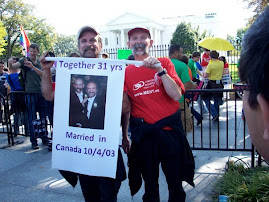
Today was a day long desired for Alex Freyre and José María di Bello, for today was their wedding day. The two married today in Ushuaia, Tierra del Fuego, after a months long battle for the right to marry that is still being played out. The two moved to Ushuaia in order to get married. They had been blocked from marrying after a judge stayed the decision that allowed them to marry. The decision stated that the Civil Code which defines marriage as being between a man and a woman unconstitutional.
Governor Fabiana Ríos held that the original decision to grant the couple marriage rights was to be upheld and overrode the registrar who initially refused to grant them the marriage license. The couple, who are both HIV positive, had initially wanted to marry on 1 December, which is World AIDS Day.
Currently, civil unions are available in some cities in Argentina, but do not grant full equality. Currently, civil unions are available in a few other places such as Uruguay. Mexico City recently adopted full marriage equality.
Tuesday, December 29, 2009
Argentina Town Holds First Same-Sex Marriage In Latin America - Lez Get Real


Monday, December 28, 2009
A transitional year for same-sex marriage -- latimes.com
A transitional year for same-sex marriage -- latimes.com
By Jonathan Rauch
December 27, 2009
For the gay marriage debate, 2009 was transitional instead of transformative, but the year was historic nonetheless. To mangle Churchill, it was not the end, nor even the beginning of the end, but it was at least the beginning of the middle.
This is an issue on which the fundamentals of public opinion change glacially. Support for same-sex marriage is rising, but only by about a percentage point or so a year. Essentially, a third of the public supports gay marriage, another third or so supports civil unions instead, and the remaining third opposes any kind of legal status for same-sex couples.
Although public-opinion fundamentals didn't change in 2009; the politics of gay marriage did. Here are the ways the year marked a shift to what a storyteller might call the "long middle."
The preemptive strikes on both sides have failed. Early on, conservatives feared that courts would impose same-sex marriage nationally by fiat. They responded with an attempt to ban gay marriage nationally by constitutional amendment. But the federal courts kept their distance, and the amendment was rebuffed.
As the year ends, it is clear that neither side can knock the other off the field. Gay marriage is firmly established in five states (with the District of Columbia's likely to follow suit), but it is banned, often by constitutional amendment, in most of the others. Unless the Supreme Court shocks the country and itself by declaring gay marriage a constitutional right, the issue will take years, perhaps decades, to resolve. All-or-nothing activists will be disappointed, but the country will get the time it needs to make up its mind.
Legislators are taking over from judges. For years, the only way same-sex marriage seemed possible was by court order. But with state venues for pro-gay-marriage lawsuits having just about dried up, the fight has moved from the lower courts to the political branches, much as the civil rights struggle did in the 1960s. Now, as then, legislative victories afford the movement more momentum and popular legitimacy than judicial ones ever could.
Opponents were fond of arguing that the gay-marriage movement was not just wrongheaded but antidemocratic. But in 2009, gay marriage was passed by the legislatures and signed into law in Maine and New Hampshire, and it was enacted by a veto-overriding majority in Vermont. Nothing undemocratic about that.
Same-sex marriage has been mainstreamed. In its first decade or so on the national stage, gay marriage was a fringe idea, the property of the political far left. No longer. Gay marriage may still be losing at the ballot box, but in Maine in 2009, as in California in 2008, the margins have grown tight. With its establishment last spring in Iowa, same-sex marriage has penetrated the heartland, by court order but with little backlash. Many Democrats have come to see support for gay unions as a political plus. Increasingly, it is the opponents who are playing cultural defense, insisting that they are the ones who are being marginalized and stigmatized.
There's a backlash against the backlash. The most important trend of 2009 began Nov. 4, 2008, when California voters passed Proposition 8, revoking gay marriage in their state. Until then, the preponderance of passion lay with opponents. After Prop. 8, however, many heterosexuals embraced gay marriage, taking ownership of an issue that they have come to view as the next great civil rights battle.
For same-sex marriage advocates, the emergence of a dedicated core of straight supporters is a sea change. There is now comparable energy and commitment on both sides.
It was just such passion, indeed, that led two of the country's most distinguished lawyers -- Theodore Olson, a Republican, and David Boies, a Democrat -- to join hands across party lines in 2009 and file a lawsuit asking the federal courts to overturn California's Proposition 8. The case is a long shot legally, but the fact that it has attracted such solidly mainstream legal talent is one more sign that the same-sex marriage issue has come of age.
Jonathan Rauch, a guest scholar at the Brookings Institution, is the author of "Gay Marriage: Why It Is Good for Gays, Good for Straights, and Good for America."
Copyright © 2009, The Los Angeles Times
Wednesday, December 23, 2009
No Religious exemption for opponents of same sex marriage
Maggie must be pissed off and unfortunately ammunition for the opposition
In recent days courts in both England and the United States have ruled that individuals whose alleged strong religious convictions are opposed to legal recognition for same-sex partners are not thereby excused from complying with laws banning sexual orientation discrimination when it comes to doing their jobs. The cases arose in different contexts - government employment and private business - and invoked some different legal arguments, but in the end they boiled down to the same general principle: that a legislated policy of non-discrimination on the ground of sexual orientation trumps private rights of religious belief when it comes to the public sphere of business or government services.
In the U.K., the ruling came from the Court of Appeal (Civil Division), hearing an appeal from the Employment Appeal Tribunal in the case of Lillian Ladele, who was employed by the London Borough of Islington as a registrar of births, marriages and deaths, beginning in 2002. Ladele v. London Borough of Islington, [2009] EWCA Civ. 1357 (Dec. 15, 2009). When the U.K. enacted a law authorizing civil partnerships for same-sex couples, the local authorities determined that the registrars of births, marriages and deaths who served as civil officiants for weddings would also serve that role for the civil partnerships. Ms. Ladele, asserting her religious objection to having anything to do with legally uniting same-sex couples, argued that she should be exempted due to her religious belief. After all, she argued, under European Human Rights Law and English law, freedom of religious belief is protected.
Ms. Ladele's stand induced tension with her fellow registrars, especially some of whom were gay and complained formally that her refusal to perform such ceremonies was discriminatory. The complaints led to formal proceedings, and a ruling by an Employment Tribunal that the employer was guilty of discrimination on grounds of religious belief by requiring her to perform such ceremonies. The local authorities appealed to the Employment Appeal Tribunal, which set aside that determination, deciding rather that allowing Ms. Ladele to refuse services to same-sex couples would violate the overriding policy of non-discrimination. The position of the Appeal Tribunal, affirmed by the Court of Appeal, was that employees are free to believe what they like, but as civil servants they are obligated to carry out their lawful functions without discrimination on the basis of sexual orientation against members of the public entitled to access their services.
The court endorsed the Appeal Tribunal's determination that the Employment Tribunal's finding of discrimination against Ms. Ladele was "quite unsustainable." As the Appeal Tribunal had stated, Ms. Ladele's complaint "is not that she was treated differently from others; rather it was that she was not treated differently when she ought to have been," i.e., a failure to accommodate her religious beliefs. The court found that local officials were not motivated by Ladele's religious beliefs in taking action against her, but rather by her refusal to perform "her assigned civil partnership duties." Thus, it was not a case of direct discrimination, but rather "indirect discrimination" in the sense that requiring her to perform her duties would burden her religious belief as it was expressed through her refusal to perform an assigned job duty.
The crux of the decision may be found in the following quotation from the Court of Appeals' opinion, at paragraph 46: "Islington wished to ensure that all their registrars were designated to conduct, and did conduct, civil partnerships as they regarded this as consistent with their strong commitment to fighting discrimination, both externally, for the benefit of the residents of the borough, and internally in the sense of relations with and between their employees. I find it very hard to see how this could be challenged, either as being Islington's actual aim, in the light of the evidence, or as being a legitimate aim, in the light of Islington's Dignity for All policy, current legislation and mainstream thinking."
In other words, in the U.K., and in the borough of Islington, the commitment to non-discrimination on grounds of sexual orientation in government services is firmly established, what under U.S. law might be called a "compelling state interest," and would take priority over the individual religiously-based objections of public employees assigned on a routine basis to perform government services. This is confirmed in paragraph 55 of the opinion: "This appears to me to support the view that Ms. Ladele's proper and genuine desire to have her religious views relating to marriage respected should not be permitted to override Islington's concern to ensure that all of its registrars manifest equal respect for the homosexual community as for the heterosexual community." The court found this view consistent with the U.K.'s treaty obligations under the European Convention as well as national and local law.
The court concluded that "it is simply unlawful for Ms. Ladele to refuse to perform civil partnerships. It is also hard to resist the conclusion that this means that Islington had no alternative but to insist on her performing such duties together with their other registrars." The court did note that some other local jurisdictions had taken a different path, refraining from assigning objecting officials from performing such ceremonies in order to avoid confrontations, and stated that they were free to do so, but that Islington was totally within its rights to impose a uniform job assignment on all its registrars since no such accommodation was required by the law.
The American ruling came out of the Second Judicial District Court in Bernalillo County, New Mexico, where a mom-and-pop photography business was hauled before the state's Human Rights Commission for refusing to provide their photography services to a lesbian couple for their commitment ceremony. Elane Photography, LLC v. Willock, CV-2008-06632 (Dec. 11, 2009). The Human Rights Commission found that New Mexico's prohibition of sexual orientation discrimination by "any public accommodation" had been violated by Elaine and Jon Huguenin, doing business as Elane Photography LLC, and that their business was not entitled to some sort of religious belief exemption from having to provide equal services without regard to sexual orientation of customers. Elane Photography filed suit against Vanessa Willock, who had filed the civil rights complaint, seeking an order setting aside the Commission's ruling.
The Huguenins argued strenuously on appeal that their business should not be considered a public accommodation, as they were just a mom-and-pop company operating out of their home, going to events when contracted to provide photography services, but the court found that they were advertising their services on the internet and in the yellow pages, and comfortably fit within the developing case law in New Mexico and around the country in meeting the requirements of a "public accommodation" as a business actively providing services to the public.
They also made the usual disengenuous argument that they were not discriminating based on sexual orientation. Indeed, they would be happy to photography a wedding between a gay man and a lesbian, for example, but they just held religious objections to any kind of formal ceremony linking two persons of the same sex in some sort of wedding. They said that, if anything, they were discriminating on the basis of marriage. As to this argument, wrote Judge Alan M. Malott, "The Court disagrees and finds that Plaintiff's policy discriminates, on its face, against gays and lesbians. It goes without saying that they are the only members of the public who are involved in same-sex marriages or commitment ceremonies. Just as with professional creativity, a sincerely held belief does not justify discrimination based upon sexual orientation under the NMHRA."
As to the religious discrimination claim, the plaintiffs argued that the state should not compel them to participate in a ceremony to which they held religious objections, but Judge Malott rejected the idea that requiring them to provide their professional photography services at such an event amounted to that. "This case is not an example of religious persecution," he wrote. "Plaintiff and its owner-operator is not being forced to participate in any ceremony or ritual; the only requirement is that she photograph the event. This is no different from the caterer or florist attending the ceremony in order to provide its commercial service; they attend it, not participate in it."
Plaintiffs complained that the NM Human Rights Act was not "neutral" with respect to religion because it exempted religious institutions from having to comply with the sexual orientation non-discrimination provision, but provided no such exemption for religious individuals. Consequently, they challenged the constitutionality of the act, arguing that New Mexico had no compelling interest sufficient to justify such an abridgement of religious freedom. Malott rejected this argument, finding that the act was perfectly neutral with respect to religion, and was not intended to discriminate on grounds of religion. But even if a compelling interest were needed to justify it, he found one: the state's desire to stamp out discrimination by businesses offering goods and services to the public.
Of course, the Alliance Defense Fund is representing Elane Photography, so this ruling will be appealed to the state appellate courts, and, one suspects that if the state appellate courts affirm Judge Malott, ADF will file a cert. petition to the US Supreme Court.
An interesting side point: in both cases, the discriminator claimed that a religious objection to same-sex marriage animated their refusal to provide a service, but ironically in neither case is same-sex marriage actually involved. Neither the U.K. nor New Mexico provides legally for same-sex marriages. The U.K. provides a "separate but equal" civil partnership status, and New Mexico provides NOTHING to private citizens. Vanessa Willock and her partner wanted to get professionally-done photographs of their private commitment ceremony, an event having no legal significance in New Mexico. So it strikes this observer that in both cases the claim of religious persecution of those opposed to same-sex marriage is being a bit misdirected.
On the other hand, religiously-inspired bigotry has traditionally been protected under American law and certainly under traditional British law -- where there is an established state church -- so the strong declarations by both courts that anti-discrimination policy takes priority over private religious objections by individuals and businesses shows how a sea change in law has occurred over recent decades. I'm not sure one would have expected rulings such as these a generation ago.... and remember that in recent memory the US Supreme Court has upheld the right of the Boy Scouts and the organizers of the St. Patrick's Day Parade in Boston to maintain anti-gay policies based on personal beliefs, for many religiously-inspired, opposed to homosexuality.
Monday, December 21, 2009
Marriage Equality Comes To Mexico City - Lez Get Real
Marriage Equality Comes To Mexico City - Lez Get Real
Marriage Equality has arrived in Mexico City. By 39-20 with 5 abstentions, Mexico City became the first Latin American city or nation to legalize marriage between two people of the same sex. Currently, civil unions are permissible in the Mexican state of Coahuila, just south of Texas. Uruguay is the only full nation in Latin America to allow civil unions. Now that it has been passed, it is expected to be signed into law by Mayor Marcelo Ebrard. The next step according to Mexico City spokesperson Oscar Oliver is to take up legislation allowing gays and lesbians to adopt.
The move was widely denounced by the Roman Catholic Church and other conservative groups; however, the Leftist controlled legislature passed the legislation handily. The Democratic Revolutionary Party had already passed abortion rights and civil unions within the city. Marriage will no longer be considered a union of a man and a woman in the law codes, but rather “the free uniting of two people”. Lawmaker David Razu proposed the changes in order to grant the same rights to same-sex couples with regards to social security and other social services that are already held by heterosexuals.
The movement of many Catholic nations upon the issue of marriage equality has signaled the erosion of the Vatican’s power over many predominantly Catholic nations. Some twenty nations perform civil unions, and seven allow for full marriage equality. Currently, six American states offer same-sex marriage and another nine have civil unions or domestic partnerships
Friday, December 18, 2009
Poll: U.S. evenly divided on same-sex marriage
moving in the right direction
Poll: U.S. evenly divided on same-sex marriage
On an issue where survey results once registered lopsided disapproval, the American public is now almost evenly divided on same sex marriage -- although approval remains below 50 percent -- according to a new Angus Reid Poll.
The survey found that 43 percent favor same-sex marriage while 46 percent remain opposed.
Support for giving full legal rights to same-sex couples -- the "anything but marriage" status approved by Washington voters when they voted for Referendum 71 in November -- gets greater support.
A total of 53 percent give thumbs-up to "the same rights as married couples" while 37 percent are opposed: 10 percent remain undecided.
The independent poll of 1,001 American adults was taken December 8 and 9, and has a margin of error of plus or minus 3.1 percent.
The backing for same-sex marriage, according to the Reid poll, is centered among those living with a "significant other" (65 percent), single people who have never married (56 percent) and those who are widowed (51 percent).
Those who are divorced (38 percent), married (34 percent) or separated (34 percent) are less supportive.
Approval for anything-but-marriage rises to 76 percent with the widowed and 71 percent among those living with a "significant other," and is between 45 and 50 percent among those married, separated and divorced.
The Reid poll also asked about factors influencing attitudes, with the question: "Do you have any close friends or relatives who are openly gay or lesbian?" The number answering "Yes" totaled 53 percent, those replying "No" were 46 percent, with 2 percent refusing to answer.
The survey asked "Do you think being homosexual is . . .", with 47 percent answering "Something people choose to be," to 34 percent who agreed to "Something people are born with." Nearly 20 percent were not sure.
The Washington Poll, directed by a UW political scientist, surveyed attitudes in this state last year.
It found that 36.7 percent of those surveyed support same-sex marriage with 29.3 percent in favor full legal benefits.
A total of 21.4 percent opposed any legal rights for same-sex couples, while 12.6 percent said they would endorse "some" rights.
Fenty to sign same-sex marriage bill at church in NW D.C. - washingtonpost.com
Fenty to sign same-sex marriage bill at church in NW D.C. - washingtonpost.com
By Nikita Stewart
Washington Post Staff Writer
Friday, December 18, 2009; B03
Mayor Adrian M. Fenty will sign legislation Friday to legalize same-sex marriage in the District at a bill-signing ceremony so historic that his staff scrambled to find the perfect location Thursday.
Would it be All Souls Unitarian Church, a Northwest house of worship known for its diversity, liberalism and welcoming of same-sex couples? Would it be Covenant Baptist Church, a predominantly black church in Southwest where husband-and-wife team of Dennis and Christine Wiley serve as co-pastors and support gay marriage? Or would it be a secular site?
Late in the day, Katie Loughary, executive director at All Souls, said it appeared that Covenant was winning. "We're disappointed, yes," she said. "But we're excited that it's happening."
But the letdown was turned around when the Rev. Robert Hardies, All Souls' senior pastor, said that he had been contacted by the mayor's office and told that his church would be the spot.
"We're honored to be able to host this historic bill-signing," he said. "We believe this is a historic step forward for justice and human rights in our nation's capital."
All Souls is ideal, said D.C. Council member Jim Graham (D-Ward 1). "It's great that he's chosen one of the key churches in this struggle, rather, in this victory, in the most diverse ward in the city," said Graham, one of two openly gay council members. "I'm so excited." The church is in Ward 1.
Hardies is co-chairman of D.C. Clergy United for Marriage Equality, a coalition of ministers founded this year to counter a group of clergy opposed to same-sex marriage. The Wileys were also leaders in the group, and Covenant would have been a symbolic choice -- it is in Ward 8, which is represented by council member Marion Barry, who dissented when the council voted 11 to 2 on Tuesday to legalize gay marriage.
Hardies said Fenty's decision to sign the bill in a church was telling. "This is symbolic of the strong religious support for this bill in D.C.," he said, noting that more than 100 clergy members had signed a declaration in support of same-sex marriage.
The measure was opposed by other religious leaders. The Catholic Archdiocese of Washington has strongly opposed the bill, saying that its charitable arm might have to cancel its contract with the city to deliver social services.
After Fenty (D) signs the bill, the legislation will be subject to congressional review under Home Rule.
Wednesday, December 16, 2009
Austria legalizes civil unions and formally bans adoption and IVF | ProudParenting.com
Austria legalizes civil unions and formally bans adoption and IVF | ProudParenting.com
Austria will begin recognizing civil unions on New Year's Day 2010, following the parliament's passage of a civil union bill on Dec. 10.
Unfortunately, the new bill also formally bans the adoption of children or artificial insemination for same-sex couples.
The bill will give same-sex couples many of the rights enjoyed by their heterosexual counterparts, including access to a pension if one partner dies and alimony in the event of a split.
"We are living in the 21st century and I'm very glad this step is being taken today," Justice Minister Claudia Bandion-Ortner said during parliamentary debate leading up to the vote.
And, unlike straight couples, gay couples will not be able to record their unions at the civil registry office but with another authority instead. The issue led to heated debate in recent weeks, with critics saying it clearly signals that a same-sex partnership isn't given the same weight as a marriage between a man and a woman.
Gabriele Heinisch-Hosek, a Social Democrat who is the country's minister for women's affairs and fought against the registration differences, described the vote as "the first step in the right direction."