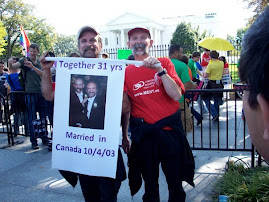
A look at key gay-marriage laws in America - Yahoo! News:
It's been 17 years since Hawaii's Supreme Court first ruled that summarily restricting marriage to opposite-sex couples violated the equal protection clause of that state's constitution. Yet, to this day, only five states and the District of Columbia permit gay couples to marry. It took another 11 years after the Hawaii decision before any state allowed same-sex couples to tie the knot.
The Hawaii court's revolutionary decision prompted gay-marriage opponents to obtain a legislative amendment to the state constitution to eliminate the constitutional basis for the court's conclusion. Thus, the Hawaii court's ruling did not actually lead to same-sex marriages. While several states and localities fashioned domestic partnerships and civil unions in the interim, it wasn't until 2004 that any of the U.S. states began marrying gay couples. The first state to do so was Massachusetts, ironically a commonwealth long-identified with socially conservative blue laws that are holdovers from colonial days.
In that same year, Gavin Newsom, mayor of San Francisco, briefly opened the door to same-sex marriages, issuing licenses to 4,000 gay couples despite language in the California Code specifying that marriage involves a man and a woman. Litigation ensued, and the state Supreme Court voided the marriages. Twice thereafter, the legislature voted to authorize same-sex marriage, but the governor vetoed both bills.
In 2008, the California Supreme Court overturned the gay-marriage prohibition, but voters by referendum amended the state constitution to ban gay marriage once again.
In 2010, federal judge Vaughn Walker ruled that Proposition 8, the voter-approved measure that barred gay marriage in California, violated constitutional due process and equal protection clauses. Prop. 8 supporters are appealing.
The states that currently permit same-sex couples to marry are Massachusetts, Vermont, New Hampshire, Connecticut, Iowa and the District of Columbia.
Massachusetts also took the lead in allowing out-of-state same-sex couples to marry there when in 2009 it repealed a 1913 residency requirement for marriage. That same year, Vermont's legislature overrode a gubernatorial veto of a bill authorizing gay marriage. Connecticut likewise followed the legislative route to authorizing same-sex couples to marry. It passed a law in 2008, phasing out civil unions, which had been allowed since 2005. By year's end, all civil unions in Connecticut will have been converted to marriages.
New Hampshire followed a similar path to its New England neighbors, passing a law specifically authorizing same-sex marriage effective January 2010.
In Iowa, however, same-sex couples acquired the right to marry through litigation. The Iowa legislature passed a Defense of Marriage statute, a common type of law defining marriage as the union of one man and one woman, that was challenged in court. The Iowa Supreme Court struck the law as unconstitutional last year, thus affirming the legality of gay marriage.
The District of Columbia legalized gay marriage in December 2009, effective March 2010.
States that do not recognize same-sex marriage but authorize domestic partnerships include California, Oregon, New Jersey Nevada, Washington, Hawaii, Maine and Wisconsin. New Jersey's domestic partnership law provides the same benefits as marriage to couples availing themselves of it, whereas the other states with domestic partnership laws provide similar but not as extensive benefits as those afforded to married couples.
Three states without gay marriage laws of their own explicitly recognize same-sex marriages performed elsewhere. These states are Rhode Island, New York and Maryland.
Wednesday, September 29, 2010
A look at key gay-marriage laws in America - Yahoo! News


Wednesday, September 22, 2010
Gay Marriage Coming to The Netherlands Antilles | Gay Rights | Change.org
Gay Marriage Coming to The Netherlands Antilles | Gay Rights | Change.org
Ten years ago, The Netherlands was the first country to legalize same-sex marriage. Now three former Dutch colonies are assuming the same laws that give same-sex couples equal marriage and adoption rights. This news is pretty distinctive, considering that these islands are located in the Caribbean — usually considered one of the more homophobic regions of the world, where gays and lesbians are routinely victims of prejudice, violence and unjust laws.
The Netherlands Antilles consist of five islands in the Caribbean Sea. On October 10th, the two largest islands, Curacao and Sint Maarten, are set to become independent states within the Kingdom of the Netherlands. The other three islands are adopting Dutch law as they become special municipalities of the Netherlands. Thus, gay marriage and adoption will become legal on the islands of Bonaire, Saba and Sint Eustatitus.
The Lower House of the Dutch Parliament approved a bill last week that will legalize gay marriage and adoption in these three states by 2012. Though they are under Dutch rule (or will be, at least), these exotic locales are actually very socially conservative islands. The three of them combined have a population of only 20,000.
Many residents hold strong religious beliefs that contradict Dutch laws on issues like abortion, euthanasia and, yes, same-sex marriage. It will be interesting to see if these new laws can change these views and the attitude toward gays in the Caribbean in general. At the very least, there will soon be three new destination wedding alternatives for the gay and lesbian marrying-kind.
Photo credit: Wikimedia Commons
Wednesday, September 15, 2010
Acceptance Seen of Gay Couples With Children - NYTimes.com
Acceptance Seen of Gay Couples With Children - NYTimes.com: "- Sent using Google Toolbar"
By SAM ROBERTS
Published: September 15, 2010
A majority of Americans now say their definition of family includes same-sex couples with children, as well as married gay and lesbian couples.
At the same time, most Americans do not consider unmarried cohabiting couples, either heterosexual or same-sex, to be a family — unless they have children.
The findings — part of a survey conducted this year as well as in 2003 and 2006 by Brian Powell, a sociology professor at Indiana University, Bloomington — are reported in a new book, “Counted Out: Same-Sex Relations and Americans’ Definitions of Family,” to be published on Wednesday by the Russell Sage Foundation. Since the surveys began, the proportion of people who reported having a gay friend or relative rose 10 percentage points, said Professor Powell, the book’s lead author.
“This is not because more people are gay now than in 2003,” he said. “This indicates a more open social environment in which individuals now feel more comfortable discussing and acknowledging sexuality. Ironically with all the antigay initiatives, all of a sudden people were saying the word ‘gay’ out loud. Just the discussion about it made people more comfortable.”
The book concludes that framing the equality of same-sex couples in terms of “the best interests of the child” might prove to be a more successful political argument than others.
“Neither the numbers from our data nor actual votes on initiatives are anywhere near the sufficient magnitude to support the idea that the public is ready to embrace same sex-couples with open arms,” the authors say. But, likening the resistance to laws and mores against interracial marriage, “we envisage a day in the near future when same-sex families also will gain acceptance by a large plurality of the public.”
The latest telephone survey of 830 people conducted this year found that Americans were almost equally divided on same-sex marriage. “I don’t think people are ready to embrace it, but people are ready to accept it,” Professor Powell said of same-sex marriage.
The survey also found a growing acceptance that genetics, rather than parenting, peers or God’s will, was responsible for sexual orientation.
Since 2003, the survey found a decline of 11 percentage points in the number of people who generally define family as a husband and wife with or without children.
Prof. Stephanie Coontz of Evergreen State College in Washington, director of research and public education at the Council on Contemporary Families, a research and advocacy group, said that “Americans seem to be open to seeing same-sex couples with children as families, even while they hesitate to recognize their unions as marriage.”
David Blankenhorn, president of the Institute for American Values, a marriage research and advocacy group, said he was not surprised by the findings. “I like the standard definition of family: two or more persons related by blood, marriage or adoption,” Mr. Blankenhorn said. “Keeps it simple and coherent.”
But, he added: “We live in groups, and we need each other. So it’s always a good thing, isn’t it, when any of us truly loves and is loved by another.”
State-by-State Gay Marriage Acceptance
State-by-State Gay Marriage Acceptance: "- Sent using Google Toolbar"
State-by-State Gay Marriage Acceptance
Hank Pellissier
Hank Pellissier
Ethical Technology
Posted: Sep 14, 2010
How is gay marriage in America proceeding down the aisle? This question concerns all transhumanists because persecution of homosexuality is an anti-Enlightenment human rights violation that is rooted in archaic religious superstition and anti-scientific thought. Actively supporting gay marriage is the ethically responsible position for all progressive transhumanists.
image1Surprisingly, the grandest advance in homosexual matrimony in the last 60 days is not the California judicial dithering over Proposition 8. No. Peer south of the border, amigos, and you’ll see not Uno, but Dos Hispanic nations that have embraced same-sex marriage.
First, the Senate of Argentina ratified gay marriage by a vote 33-27 on July 15. The proposal was spearheaded by President Cristina Fernandez and her husband, ex-President Nestor Kirchner, and opposed (predictably) by the Catholic Church, who condemned it as “a move by the father of lies [Satan] to confuse and deceive the children of God.” Buenos Aires already had civil unions; so did the village of Ushaia in Tierra del Fuego. The new law’s opponents are mounting only feeble resistance as the gauchos gallop towards a secular society, motivated by godfather Spain’s similar legislation in 2005.
I promised two miracles, so prepare for a shock if your virgin ears have not heard the news. On August 11, gay marriage was essentially ratified in… Mexico. Blink again, and believe it. The nation that exported machismo is swishing towards the altar. Okay, right, Frieda Kahlo was openly bisexual, but… where’d this come from?
Distrito Federal. Gay marriage was initiallly legalized in Mexico City by its progressive mayor Marcelo Ebrard (who is expected to run for El Presidente in 2012) and five months later the Supreme Court announced that Mexico City gay weddings must be recognized by all 31 Mexican states. The Catholic Church (redundantly) had a hissy-fit, shrilling that the measure’s enactment was more horrible for Mexicans than the current drug war (25,000 dead and counting).
image2
The United States is now in the embarrassing position of being surrounded by two large nations — Mexico and Canada — that have more progressive gay rights than the red-white-and-blue citizenry. This hypocritical stance for a populace that identifies itself with personal freedom will sharply intensify when additional Latin American nations ratify same-sex marriage: I predict this will happen in four more nations in the next four years: Uruguay, Ecuador, Colombia, and… BRAZIL — the samba queen herself, emerging superpower, “Kiss of the Spider Woman” country.
Is the USA future equally gay? Indeed. Popular opinion is shifting inexorably towards an accepting view of same-sex marriage; everyone knows this, even Republicans. Recent GOP heavyweights who have declared that gay marriage is either valid, or not worth fighting about, include Laura Bush, Dick Cheney, Glenn Beck, Elisabeth Hasselbeck, and Cindy and Meghan McCain. Many Libertarian and “Tea Party” members are equally supportive of gay marriage, or at least indifferent. So… who’s resisting?
Religious folks. Mormons, conservative Catholics, evangelical fundamentalists. But they’re slowly getting outnumbered by their own voting children: a New York Times/CBS News poll revealed that 57% of the populace under 40 years old is supportive of gay marriage.
How fast are we changing? My calculation is this: every year, gay marriage proponents gain an additional 1% of the electorate. This is evidenced in California numbers: in March 2000, Proposition 22 wanted to amend the Family Code to say “only marriage between a man and a woman” would be recognized in the state. image3 The measure passed, 61.4% to 38.6%. In November 2008, Proposition 8 also rejected gay marriage, but in a much closer election, 52.24% to 47.76%. Elementary math reveals that gay marriage gained 9.16% more supporters in just 8.5 years.
Below I have calculated when same-sex weddings will achieve majority support throughout the land of liberty. For 30 states, I’ve done this by adding 1% per year to the percentage that voted against a gay marriage ban, until the total reached 50.1%. In the remaining states, I used either polling figures (that I often regard skeptically), and/or I calculate an acceptance date based on the behavior of neighboring states with a similar demographic. If a state finds itself surrounded by either gay-marriage states (or nations), or by anti-gay marriage states, I accelerate or delay the process by two to four years, and I hurried slacker Mississippi along, alone in the end, with a five year nudge. Justification for this equation is evident in New England, which adopted gay marriage in a daisy-chain fashion, and also in California, which was deeply impacted by Utah Mormons in Prop 8.
My results are different than those arrived at by statistician Nate Silver of the New York Times. His figures, I believe, are erroneous because he over-estimates the slide towards gay-friendliness at 2% annually, twice my prognosis. Data explaining my analysis is referenced at the end. If you disagree with me, let me know. Did I position your home-state correctly? I welcome all critiques and suggestions.
2004 Massachusetts
2008 Connecticut
2009 Vermont
Iowa
2010 New Hampshire
Washington D.C.
2011 New Jersey
2012 Oregon
California
Maine
New York
Delaware
Washington
South Dakota
2013 Maryland
Colorado
2014 Michigan
Virginia
Rhode Island
Wisconsin
New Mexico
2015 Arizona
Alaska
2016 Ohio
Pennsylvania
Illinois
2017 Hawaii
Minnesota
2019 Nevada
Indiana
2020 Idaho
Wyoming
Montana
Florida
Nebraska
2021 Utah
2024 North Dakota
Missouri
2025 Kansas
2028 Texas
2029 Arkansas
West Virginia
North Carolina
2030 Kentucky
Georgia
Oklahoma
2032 Louisiana
South Carolina
2034 Alabama
Tennessee
2035 Mississippi
Gay marriage will arrive earlier if state courthouses deem it unconstitutional to do otherwise. The above scenario should be viewed as a cautious prediction, based entirely on majority voting support. My final forecast: the last states to concede to gay marriage were all members of the Confederacy that was reluctant to end African-American slavery. This parallel will be repeatedly noted.
Data:
Alabama: 19% vote against gay marriage ban in 2006. Neighboring influence accelerates it three years.
Alaska: 32% voted against marriage ban in 1998. Canadian influence accelerates it two years.
Arizona: 44% vote against gay marriage ban in 2008.
Arkansas: 25% voted against marriage ban in 2004.
California: 48% vote against gay marriage ban in 2008.
Colorado: 44% vote against gay marriage ban in 2006.
Delaware: State legislature supports gay rights.
Florida: 38% vote against gay marriage ban in 2008.
Georgia: 24% voted against marriage ban in 2004.
Hawaii: 31% voted against marriage ban in 1998.
Idaho: 37% vote against gay marriage ban in 2006.
Illinois: 2005 poll shows only 31% support gay marriage, but half of Chicago. Neighbors accelerate it four years.
Indiana: Conservative MidWest state finally follows neighbors.
Kansas: 30% vote against gay marriage ban in 2005.
Kentucky: 24% voted against marriage ban in 2004.
Louisiana: 22% voted against marriage ban in 2004.
Maine: Narrowly rejected gay marriage in 2009.
Maryland: Recent UCLA study says the state will gain 3.2 million annually via same-sex marriage.
Michigan: 41% voted against marriage ban in 2004.
Minnesota: 2010 poll says only 40% of state supports gay marriage, neighbors accelerate it three years
Mississippi: 14% voted against marriage ban in 2004.
Missouri: 29% voted against marriage ban in 2004.
Montana: 33% voted against marriage ban in 2004. Canadian influence accelerates it one year.
Nebraska: 30% voted against marriage ban in 2000.
Nevada: 33% voted against marriage ban in 2002.
New Jersey: Poll says voters already support gay marriage by 6% margin.
New Mexico: Libertarian leaders; beats neighbor Arizona by one year.
New York: 2009 poll suggests that 47% support gay marriage.
North Carolina: 2009 poll showed only 21% support gay marriage.
North Dakota: 27% voted against marriage ban in 2004. Neighboring influence accelerates it three years.
Ohio: 38% voted against marriage ban in 2004.
Oklahoma: 24% voted against gay marriage ban in 2004.
Oregon: 43% voted against gay marriage ban in 2004.
Pennsylvania: Conservative resistance, but the city of “brotherly love” spearheads change.
Rhode Island: 2009 poll says 43% oppose gay marriage in this Catholic state, but New England tolerance will accelerate it by 2 years.
South Carolina: 22% vote against gay marriage ban in 2006. Neighbors accelerates it three years, religion delays it one.
South Dakota: 48% vote against gay marriage ban in 2006. Neighbors delay it three years.
Tennessee: 19% vote against gay marriage ban in 2006. Neighbors accelerate three years.
Texas: 24% vote against gay marriage in 2005. Mexican and New Mexican influence accelerates it three years.
Utah: 34% voted against gay marriage ban in 2004. Mormons add a year.
Virginia: 43% vote against gay marriage ban in 2006.
Washington: Follows Oregon and Canada neighbors. Supported domestic partner referendum in 2009 by 7%.
West Virginia: Socially conservative state finally follows its neighbors.
Wisconsin: 41% vote against gay marriage ban in 2006. Neighbors Michigan and Iowa accelerate one year.
Wyoming: Still embarrassed by the murder of Matt Shepherd, the “Brokeback Mountain” state is also proud that it was the first state to give women the vote in 1869.
Wednesday, September 8, 2010
Report: Gay Couples Closely Resemble Straight Ones--In Iowa, Anyway :: EDGE Chicago
Report: Gay Couples Closely Resemble Straight Ones--In Iowa, Anyway :: EDGE Chicago: "- Sent using Google Toolbar"
A new report suggests that in many ways, same-sex marriages are virtually identical to heterosexual unions--at least, in the single heartland state where marriage equality is allowed.
IowaWatch, the web site affiliated with the Iowa Center for Public Affairs Journalism--a nonpartisan, independent news resource--researched and prepared the report, then wrote an article on its findings. That article was picked up and run at the website for Iowa newspaper the Press-Citizen on Sept. 8.
The article noted that "Iowa’s 18-month experience with the newly legalized institution has revealed striking similarities to traditional marriage and no discernible harm to it," and reported that the majority of same-sex marriages in the state--almost two-thirds--were women, a result that the report suggested might have to do with gender inclinations: if men could reap the federal rights and protections accorded to marriage, rather than being restricted to the state-level rights due to anti-gay federal legislation, they might be more apt to marry.
Women, on the other hand, may be more disposed toward domesticity and so more willing to accept limited marriage rights that lack federal standing. "The disparity also reflects similar trends in other states where same-sex marriages are allowed," the article noted.
The article recounted that opponents of marriage equality have succeeded in framing the debate as a matter of same-sex marriage potentially harming mixed-gender unions. No account for the mechanism of such harm has ever been tendered, and when pressed for an explanation as to how such harm would come to befall straight marriages if gays were allowed to marry, the lawyer for a group defending California’s Proposition 8 admitted in federal court that he didn’t know the answer. Judging purely by the numbers in Iowa over the last year, such claims fall flat: marriage is up in the state--and divorce has declined. In other words, gays are joining straights in marriage, and neither straights nor gays are divorcing in droves because of it.
Indeed, a 2008 study in the UK--where same-sex families are allowed to enter into civil unions and receive that same legal rights and protections as heterosexuals--suggested that gays and lesbians who tie the knot are less likely to divorce. One reason for that, the IowaWatch report theorized, is that same-sex couples have had to endure so many hurdles and obstacles to legal parity that by the time they are granted marriage rights--even on the state level, in the five states that provide marriage equality--their commitment is often rock-solid. Heterosexual couples are not tested in the same way; they are free to marry at will anywhere in the country--and, as the divorce rate shows, equally free to split up and try again if their first marriage does not suit them.
The study undertaken by IowaWatch depicted families that wrestled with the same worries that heterosexual couples contend with in their daily lives: finances, children, and household chores. What the study did not uncover was any evidence that two married men or two married women in any way diminished the marriages of heterosexual couples.
Despite the lack of any evidence for damage to straight couples being wrought by married gays and lesbians, the anti-gay religious right continues to insist that same-sex families should be denied legal recognition. The article quoted Maggie Gallagher, chair of the National Organization for Marriage (NOM), as saying, "They shouldn’t be allowed to marry. They shouldn’t be allowed to redefine marriage to mean whatever relationship [they] choose."
NOM has pursued a campaign against gay and lesbian family equality in 19 states this summer, including Iowa, where last month the group organized a rally. The anti-gay group told a small crowd of supporters at the Aug. 1 rally in Des Moines that broken families result in higher taxes, and suggested that one way to preserve heterosexual marriages--and save taxpayers money--would be to rescind marriage equality in Iowa.
The anti-gay rally drew a small crowd of around 75 people, the AP article said. Another rally sponsored by local marriage equality group One Iowa drew several times as many supporters--about 250.
Gay Families Are, Well... Families
But the specter of broken families applies no more to gay unions than to straight ones, and possibly less. Moreover, aside from one distinction--the fact that both parties in same-sex marriages are of the same gender--married gays and lesbians are virtually indistinguishable from mixed-gender marrieds--that is to say, gay married couples live the exact same "lifestyle" as heterosexual married couples, with their lives centering on work, mortgages, home, and family.
"Not much has changed," Ledon Sweeney, a gay Iowa City resident married to his male life partner, admitted. "We live pretty boring lives. We go to work; we mow our lawn, we pay our mortgage, and we go on vacation if we can save enough money."
Recent election cycles have repeatedly thrown the spotlight on same-sex families, and in Iowa this year that pattern is ongoing, the article said. Anti-gay challengers to the governor and to several Supreme Court justices seek to put the rights of gay and lesbian families up to a vote, a la Proposition 8--the anti-gay California ballot initiative that was recently found to be unconstitutional. An appeal on that decision is pending.
Meantime, the justices on Iowa’s Supreme Court face threats of impeachment and, in the case of the three justices who must defend their places on the bench this year, replacement by the electorate. The 2009 state Supreme Court decision that cleared the way for same-sex families to wed in Iowa was unanimous. The three justices who face a retention vote this year have already been targeted by an anti-gay PAC.
One open question is whether, having seen that the sky has not fallen, Iowans will pursue the issue at the ballot box. But another uncertainty is how locals will take to out-of-state interests such as NOM--which was a major player in the passage of Proposition 8 in 2008, as well as the 2009 repeal of a law in Maine that would have granted gay and lesbian families marriage rights in that state--intruding on Iowa’s affairs.
"I think Iowa is pretty libertarian," gay Iowan Mark A. Holbrook, also married and also a resident of Iowa City, said. "A lot of people don’t feel compelled to force their views on others."
The state’s lawmakers have not, at any rate, felt compelled to put the rights of some families up to voters, while leaving the rights of others unmolested--a fact acknowledged even by anti-gay Republicans. "There’s just no chance at all" that the Democratically-dominated state government will clear the way this year for a ballot box attack on Iowa’s gay and lesbian families, according to former Republican state senator Jeff Angelo. "Democratic leaders have really put themselves out there and said they are not going to allow a vote, so it won’t happen. I think Republicans know that."
Iowa Democrats in the state’s senate and house alike turned back multiple attacks on marriage equality in 2009. State Senate Majority Leader Mike Gronstal even declared that he would not permit the issue to come up for a vote.
That did not sit well with the anti-gay right. "As long as Mike Gronstal is the de facto governor of Iowa, there’s not going to be a marriage amendment, barring direct intervention in that man’s heart by God himself," Christian talk radio host Steve Deace told the media. "Beyond that, like the Pharaoh of old Mr. Gronstal’s heart is hardened towards righteousness and morality, and it’s clear that promotion of homosexuality is something he’s serious about. He’s not budging, and the few of his fellow Democrats who might otherwise share the views of folks like me are too intimidated by him to stick their necks out for what’s right."
An alternative view, of course, is that even in the current politically restless climate, where politicians who once seemed friendly to the cause of family equality often duck and cover--as happened in New Jersey earlier this year--Iowa’s lawmakers, having determined where they stand, are not too intimidated to hold their ground.
Kilian Melloy reviews media, conducts interviews, and writes commentary for EDGEBoston, where he also serves as Assistant Arts Editor.
Monday, September 6, 2010
Monday, August 9, 2010
Lambda Legal’s Jon Davidson Explains What’s Next: Judge Walker’s Stay of His Prop 8 Ruling, Timeline For Appeals and More | LGBT POV
this is great explains all the possibilities
Lambda Legal’s Jon Davidson Explains What’s Next: Judge Walker’s Stay of His Prop 8 Ruling, Timeline For Appeals and More | LGBT POV: "- Sent using Google Toolbar"
on Davidson, Legal Director for Lambda Legal, appeared on KNBC’s NewsConference with Conan Nolan Sunday to discuss Judge Walker’s Prop 8 ruling last Wednesday. See the video below.
I asked Davidson if he could please explain the confusion about Judge Walker’s stay of his ruling and the process by which an appeal is granted and decided. Part of his explanation included this very interesting conclusion that if the plaintiffs and the city/county of San Francisco “raise an additional argument about why the proponents cannot show they are likely to succeed on appeal: there ultimately may be no appeal.”
Davidson (pictured here at the May 5, 2008 rally in WeHo celebrating the California Supreme Court’s ruling that same sex couples were denied their constitutional right to marry) also responded to Family Research Council’s Tony Perkins’ reference on ‘Face the Nation’ about a possible new federal constitutional marriage amendment and whether or not the introduction of such an amendment might influence the justices hearing a possible appeal.
Herewith the Q & A with Jon Davidson:
Where do things stand now regarding the stay of Judge Walker’s ruling?
Last Tuesday, Judge Walker announced that he would be releasing his decision on whether Prop 8 is constitutional the next afternoon. Later that day, anticipating that they were going to lose and would be seeking to appeal his decision, the proponents of Prop 8 filed a request for a stay (that is, a “hold” on the effectiveness of Judge Walker’s ruling) until after the conclusion of the appeal.
On Wednesday, Judge Walker released his decision holding that Prop 8 violates the equal protection and due process guarantees of the United States Constitution. As part of that decision, he issued an order requiring the government defendants in the case (California’s Governor, Attorney General, officials in the state Department of Public Health, and the clerks of Alameda and L.A. Counties, where the plaintiffs in the case had sought marriage licenses) to no longer apply or enforce Prop 8 and to direct all of their subordinates not to do so either, which would mean that same-sex couples again could marry in California. Immediately thereafter, however, Judge Walker issued an order temporarily staying what he required of the defendants until he ruled on the proponents’ motion for a stay pending appeal. He told the parties to file written arguments regarding whether or not he should grant the stay pending appeal by Friday. He said that he would not hold a hearing on the stay motion unless he subsequently ordered there to be one. He did not indicate when he would rule on the motion for a stay pending appeal.
On Thursday, the proponents of Prop 8 filed notice that they were appealing Judge Walker’s ruling to the federal Court of Appeals for the Ninth Circuit, which governs California and 8 other western states.
On Friday afternoon, Attorney General Jerry Brown filed papers opposing the grant of a stay pending appeal. Then, much to many people’s surprise, Governor Schwarzenegger and the Department of Public Health officials filed papers also opposing the grant of a stay. Then, the plaintiffs in the case, along with the City and County of San Francisco, filed papers opposing the grant of a stay as well.
It is now up to Judge Walker to decide whether to stay his order while the appeal proceeds (which would mean that same-sex couples would continue not to be allowed to marry in the interim) or not to do so (which would mean that same-sex couples could marry as soon as he rules on the pending stay motion, subject to a later decision by an appellate court that might subsequently decide that the ability of same-sex couples is on hold again).
Will Judge Walker grant or deny the motion for a stay pending appeal?
While many legal analysts thought that Judge Walker was likely to grant the stay pending appeal, Friday’s filings have dramatically changed the likelihood of that.
The standards for when a stay or a trial court’s order pending appeal are well-settled. In order to be entitled to such a stay, the party seeking the stay has to make a “strong showing” that the party is likely to succeed on the merits of the appeal and also has to show that that party will be irreparably injured if there is no stay. In addition, courts consider whether the issuance of a stay will substantially injure other parties and where the public interest lies.
Normally, it is the party ordered to do or not do something that seeks a stay. This is an unusual situation, however, because the parties whom Judge Walker ordered not to enforce Proposition 8 have asked him not to stay his order while the appeal proceeds.
Jerry Brown argues in his opposition to a stay that, as he has “consistently stated and as was convincingly demonstrated at trial,” Prop 8 violates the U.S. Constitution and that the proponents cannot demonstrate a likelihood that they would succeed on the appeal. He further argues that any potential “limited administrative burdens” on the state, should marriages entered while the appeal is pending later be declared invalid, are outweighed by the harm to the plaintiffs in continuing not to be allowed to marry. Finally, he argues that, because Prop 8 conclusively has been demonstrated to be unconstitutional, the public interest weighs against its continued enforcement.
Even though they took no position during the case on whether Prop 8 should be struck down or not, now that it has been “demonstrated by overwhelming evidence” (in the words of Judge Walker’s opinion) to be unconstitutional, Governor Schwarzenegger and the other administration defendants have joined Jerry Brown in arguing that no stay should issue while the case is under appeal. They argue that allowing same-sex couples to marry at this point “is consistent with California’s long history of treating all people and their relationships with equal dignity and respect” and that “a stay is not necessary to protect any governmental or public interest.” There would be no administrative difficulty or reason to delay their resuming issue marriage licenses, they submit. And California has already issued 18,000 marriage licenses to same-sex couples “without suffering any resulting harm,” they point out.
The plaintiffs in the case, joined by the City and County of San Francisco, note quite persuasively that Judge Walker already stated in his opinion of last Wednesday that “California has no interest in waiting and no practical need to wait to grant marriage licenses to same-sex couples.” They argue that the proponents “cannot possibly make a ‘strong showing’ [that] they are likely to prevail on the merits of their appeal” because they “have simply repeated the very same arguments” that Judge Walker already carefully considered and rejected. Nor can the proponents establish that they or anyone else will suffer any injury in the absence of a stay because, the plaintiffs and San Francisco explain, Judge Walker already found that the proponents had presented “no reliable evidence that allowing same-sex couples will have any negative effects on society or on the institution of marriage.” Indeed, since the proponents were not able to show that they were harmed by the marriages of the 18,000 couples who lawfully married in California before Prop 8 passed and who remain married in California, there is no reason to believe they would be harmed by more same-sex couples marrying in the state while the appeal proceeds. By contrast, the plaintiffs and San Francisco explain, the plaintiffs and other same-sex couples will suffer irreparable harm of their constitutional right to marry continues to be denied while an appeal, which could take several years to be resolved.
The plaintiffs and San Francisco raise an additional argument about why the proponents cannot show they are likely to succeed on appeal: there ultimately may be no appeal.
What?
So far, the government-defendants in the case have not appealed. Given what they have said in their oppositions to the stay request, it seems likely that they will not. If that happens, there will be a legal question of whether, when those who are ordered to do something don’t appeal, someone not ordered to do anything has any right to appeal. To understand this, one has to appreciate a few things about federal courts.
Federal courts can only hear cases where there is what’s called a “case or controversy.” They can’t issue advisory opinions about issues just because parties may have an abstract dispute with one another. Rather, in order to be able to pursue an appeal, a party has the burden of showing that it has “a direct stake in the outcome” and has been injured by the ruling in a concrete manner that is particularized to that party and different from citizens at large who may not like the judge’s ruling. In a previous case, the U.S. Supreme Court said it had “grave doubts” about whether proponents of a ballot initiative limiting government action who had been allowed to intervene in a case can pursue an appeal when the initiative has been found unconstitutional and the government does not appeal. In that case (which involved an amendment to Arizona’s Constitution that declared English as the “official language” of that state was constitutional), the Supreme Court questioned what would give initiative sponsors the ability to step into the shoes of the government in defending the constitutionality of an initiative on appeal when public officials do not. The Court decided the case on other grounds, but its comments strongly indicate that the proponents may have no right to appeal if the other defendants do not.
This issue arose in another context already in the Perry case. Before the trial, Imperial County moved to intervene in the case as well, just as Prop 8’s proponents previously had done after no party objected to their intervention. The plaintiffs opposed intervention by Imperial County and Judge Walker did not rule on the county’s motion to intervene at the time. On Wednesday, however, at the same time as he issued his decision ruling Prop 8 unconstitutional, Judge Walker ruled that Imperial County had no right to intervene because it is a subdivision of the state, is obligated to comply with governing state law regarding marriage, and is not harmed by allowing same-sex couples to marry. Imperial County had argued that it should be allowed to intervene because there was a legal question whether, if the government defendants already in the case did not appeal, there would be no one with a right to appeal. Judge Walker concluded, however, that, regardless of whether or not that was true, Imperial County would have no right to appeal. He explained that the standards for being able to appeal when other parties don’t are stricter than the standards for being allowed to intervene at the trial level. He concluded that Imperial County had no right to do either and, in particular was not entitled to “stand in to defend Proposition 8 on appeal if the legal representatives of the state determine that defending Proposition 8 is not in the state’s best interests.”
How will this get decided?
A definitive ruling on whether the proponents have a right to appeal if the defendants do not is not likely to be made in connection with the consideration of whether or not Judge Walker’s order should be stayed pending appeal. Judge Walker or a higher court may comment on the issue, however, as part of deciding whether the proponents have shown they are likely to succeed on the appeal because, if the proponents have no right to appeal, they obviously can’t show they likely would prevail on an appeal.
If the defendants do not appeal within the permitted time (30 days from the time Judge Walker’s order is entered, which will be when he rules on the motion for a stay pending appeal), then the plaintiffs and San Francisco could file a motion to dismiss the appeal that has already been filed by the proponents on the ground that the proponents hah no right to appeal. In the alternative, the plaintiffs and San Francisco could raise the issue of the proponents’ right to appeal or not as part of their briefing opposing the merits of the proponents’ appeal.
If the three judges randomly assigned to hear the case at the Ninth Circuit dismiss the appeal, the proponents could ask the 27 judges on the Ninth Circuit to reconsider that. If a majority of those judges agree to do that, the question would be decided by a panel of 11 randomly assigned to hear the case “en banc” (which refers to a hearing by a large component of the appellate court). Whether they hear it or not, if the appeal is dismissed, the proponents could ask the Supreme Court to decide whether they have a right to appeal. If the Supreme Court declines to hear that, the case is over. If the Supreme Court agrees to consider the question, it could decide that the proponents have no right to appeal and, again, the case would be over. If the Supreme Court were to decide that the proponents do have a right to appeal, the Court likely would send the case back to the Ninth Circuit for three judges to initially decide the merits of the appeal, resulting in a delay of the final determination of the validity of Prop 8 for some time.
In other words, it could indeed be decided that, if the government defendants do not appeal, the proponents cannot and the case will be over. In that situation, same-sex couples will be permanently allowed to marry in California. Judge Walker’s ruling will stand and it may have an impact on future cases dealing with the right of same-sex couples to marry, but it would not itself change the marriage laws of any state other than California.
So, bottom line, will Judge Walker grant the further stay or not?
In a recent decision, the Supreme Court explained that whether or not to issue a stay pending appeal depends upon the circumstances of a particular case. The Court has cautioned lower courts against “reflexively holding a final order in abeyance pending review.” In cases in which state trial courts have held that a state’s ban on same-sex couples marrying violates the state’s constitution, the parties either agreed to a stay or the courts granted a motion by the defendants for a stay pending appeal. What makes the Perry case quite different from any of those, however, is that the defendants are opposing rather than seeking the stay and the stay is only being sought by intervenors, who have not been ordered to do anything, may not be able to show any legally-recognized harm, and may not even have a right to appeal.
So, no one can say for sure. As he’s done throughout the case, Judge Walker is likely to carefully consider the legal standards and apply them to this case, taking into account how the appellate courts are likely to rule when the question is before them.
What happens if Judge Walker denies the stay pending appeal?
Even if he denies the proponents’ stay pending appeal, Judge Walker might extend his temporary stay for a brief period of time (a week or so) in order to give the proponents time to ask for a stay from the Ninth Circuit while there’s a temporary stay in place. If he does not do that, the proponents are likely to file a request for an emergency stay from the appellate court.
The Ninth Circuit would then apply the same test as Judge Walker did in deciding whether or not to issue a stay of Judge Walker’s order pending the appeal. If they deny a stay as well, the proponents could ask Supreme Court Justice Anthony Kennedy (who reviews such matters arising out of the Ninth Circuit) to issue a stay pending the appeal. If he also denies a stay, the proponents could seek a stay from the full Supreme Court.
What is the likely timing for the appellate process?
In response to the proponents’ notice that they are appealing Judge Walker’s ruling, the Ninth Circuit issued a scheduling order. At present, the proponents’ opening brief on appeal is due November 12th. The plaintiffs’ brief on appeal currently is due December 13th. The proponents then would have the option of filing a reply brief, which would be due January 12, 2011. It is not uncommon for parties to seek an extension of time to file their briefs on appeal, so any of these dates could be delayed.
According to the Ninth Circuit’s website, the average time between the completion of briefing and the scheduling of oral argument is 9-12 months, so argument of the appeal is not likely until late 2011, at the earliest. There is no time limit for when the judges must issue their opinions after the argument. It is not unusual for it to take more than a year from the date of argument until the appeal is decided by the Ninth Circuit. Once the case is decided, the losing party can seek review by a larger number of judges on the Ninth Circuit. If such a request is granted, that could add another year or more before the case is even in a position for a party to seek Supreme Court review.
Thus, if the appeal is not dismissed, it is possible that a request to the Supreme Court to hear the case might not even have been made by the time of the November 2012 elections. If an effort to repeal Prop 8 is made that year and succeeds, it could “moot” the case (meaning that there would no longer be any “live” dispute because Prop 8 would no longer be in effect) and the appeal could be dismissed for that reason.
Will calls by gay rights opponents for a federal constitutional marriage amendment affect the appellate court judges?
I really don’t think so. Those calls are little more than political posturing. Amending the U.S. Constitution is a very difficult and time-consuming process – unlike amending the California Constitution. Since the adoption of the Bill of Rights, the Constitution has only been amended 17 times. Absent a constitutional convention, a proposed amendment to the U.S. Constitution must first pass both the House and the Senate by a 2/3 margin. Then, if that happens, the proposed amendment must be ratified by 3/4 of the legislatures of the states. Although approximately 200 amendments are typically introduced in each term of Congress, most do not get out of committee. Even though Republicans then held majority control of Congress and the presidency, the four times a federal constitutional marriage amendment was introduced between 2003 and 2008, it went nowhere.
Federal judges understand this and the threat to amend the Constitution if the courts do not rule a certain way has not affected judicial decisions on issues at least as controversial as marriage by same-sex couples. There have been all sorts of calls in recent years for constitutional amendments to allow prayer in schools, criminalize flag burning, deny citizenship to children born in the U.S. to undocumented immigrants, and ban abortion. (In fact, proposals to amend the Constitution to bar interracial marriage were introduced in 1871, 1912, and 1928.) Notwithstanding these, judges have done their jobs of deciding what the Constitution requires, not what a majority of the public might desire. Federal judges have lifetime tenure precisely in order to immunize them to concerns about public reactions to their rulings.
Should same-sex couples get married in California at this point if Judge Walker denies the motion for a stay pending appeal?
As with anyone else, couples need to decide if marriage is right for them. Same-sex couples also need to take into account that the federal government still does not honor marriages that same-sex couples lawfully enter. Same-sex couples also need to understand that negative consequences can result from marriage for lesbians, gay men, and bisexuals who are in the military, who are not citizens or who are dependent on receiving federal benefits.
But, beyond that, were Judge Walker’s ruling to be reversed on appeal, it is possible that the validity of a marriage a same-sex couple entered while there was no stay in effect could be questioned by some people. After Mayor Gavin Newsome allowed same-sex couples to marry and approximately 4,000 did, those marriages were invalidated when the California Supreme Court ruled that Mayor Newsome had no authority to permit those marriages and that those marriages were therefore entered invalidly. Marriages entered after Judge Walker’s ruling, by contrast, would have been valid according to a court judgment at the time they were entered, so the situation would be very different. But, again, no one knows for sure how those marriages would be treated should Judge Walker’s ruling later be reversed.
The proponents of Prop 8 have argued that this is a reason for a stay to be granted. The plaintiffs and San Francisco have responded that same-sex couples can decide for themselves whether to marry or not and the proponents will not be adversely affected if those couples marry; that the proponents’ “sudden interest in safeguarding the interests” of same-sex couples hardly seems genuine; and that whether or not there would be any problem for those who marry is speculative and not grounds for a stay.
One way same-sex couples who do marry if no stay pending appeal is issued is to enter a registered domestic partnership in California (if they have not already done so) in addition to marrying. That way, they will retain the legal rights, benefits, and responsibilities that California provides equally to married couples and registered domestic partners regardless of how the appeal is resolved. Of course, if Judge Walker’s ruling were reversed later, those who married may experience the grave emotional harm that such a reversal could inflict.